
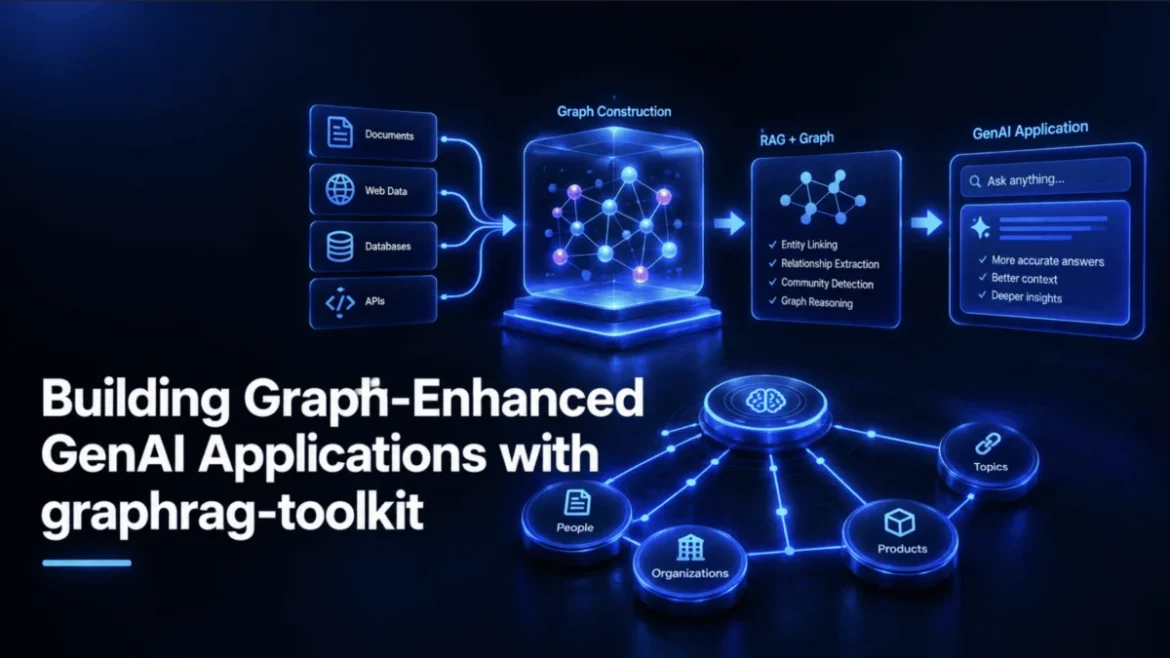
The landscape of Generative AI has long been dominated by standard retrieval-augmented generation (RAG), a technique that bridges the gap between static large language models (LLMs) and private data repositories. However, as enterprise applications move from simple question-answering bots to complex analytical engines, the limitations of traditional vector-based retrieval have become increasingly apparent. When users ask questions that require synthesizing information across disparate documents—such as determining the interaction between international warranty policies and specific regional supply chain regulations—vector search often fails. It lacks the structural intelligence to map relationships, treating every document chunk as an isolated "island."
To solve this, the industry is shifting toward Graph-Enhanced Retrieval-Augmented Generation (GraphRAG). By integrating knowledge graphs with vector indices, developers can now force AI models to reason over connected facts rather than isolated semantic fragments. A primary catalyst for this evolution is the open-source graphrag-toolkit, introduced by AWS Labs, which provides a robust framework for building hierarchical lexical graphs.
The Structural Limitations of Vector-Only RAG
To understand why GraphRAG is gaining traction among database architects and AI engineers, one must first analyze the mechanics of standard vector search. In a typical RAG pipeline, documents are chunked, embedded into high-dimensional vector space, and indexed. When a query is submitted, the system performs a nearest-neighbor search to retrieve chunks that are mathematically similar to the query.
This mechanism is inherently "blind" to context. If a user asks a multi-hop question—a query requiring the synthesis of information from different sections of a document or even different files entirely—vector search struggles. It identifies chunks that "sound" like the query but cannot trace the causal, hierarchical, or entity-based links between them. This results in hallucination or incomplete answers, as the LLM receives only a fraction of the necessary context.
Major players in the database sector, including Neo4j and Oracle, have converged on a unified solution: using graphs to provide the "connective tissue" that vector indexes lack. By mapping entities, relationships, and concepts, these systems allow the LLM to traverse the document collection, effectively mimicking human research patterns where one fact leads to another.
Evolution of the graphrag-toolkit
The graphrag-toolkit is an open-source, Apache 2.0-licensed Python framework designed to streamline the implementation of these complex retrieval systems. Released by AWS Labs, the project seeks to move GraphRAG from a theoretical concept to a production-ready standard. The toolkit is bifurcated into two primary components: lexical-graph and BYOKG-RAG.
The lexical-graph component is the more innovative of the two, offering a framework for automatically constructing a hierarchical knowledge graph from unstructured text. The BYOKG-RAG (Bring Your Own Knowledge Graph) approach is intended for organizations that have already invested in knowledge graph infrastructure and require a specialized querying layer to interface with their LLMs.
The methodology behind the lexical-graph model is detailed in the academic research paper, "Hierarchical Lexical Graph for Enhanced Multi-Hop Retrieval." The system organizes information into a six-tiered hierarchy: Source, Chunk, Topic, Statement, Fact, and Entity. This structure ensures that the system can perform "hops" across these levels, allowing for more granular and accurate retrieval than simple chunk-level matching.
Chronology and Implementation Architecture
The implementation of a graph-enhanced assistant involves a rigorous, multi-stage pipeline. The process begins with the extraction of raw documents, which are processed into clean, self-contained propositions through a dual-pass LLM approach. The first pass focuses on cleaning raw text, while the second extracts the entities and relationships necessary for the graph.
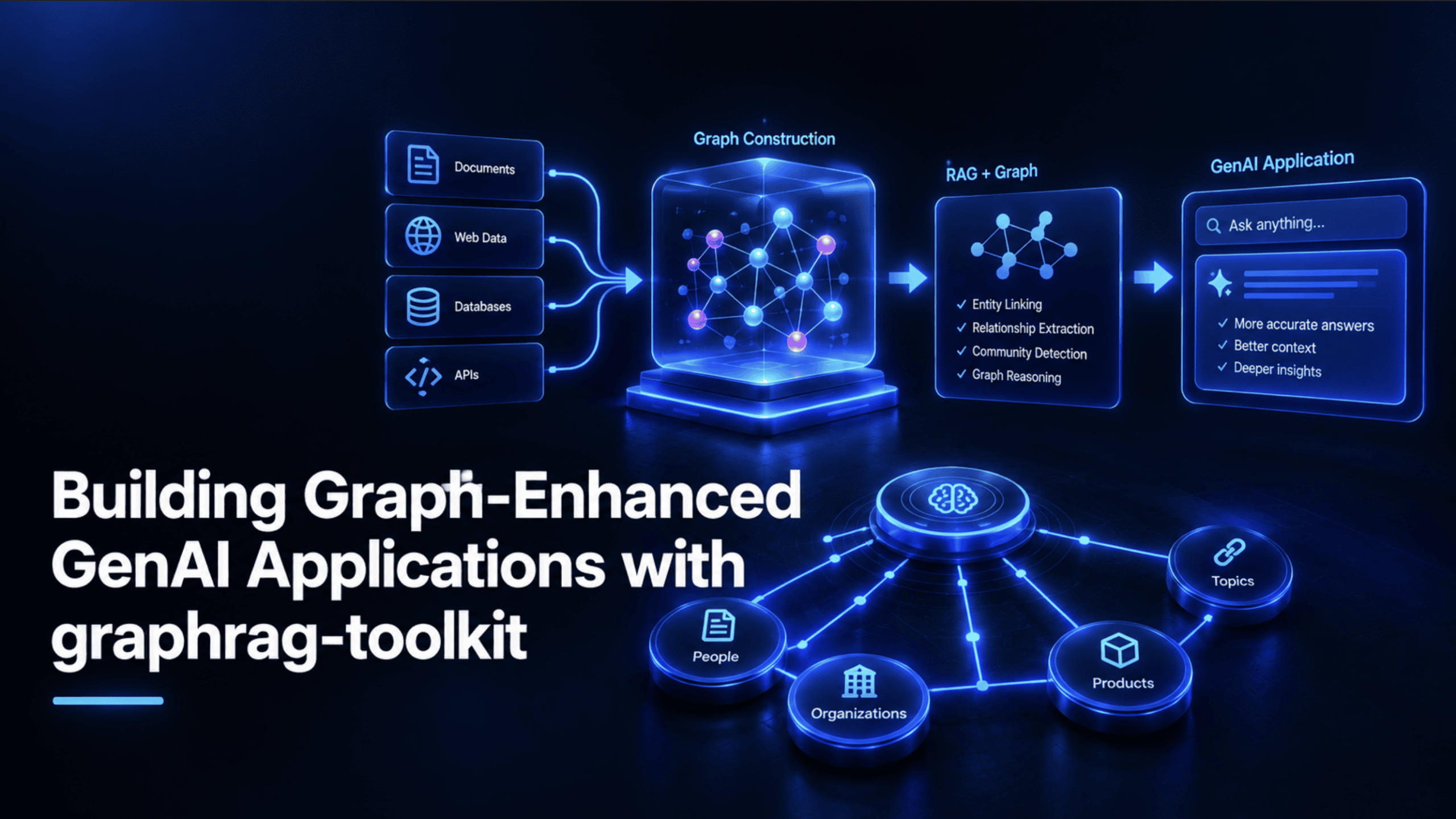
- Ingestion and Cleaning: Documents are chunked and passed through an LLM to refine the content into propositional statements. This step is critical, as it eliminates noise and ensures that the subsequent graph construction is based on high-quality, structured data.
- Graph Construction: The processed data is fed into a graph database (such as Amazon Neptune, Neo4j, or FalkorDB) and a vector database (such as PostgreSQL with pgvector).
- Indexing: The system creates links between the vector embeddings and the graph nodes, establishing the "traversal" capability.
- Traversal-Based Querying: When a user poses a question, the system uses the vector index to find "anchor points" and then traverses the graph to collect related information before sending the final context to the LLM.
Industry adoption of this architecture is already underway. Deloitte, for instance, has utilized the lexical-graph framework within its Amazon Neptune-based GenAI Security Intelligence Center. This deployment serves as a real-world case study for the scalability and efficacy of hierarchical lexical graphs in enterprise-grade security operations.
Technical Dependencies and Infrastructure
Building a robust GraphRAG environment requires a specific stack. For developers seeking to minimize costs, running Neo4j and PostgreSQL with pgvector within Docker containers is the standard local approach.
The toolkit relies heavily on Amazon Bedrock for the LLM orchestration layer. While the graph and vector stores can be hosted locally or on-premise, the extraction process currently requires a connection to Bedrock. This design choice leverages AWS’s security infrastructure, including SigV4 request signing and TLS 1.3 encryption, ensuring that the data pipeline remains secure during the intensive extraction and embedding phases.
Analysis of Implications for AI Research
The transition toward graph-enhanced AI signals a broader maturation of the LLM ecosystem. For years, the primary challenge of GenAI was "prompt engineering"—trying to force models to be smarter by tweaking input text. The shift to GraphRAG represents a move toward "system architecture engineering," where the intelligence of the application is derived from the structure of the data itself.
The implications for data-heavy industries—legal, healthcare, and finance—are significant. In these fields, information is rarely siloed; it is deeply interconnected. A legal firm, for example, can use this architecture to link thousands of case files, statutes, and precedents, allowing for an AI assistant that can trace the evolution of a legal argument across decades of documents.
Furthermore, the toolkit’s ability to manage multi-tenancy and versioning ensures that as document collections grow or change, the graph remains accurate. This addresses the "stale data" problem, where legacy RAG systems often return information that has been superseded by newer, contradictory records.
Future-Proofing with Model Context Protocol
Looking ahead, the integration of the Model Context Protocol (MCP) suggests a future where these graphs act as modular, plug-and-play tools for AI agents. An agent could potentially traverse a catalog of domain-specific graphs, selecting the most relevant one based on the user’s intent. This modularity reduces the need for monolithic, all-encompassing databases and favors a federated approach to knowledge management.
For developers and organizations, the path forward is clear: move away from simple semantic similarity and toward graph-based relationship mapping. By adopting tools like the graphrag-toolkit, enterprises can ensure their generative AI applications are not just fluent, but accurate, grounded in structural logic, and capable of handling the complexities of human-level research.
The current state of the art, as demonstrated by the implementation of the lexical-graph framework, proves that the barrier to entry for high-performance GraphRAG is lowering. Whether through self-guided workshops or production-level deployments, the convergence of graph databases and LLMs represents the next logical step in the evolution of enterprise intelligence. The goal is no longer just to find the right chunk; it is to understand the entire map of knowledge.
