
The landscape of proprietary trading, particularly for retail participants, has long been mired in opacity and allegations of misconduct, a reality starkly illustrated by the August 2023 actions of the U.S. Commodity Futures Trading Commission (CFTC) against MyForexFunds. This Toronto-based prop-trading firm, which had amassed over $310 million in fees from more than 135,000 customers, faced a severe asset freeze. The crux of the CFTC’s complaint was not that prop firms are inherently illegal, but rather that MyForexFunds systematically misrepresented its operations. It falsely claimed customers were trading against third-party liquidity providers when, in fact, the firm itself was the primary counterparty to substantially all trades. Furthermore, the CFTC alleged the firm employed software designed to manipulate customer fills to less favorable prices and arbitrarily close winning accounts using fabricated technicalities. In essence, MyForexFunds operated as a clandestine "bucket shop" masquerading as a legitimate prop firm.
This high-profile case serves as a critical backdrop to understanding the emerging category of onchain prop firms. What MyForexFunds sought to conceal – its role as the house betting against its own customers – is precisely what these new blockchain-native entities now openly document. The fundamental conflict of interest inherent in the model has not vanished, but the veil of secrecy surrounding it has been lifted. Moreover, the promise of an actual, verifiable route to a real market, which MyForexFunds merely faked, is becoming a tangible reality for a segment of its traders. This piece reflects the rapidly evolving landscape as of mid-June 2026, where the onchain prop-firm sector, barely six months old, is witnessing significant innovation, with key players in alpha or early launch stages, and metrics like tokens, fees, and funded-trader counts still highly dynamic. The specifics presented herein should be considered a snapshot of a nascent, rather than settled, industry.
The Anatomy of a Traditional Prop Firm: A Paid Exam with a Catch
At its core, a modern proprietary trading firm, stripped of its marketing rhetoric about "funding the next generation of traders," offers a singular product: a paid examination with a potential payout. Aspiring traders pay a one-time fee, ranging from approximately $50 to several thousand dollars depending on the desired account size, to participate in a simulated trading challenge. During this phase, traders operate a demo account under a predefined set of rules. Success is typically defined by hitting a profit target, often around 10%, without exceeding a stipulated drawdown limit. Upon achieving these criteria, the trader is declared "funded" and subsequently receives a share of their generated profits, commonly 80%, with the firm retaining the remainder.
The revenue generated from these evaluation fees constitutes the most visible aspect of the business. Industry leader FTMO, based in Prague, reported an impressive $329 million in revenue in 2024 across 2.3 million open accounts and has disbursed over $450 million to traders throughout its ten-year history. UAE-based challenger FundedNext also cleared an estimated $100 million-plus in 2024. The total addressable market for these evaluation fees is estimated to be in the low billions annually, underscoring the scale and profitability of this industry, which largely operates on a standardized customer acquisition funnel.
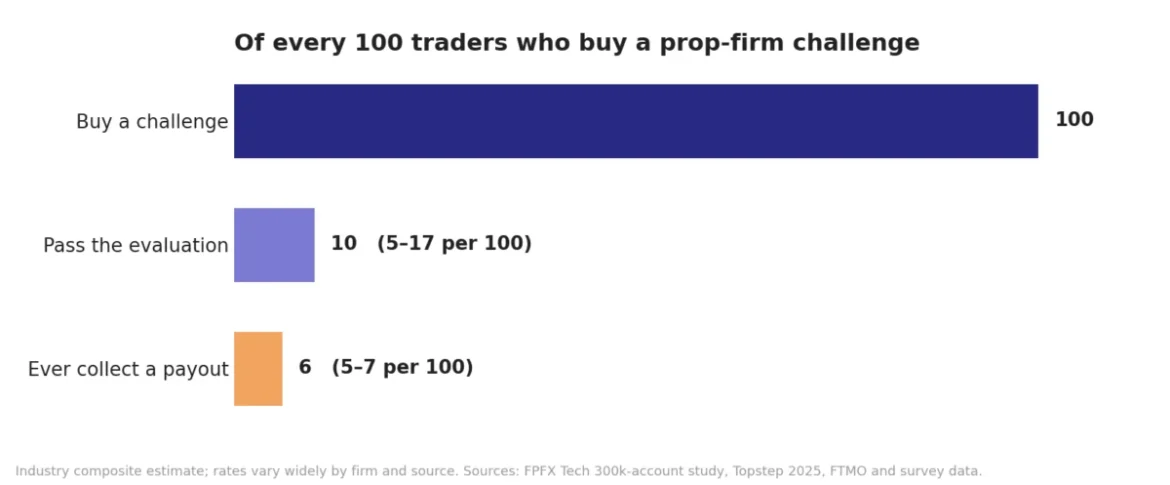
However, the efficacy of this funnel hinges on a critical, often unspoken, reality: a vast majority of participants fail. While audited data is scarce, credible estimates for success rates are consistently low and differentiate between passing the evaluation and actually collecting a payout. Industry-wide data suggests that for every 100 traders who undertake a prop-firm challenge, approximately 10 manage to pass the initial evaluation, and a mere 6 ever go on to collect a payout. This stark reality is further corroborated by individual firm data:
- FTMO: Community estimates suggest approximately 8% pass Phase 1 of their evaluation, with around 7% of all entrants ever collecting a payout.
- Topstep: Firm-published data from their 2025 Combine indicates a 16.8% pass rate, but only 33% of funded traders ultimately collect payouts.
- FPFX Tech study: A third-party analysis of 300,000 accounts found that only 7% ever collected a payout.
- The Funded Trader: Its CEO publicly stated that only 1-2% of all clients ever collect payouts.
- Industry composite: Surveys and aggregated data suggest 5-10% pass evaluation (higher in futures markets), with roughly 5-7% of entrants ever collecting a payout.
The general consensus that "1 in 20 traders pass" holds roughly true for forex-focused firms, while the more rule-driven futures market offers slightly better odds. Regardless, the buyer’s low probability of success is an intrinsic part of the product. The economics are straightforward: most customers fail, their fees directly contribute to gross margin, and the small minority who succeed are paid from the significantly larger pool of fees generated by the failures. This fee funnel, rather than sophisticated trading strategies, forms the fundamental bedrock of the business model.
The Hidden Layer: Understanding the B-Book Mechanism
Beyond the transparent fee structure lies a second, less advertised, profit layer: the B-book. During the challenge phase, trading occurs in a simulated environment, with no real orders reaching an actual market. The critical question arises once a trader is "funded." Often, even at this stage, a funded trader’s orders do not reach a real market. Instead, the firm internalizes them. If the trader loses, which statistically is the most common outcome, the firm directly profits from these losses, rather than simply retaining the evaluation fee. This B-book model, long utilized by retail forex brokers, is profitable for prop firms precisely because most accounts end up in a losing position, serving as an additional revenue stream atop the fee funnel.
Conversely, an A-book involves the firm passing the trader’s orders to a genuine market venue, earning only a spread or commission. Firms strategically A-book traders they identify as potentially profitable, thus avoiding direct liability for their gains. Conversely, they B-book traders deemed likely to lose, thereby collecting their losses directly. The decision of where to route a trader’s orders is paramount and represents the core of the conflict of interest. A firm that B-books a trader has a direct financial incentive for that trader to lose. The documented failure mode, exemplified by the MyForexFunds case, involves a firm B-booking a winning trader and then fabricating a rule violation to close the account prematurely, preventing payouts.
Historically, this B-book operation has been shrouded in secrecy, with firms either outright denying its existence or simply omitting any mention of it. The new wave of onchain prop firms, however, takes an opposite approach. They explicitly describe their A/B booking engines within their public documentation, and in some groundbreaking instances, even open-source the classifier code that determines which book a trader lands in. The conflict of interest, while still present, has been dragged into the light, transforming from a hidden secret to a publicly disclosed operational detail.
The Onchain Migration: Why Now and What It Enables
The rapid shift of prop trading onto the blockchain is largely enabled by foundational technological advancements, most notably the Hyperliquid chain. Prop firms require deep liquidity across diverse markets, ultra-fast execution capabilities, and a robust, programmatic method for settling trades and disbursing payouts. Hyperliquid delivers the first two through its high-throughput onchain order book and extensive perpetuals markets. Its builder-deployed framework also empowers external teams to establish markets and tooling without the burden of developing proprietary infrastructure. A prop firm leveraging Hyperliquid benefits from deep liquidity, particularly in major crypto assets, without the need to build and maintain its own matching engine. Crucially, it inherits the chain’s inherent transparency by default, allowing every trade, rule enforcement, and payout to be a verifiable onchain event.
Beyond these technical enablers, a significant defensive motivation underpins the timing of this shift. The traditional prop industry predominantly relies on MetaTrader, a trading platform developed by MetaQuotes. In 2024 and 2025, a stringent licensing crackdown by MetaQuotes led to an estimated 80 to 100 firms, roughly one-eighth of the global total, being forced out of business. This vulnerability – a business model susceptible to being shut down by a software licensor – starkly contrasts with the structural resilience offered by an onchain venue, where settlements occur on a public, permissionless blockchain that cannot be unilaterally revoked. This structural robustness is a core tenet of the onchain proposition.
The fundamental pitch of the onchain model revolves around taking three historically opaque elements of prop firms – the rulebook, payouts, and counterparty relationship – and making them transparent and verifiable. While the reserve and rulebook are genuinely verifiable onchain, the routing of every single trade isn’t always fully provable in real-time. For instance, while a firm can A-book to Hyperliquid, it’s not always possible for an individual trader to definitively prove their specific fill was mirrored onchain versus being booked internally. Similarly, the exact promotion threshold for a classifier deciding A/B booking might not be public. Therefore, "disclosed" is often a more accurate term than "verifiable" for the A/B decision itself. Nevertheless, the act of transparently disclosing this conflict represents a significant departure from the MyForexFunds model and warrants careful consideration within this nascent category.
The Evolving Landscape: Key Players and Their Strategies
The onchain prop trading field, though young, is already witnessing consolidation and significant investment. A pivotal development emerged from outside crypto-native circles: in September 2025, Kraken, a prominent cryptocurrency exchange, acquired Breakout, a Tampa-based crypto prop firm that had facilitated over 20,000 funded accounts since 2023. This acquisition marked Kraken as the first major crypto exchange to directly enter the funded trading space, signaling that prop trading is evolving into a core feature that large exchanges seek to integrate, rather than remaining a niche experiment. Two newer entrants, both built natively on Hyperliquid, exemplify the pure onchain model.
Propr, developed by XBorg and supported by SwissBorg, launched in early 2026. It offers funding up to $100,000 for trading perpetual contracts across crypto, equities, commodities, and even prediction markets and Solana memecoins, with an 80/20 profit split and onchain payouts. Propr distinguishes itself through an uncompromising commitment to transparency: it has open-sourced its A/B booking classifier, the actual code governing the book assignment, and publishes its API documentation publicly on GitHub. The firm secured a $1.5 million seed round at a $17.5 million fully diluted valuation, with its $PROPR token slated for a full unlock at a Token Generation Event (TGE) in August 2026. XBorg is also pursuing a "license the prop firm OS" strategy, offering its underlying technology stack to other operators, indicating a belief in the lucrative potential of infrastructure provision.
Hypernova commenced a closed alpha on May 1, 2026, following a $3 million pre-seed funding round led by Lemniscap, with participation from CMS Holdings, Very Early Ventures, Pivot Global, and numerous Hyperliquid-ecosystem angels. Its architectural design intelligently splits its stack: smart contracts, accounts, and payouts are managed on Arbitrum, settling in USDC, while liquidity and pricing are sourced from Hyperliquid’s extensive suite of over 110 perpetuals spanning crypto, US equities, commodities, and indices. The team boasts a strong pedigree, including experience from RockawayX and Coinbase. Notably, CEO Anar Bayramov was an early backer of Breakout during his time at RockawayX, prior to its acquisition by Kraken. As of late May 2026, the alpha program had onboarded approximately 250 traders, funded over 20, and disbursed more than $30,000 in payouts, supported by a $1 million onchain payout reserve established from the raise.

Beyond these leaders, a growing number of firms form a longer tail, including names like HyperPnL, Upscale Trade, GT Funded, Solana Funded, and Carrot Funding, which are tracked by aggregators such as onchainprop.wtf. Caution is advised when consulting aggregators, as discrepancies exist (e.g., Hypernova’s profit split listed as 90% on an aggregator versus its own documentation stating up to 80%); primary sources should always be preferred. One stack provider projects the emergence of over 100 onchain prop firms within a year, indicating a clear trajectory of rapid category expansion and significant institutional interest, moving beyond a handful of isolated clones.
| Breakout (Kraken) | Propr | Hypernova | |
|---|---|---|---|
| Stage | Live; acquired by Kraken Sept 2025 | Live since early 2026 | Closed alpha (launched May 1, 2026) |
| Venue | Kraken infrastructure | Hyperliquid | Arbitrum settlement + Hyperliquid liquidity |
| Instruments | Crypto | Perps (crypto, equities, commodities), prediction markets, memecoins | 110+ perps (crypto, US equities, commodities, indices) |
| Account size | Up to $200K | $10K–$100K | $5K–$200K |
| Profit split | Up to 90% | 80% | Up to 80% |
| Evaluation | Challenge → funded | 1-step or 2-step → funded | 1-step assessment, 10% target |
| A/B booking | Not disclosed | Open-sourced classifier (public repo) | Dynamic by trader quality; confirmed by CEO |
| Token | None | $PROPR, TGE Aug 2026 | Planned (raise had token warrants) |
| Funding | Acquired by Kraken | $1.5M seed @ $17.5M FDV | $3M pre-seed, led by Lemniscap |
Figures are drawn from each firm’s documentation and public coverage as of mid-June 2026. Account sizes and fees vary by tier, and alpha numbers, in particular, are subject to change. Breakout, now owned by Kraken, serves as a centralized point of contrast rather than an onchain peer; its inclusion highlights market consolidation rather than direct comparison.
The B-Book: Now on the Record and Redefined
The most profound transformation brought by onchain prop firms is not merely technological, but philosophical: the A/B booking conflict, once a closely guarded secret and the subject of MyForexFunds’ legal troubles, is now a prominent marketing feature.
Anar Bayramov, CEO of Hypernova, articulated the mechanic with refreshing candor in an interview with The Block. He explained that when a trader is A-booked, their trades are routed to the real market, meaning the firm loses money if the trader loses. Conversely, if a trader is B-booked, typically due to insufficient performance data or a judgment that they are a weaker trader, their trades are kept in-house, allowing the firm to directly capture their losses. This model routes strong traders to the real market, while internalizing the trades of unproven or losing traders. Bayramov framed this approach as a solution to the legacy firms’ practice of B-booking everyone and then arbitrarily banning winning traders, a pattern strikingly similar to the allegations against MyForexFunds.
Propr pushes this transparency even further by open-sourcing its classifier, making the logic that determines a trader’s book assignment auditable by anyone. This move transforms the firm’s claims into verifiable code. In both cases, the underlying wager remains consistent: that a conflict of interest, when made visible and, in Propr’s case, inspectable line-by-line, is inherently safer and more trustworthy than one shrouded in secrecy and reliant on the assurances of a support desk. There is merit to this argument. A B-book breach that can be verified against an immutable, onchain rulebook is far more difficult to engineer retrospectively than one adjudicated within a private, opaque dashboard. While the firm still profits from a B-booked trader’s losses, it loses the ability to covertly alter the rules post-factum to ensure such an outcome.
A candid assessment reveals that onchain prop firms have not eliminated the conflict of interest. Instead, they have rendered it legible and, critically, made the A-book a real possibility for qualifying traders, rather than a fictional facade as was the case with MyForexFunds. This represents a genuine improvement over the MyForexFunds model on two key fronts: explicit disclosure and actual trade routing. However, it is important to distinguish these improvements from complete alignment of interests. A B-booked trader remains in an adversarial position against the house, which still benefits from their losses. The crucial difference now is that traders can ascertain which side of this dynamic they occupy.
Onchain Fixes vs. Persistent Realities: A Balanced View
It is essential to distinguish between the structural improvements offered by onchain prop firms and aspects of the business that remain fundamentally unchanged, albeit with enhanced transparency.
Genuinely Improved Aspects:
- Payout Reliability: One of the most pervasive complaints against legacy prop firms is their unreliability in disbursing profits, whether through delayed withdrawals, manufactured rule breaches, or outright disappearance. An immutable onchain rulebook and a publicly auditable payout reserve directly address these issues. When a firm like Hypernova’s reserve balance is openly queryable on a blockchain explorer, the question of "are they solvent enough to pay me?" ceases to be a matter of faith and becomes a verifiable fact. Similarly, when breach conditions are codified in a smart contract, "did I actually break a rule?" transforms from a subjective judgment call into an objective, verifiable outcome. For the customer, this increased certainty and trust represents substantial, non-trivial value.
- Rule Integrity: The immutability of smart contracts means that the trading rules, once deployed, cannot be altered retroactively. This eliminates the possibility of firms changing parameters or introducing new rules after a trader has qualified or achieved profitability, a common tactic used by unscrupulous legacy firms to avoid payouts.
Unimproved, and Arguably Sharpened, Aspects:
- Base-Rate Economics: Irrespective of whether a firm operates onchain or off, its business model fundamentally relies on a majority of traders failing. The stringent drawdown limits, crucial for maintaining the firm’s solvency, are precisely the conditions that lead to the washout of most accounts, often triggered by a single adverse trading day. The onchain funnel is unlikely to deviate significantly from its legacy counterpart, where roughly 5-17% pass the evaluation and a much smaller percentage (around 5-7%) ever collect a payout. This is because the same underlying profit target and drawdown mathematics drive both models. Transparency enhances trust, but it does not inherently improve a trader’s odds. A 10% profit target within a 6% drawdown limit remains a challenging examination, regardless of whether it’s enforced by a smart contract or a compliance team.
- Payout-Reserve Solvency: While a transparent, finite reserve is more honest than an opaque corporate balance sheet, it introduces a new layer of fragility. Legacy firms that failed often did so quietly, leaving traders in the dark. An onchain firm with a publicly visible reserve balance faces a unique transparency challenge: if that reserve visibly depletes towards zero during a successful month for its A-booked traders, it creates a public "run on the bank" scenario that its predecessors never had to manage. Hypernova’s daily payout cap in its alpha phase (e.g., $10,000 profit per user per day) serves as a visible pressure-release valve for precisely this constraint. Transparency, in this context, cuts both ways: a public reserve means a public run on it.
Regulatory Precedents: The MyForexFunds Case Reconsidered
It would be facile to interpret the MyForexFunds case as conclusive proof that the entire prop trading model is doomed, or that moving onchain is merely a tactic to evade offshore regulators. Such a reading misrepresents both the specifics of the case and the underlying regulatory risk.
The CFTC’s legal theory was highly specific. The actionable conduct cited was the deliberate misrepresentation – informing customers they were facing third-party liquidity providers while the firm acted as the counterparty; the intentional manipulation of execution quality; and the pretextual closure of winning accounts. The CFTC did not assert that "being the counterparty" or "running a challenge" were inherently illegal. A prop firm that accurately discloses its counterparty, routes verified flow to legitimate venues, and enforces breaches through transparent, onchain logic effectively neutralizes the majority of the CFTC’s original complaint. In this narrow sense, the onchain design offers a more robust answer to the CFTC’s actual concerns than the "offshore and hope" posture adopted by many legacy firms.
Furthermore, the MyForexFunds case has a crucial tail-end that defies easy conclusions. In May 2025, the case dramatically collapsed. Following the recommendation of a court-appointed Special Master who found that the CFTC had taken "deliberate steps down a path of obfuscation and avoidance," a federal judge dismissed the case with prejudice. The agency was ordered to pay the defendants’ legal fees for the sanctions motion, and the CFTC subsequently placed four of its lawyers and an investigator on administrative leave. The very enforcement action that profoundly shaped the risk profile of this industry did not merely stall; it was decisively dismissed, with sanctions leveled against the regulator itself. This outcome does not condone the alleged underlying conduct but clarifies that the regulatory boundary in this sector is drawn around deception and execution abuse, rather than the prop firm model itself – precisely the line an onchain firm is best positioned to respect, if it so chooses.
The more complex regulatory challenge for onchain firms mirrors broader issues in decentralized finance (DeFi), such as those highlighted by HIP-4 for prediction markets or the "onchain forex gap" for FX. A permissionless, no-KYC, and potentially offshore onchain venue may attract a long tail of users but could be structurally excluded from the regulated institutional flow that larger financial players can access. Kraken’s acquisition of Breakout represents a strategic bet on the other side of this equation: that a compliant, exchange-backed, and centrally managed version of prop trading is the one that will ultimately achieve scale within regulated markets.
Uncomfortable Questions for the Onchain Frontier
As the onchain prop firm category matures, several critical questions emerge that demand uncomfortable but honest reflection:
- If transparency is the core product, why does A/B booking logic remain partly opaque? While Propr’s open-sourcing of its classifier sets an exemplary standard, other firms, like Hypernova, describe their logic but do not publicly disclose the specific data thresholds that trigger a trader’s promotion from B-book to A-book. Disclosing the engine in plain language is a significant improvement over MyForexFunds’ deception, but "trust our classifier" is not synonymous with "verify how it was applied to me." Without full transparency on a closed classifier, individual traders cannot independently audit its application to their specific trades. The long-term credibility of this category hinges on closing this gap.
- Is the payout reserve a feature or a fuse? A public, finite payout reserve offers undeniable honesty, but it inherently introduces fragility. Legacy firms that collapsed often did so quietly, their insolvency only becoming apparent after the fact. An onchain firm whose public reserve visibly drains towards zero during a period of strong performance by its A-booked traders faces a unique and highly public transparency problem that its predecessors never had to contend with. The potential for a public "run" on the reserve is a tangible risk.
- Does putting the conflict onchain make it acceptable, or merely visible? A B-booked trader is still inherently trading against a house that profits directly from their losses. Disclosure, while crucial, does not equate to alignment of interests. The open question is whether sophisticated traders, once they can clearly see they’ve been B-booked, will simply opt to leave. Such an exodus could strand firms with precisely the losing flow that makes the B-book profitable, exacerbating the selection problem that might push firms towards more problematic behaviors in the first place.
- Who ultimately wins as the category consolidates? The market dynamics are complex. Kraken, with its established distribution and regulatory licenses, holds a formidable position. XBorg is strategically positioning itself to sell the underlying technology stack to other operators. Independent onchain firms, while offering greater transparency than incumbents, find themselves in an intermediary position, smaller than the powerful exchanges entering their market. The vision of "100 onchain prop firms" thriving independently and the reality of "one exchange owns it all" are not necessarily compatible futures.
The Takeaway: Transparency, Conflict, and the New Reality
The onchain prop firm model represents a genuinely improved answer to the core issue MyForexFunds got wrong. The problem was never fundamentally "should the firm be the counterparty," but rather "should the firm be allowed to hide this fact and then cheat traders out of their rightful earnings." Immutable rules, auditable payouts, and a transparent counterparty relationship constitute real and significant advancements. The most credible iteration of this model, exemplified by Propr’s open-sourcing of its classifier, sets a new and meaningful standard for accountability.
However, the underlying conflict of interest remains fundamentally unchanged. Most traders pay an evaluation fee and ultimately incur losses. The firm continues to profit from this losing flow while routing the successful traders’ orders to real markets. The drawdown limits, essential for the firm’s solvency, are the very mechanisms that lead to the majority of customer accounts being washed out. Onchain technology does not alter this fundamental arithmetic; it merely conducts it in full public view. For the individual purchasing a challenge, the expected value remains what it always was: negative, with a sub-10% chance of ever collecting a payout. A transparent negative-expected-value product is undeniably more honest than an opaque one, but it does not, by definition, represent a better deal in terms of financial outcome. The most clear-eyed interpretation of this entire category is as a form of gambling with an audit trail – an improvement over gambling without one, but gambling nonetheless. What is genuinely novel is narrower than the marketing often suggests: the A-book is now a real pathway for traders who earn it, rather than a fabricated one for everyone; the rulebook cannot be rewritten after a trader wins; and the payout reserve is a tangible asset that can be publicly monitored. The inherent conflict has not been solved; it has simply been relocated to a space where everyone can observe it.
