
The landscape of European impact investing is currently experiencing a profound convergence of geopolitical tension, technological disruption, and financial innovation. Across the continent, investors and civil society actors are grappling with systemic challenges ranging from the defense of independent democratic institutions to the volatile restructuring of the renewable energy supply chain. At the same time, pioneering financial instruments are emerging to direct private capital toward localized nature conservation and climate resilience. This comprehensive overview examines the primary financial developments, market signals, and strategic leadership transitions shaping the European impact ecosystem.
Safeguarding Democratic Resilience: Independent Media as an Impact Asset Class
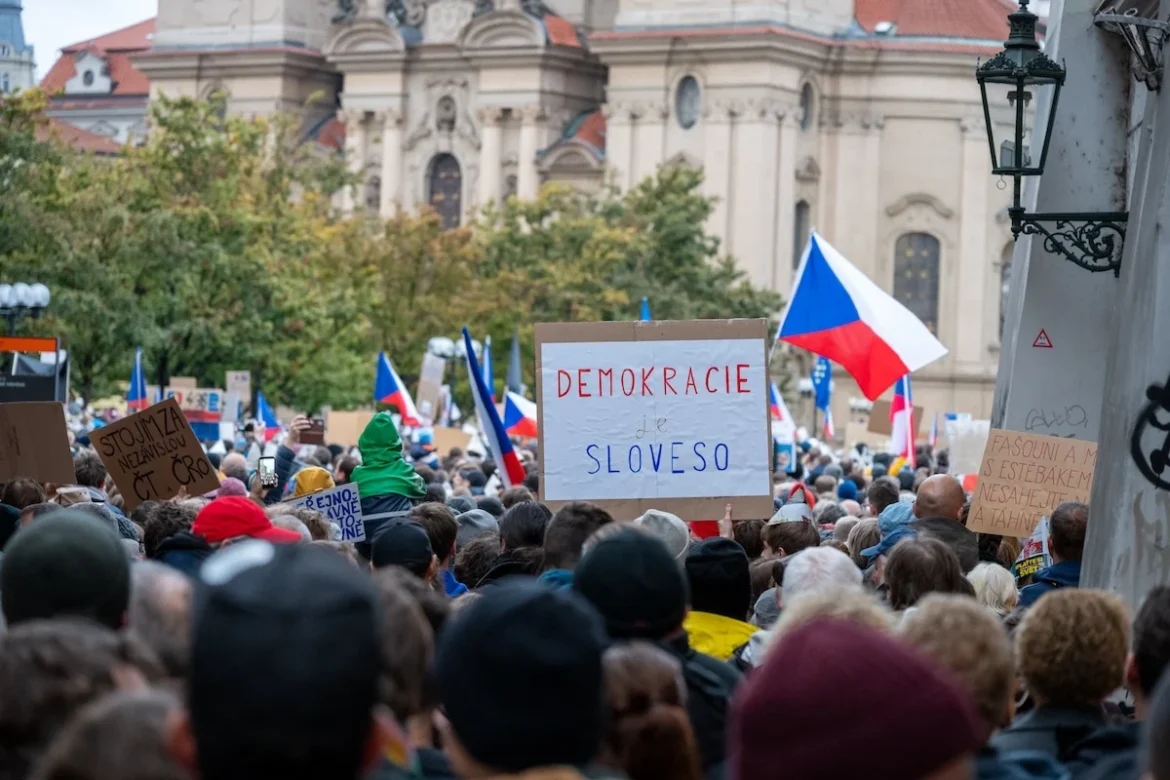
The intersection of finance and democracy took center stage in Central and Eastern Europe following unprecedented public demonstrations in Prague. More than 350,000 Czech citizens assembled in the capital—representing the largest mobilization since the historic 1989 Velvet Revolution—to protest government proposals concerning the structural funding of public broadcasting. The legislative initiative seeks to abolish traditional licensing fees, a move critics and industry associations warn will dismantle the financial autonomy of public media organizations and expose them to partisan political influence.
Demonstrators flooded Wenceslas Square carrying placards inscribed with slogans such as "Hands off the media," while wearing symbolic hats crafted from folded newspapers in tribute to a beloved animated television character. These protests underscore a broader regional anxiety regarding the erosion of press freedoms in Central and Eastern Europe, a trend compounded by the existential financial pressures traditional media companies face as they attempt to pivot away from legacy business models in the age of generative artificial intelligence.
In response to these structural vulnerabilities, an expanding cohort of impact investors is identifying independent journalism not merely as a civic necessity, but as a viable and urgent asset class. By deploying capital into modern, digital-first media startups, these investors aim to counteract the proliferation of misinformation, maintain institutional accountability, and reinforce the foundational prerequisites of democratic society.
Market participants note that the systemic disruption of traditional media gatekeeping has generated a unique window for entrepreneurial risk-taking. Industry analysts suggest that investor appetite for resilient, reader-supported journalistic ventures is poised for significant expansion as digital transformation accelerates across the continent.
Energy Transition Turbulence: Battery Sector Consolidation and Solar Ambitions
The European green transition continues to navigate a turbulent economic environment, marked by fierce international competition, shifting telecommunications expenditure, and capital scarcity. The clean technology sector experienced another high-profile casualty with the bankruptcy filing of Swedish battery manufacturer Polarium.
Polarium management attributed the company’s collapse to a severe contraction in global battery prices—largely catalyzed by aggressive competition from Chinese manufacturing hubs—alongside reduced capital outlays within the telecommunications sector and persistent delays in the deployment of large-scale battery energy storage systems. Despite enacting drastic internal cost-reduction measures that halved operating expenses relative to 2024 levels, Polarium was unable to secure a viable acquisition partner or sufficient rescue financing.
This insolvency follows a troubling pattern of distress within the Nordic clean-tech manufacturing sector. Polarium’s exit mirrors the bankruptcy of Norwegian battery cell producer Morrow Batteries in May, as well as the high-profile collapse of Swedish lithium-ion battery pioneer Northvolt late last year. These systemic failures highlight the immense capital intensity and margin compression confronting European firms attempting to scale domestic green manufacturing infrastructure in direct competition with subsidized Asian markets.
Conversely, targeted investments continue to flow into specific segments of the renewable energy supply chain where strategic European manufacturing is viewed as vital to energy security. In France, solar technology developer HoloSolis successfully secured €15 million ($16.4 million) in new financing. This capital infusion is earmarked for the ongoing development of an ambitious five-gigabyte solar production gigafactory located in Hambach.
The funding round attracted participation from prominent financial institutions and industrial partners, including the Crédit Agricole Group, British investment firm Algebris, major global solar manufacturer Trina Solar, and electric vehicle charging infrastructure specialist StarCharge. With this latest injection, HoloSolis has accumulated approximately €400 million toward its total projected capital requirement of €1 billion, illustrating the gradual assembly of public-private syndicates capable of underwriting massive industrial decarbonization projects.
Venture Capital and Fintech: Health AI and Anti-Fraud Infrastructure
Early-stage venture capital in Europe remains active, particularly in domains where artificial intelligence and machine learning intersect with administrative efficiency and security. In Spain, Madrid-based health-tech startup Wilco completed a €2.5 million ($2.7 million) financing round to scale its proprietary AI-driven voice and messaging agents. The technology is designed to assist clinical healthcare providers in managing patient pipelines, streamlining workflows from initial administrative intake through comprehensive clinical follow-up care.
The financing round was spearheaded by prominent European venture capital firm Samaipata, with strategic participation from the venture capital arm of Spanish private equity firm Abac Capital, alongside seasoned executives from the technology and healthcare sectors. The investment reflects a growing institutional preference for enterprise software solutions that alleviate operational bottlenecks within overburdened European healthcare systems.
Simultaneously, financial technology investors are allocating capital toward systemic risk mitigation and fraud prevention. London-based anti-fraud fintech startup Arcoda secured £1.8 million ($2.3 million) in a pre-seed funding round led by Concept Ventures, with additional participation from NFG Ventures and select angel investors. Launched formally just a month prior, Arcoda provides a collaborative intelligence platform that enables commercial banks, digital fintech challengers, and payment processing providers to securely share real-time risk indicators. By identifying fraudulent patterns collaboratively, the platform aims to intercept financial scams before funds are definitively transferred.
Conservation Finance: Institutionalizing Nature Stocks in Kenya
Beyond urban technology and industrial energy markets, the architecture of conservation finance is undergoing a significant evolution through the introduction of performance-based natural asset instruments. Munich-based nature finance pioneer The Landbanking Group has operationalized a novel financial mechanism termed "nature stocks," designed to direct private growth capital toward locally led land stewardship and ecosystem restoration.
The inaugural deployment of this instrument is taking place within Maasai territory in Laikipia, Kenya, in partnership with the family-run Male Conservancy. The initiative seeks to revitalize degraded ranchland and restore traditional pastoralist grazing practices that naturally sequester carbon and rehabilitate biodiversity.
Rather than relying purely on traditional philanthropic grants, the structure was facilitated by The Landbanking Group to secure $150,000 from an undisclosed international corporate consulting firm. This capital is being utilized to acquire essential equipment and implement sustainable land-management protocols across a designated portion of the conservancy. Under the terms of the arrangement, participating investors stand to receive financial returns derived from future sustainable revenue streams generated by the land, including eco-tourism and regenerative agricultural yields.
Proponents of the model argue that aligning financial returns with the ecological health of managed landscapes represents a crucial paradigm shift in conservation economics. By structuring nature as an investable asset class based on quantifiable ecological conditions, project developers hope to scale private sector participation in global biodiversity preservation while respecting the sovereignty and expertise of indigenous land stewards.
Leadership Transitions and Strategic Appointments across the European Impact Sector
As the impact investing ecosystem matures, institutional asset owners, asset managers, and advisory organizations continue to restructure their leadership teams to address complex sustainability mandates.
Within the Dutch institutional pension landscape, PGGM appointed Bas van den Dungen—formerly a senior official at the Dutch Ministry of Finance—as its new Chief Executive Officer. In the realm of corporate governance and employee ownership, Ownership Works named Libbi Lee, previously with the De Beers Group, as its Managing Director for Europe. Impact-focused private equity firm Pymwymic expanded its investment team by bringing on Carlijn van Doorne, formerly of private equity firm Egeria, as an investment manager. Furthermore, Impax Asset Management bolstered its institutional client relations by appointing Kelly Tran, previously with MFS Investment Management, as Head of Institutional.
In sustainability advisory and transition finance, the Anthesis Group recruited Gaurav Joshi, formerly with Centrica, as a Climate and Nature Associate Director. The Green Finance Institute appointed Rachel Bravard, previously with Vallard, to serve as Executive Director of its Transition Finance Lab. Additionally, Enko Capital named Claire Orton as its Chief Sustainability Officer.
Institutional recruitment pipelines remain robust across development finance institutions and environmental non-governmental organizations. The European Bank for Reconstruction and Development initiated a search for a Climate Adaptation and Nature Finance Analyst based in London. Concurrently, the Allied Irish Bank opened applications for an Associate Director within its Climate and Infrastructure Capital portfolio in Dublin. In Germany, The Nature Conservancy initiated a search for a Director of Finance and Operations in Berlin, while the World Economic Forum sought a Senior Associate for its Real Economy Transformation team in Geneva.
Looking toward industry convenings, sector participants are preparing for the upcoming Impact Investing World Forum, scheduled for December 3–4 in London, followed by the global GSG Impact Summit, which will convene in The Hague on March 2–3. These gatherings are expected to provide critical forums for investors navigating the dual imperatives of geopolitical stability, regulatory compliance, and measurable socio-environmental transformation across Europe and emerging markets.
