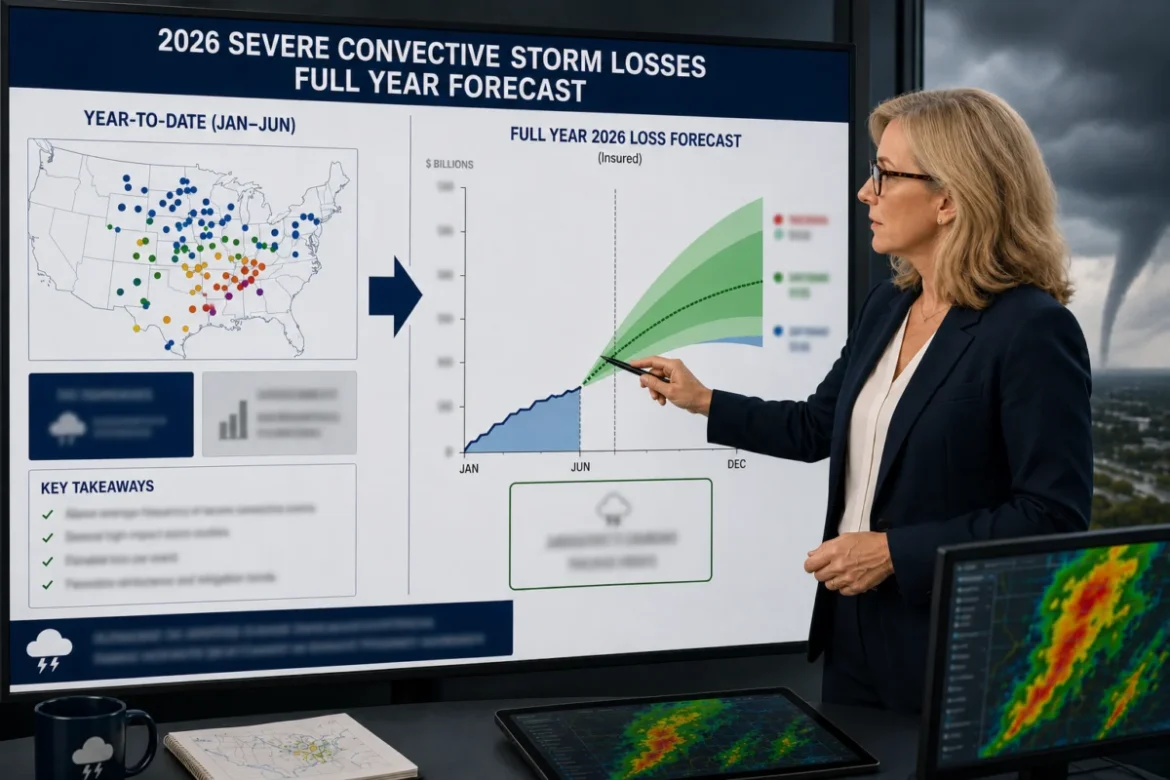
The landscape of natural catastrophe losses in the United States is undergoing a notable shift in 2026, as leading risk modeling firms and insurance brokers report a significant decline in insured losses from severe convective storms (SCS) during the first half of the year. According to a recently published bulletin from Karen Clark & Company (KCC), a prominent risk modeling firm, the total SCS losses for 2026 are projected to drop below annual averages. This forecast is based on the loss activity accumulated during the first six months of the year, a period that typically serves as a bellwether for the entire annual cycle.
Historically, the end of June marks a critical threshold for the insurance industry, as losses incurred by this date usually account for more than 75 percent of the total annual SCS losses. However, the anticipated surge in activity during the spring months—specifically May, which is traditionally the peak of the storm season—failed to materialize in 2026. This lack of volatility during the second quarter has led analysts to recalibrate their expectations for the remainder of the year, suggesting a rare reprieve for an industry that has been battered by record-breaking storm claims over the past three years.
Complementing KCC’s outlook, the global insurance broker Aon released its H1 2026 Global Catastrophe Recap, which provides a concrete statistical foundation for these projections. Aon reported that U.S. insured losses from severe convective storms totaled $27 billion for the first half of 2026. While this figure remains substantial, it represents a sharp decrease from the prior three years, where insured losses for the same period consistently exceeded $40 billion. This $13 billion variance highlights a significant cooling in the frequency and severity of loss-generating events across the United States, even as specific regions faced localized record-breaking weather phenomena.
Meteorological Drivers Behind the Loss Reduction
The primary driver for the lower-than-average loss totals in 2026 is a fundamental shift in atmospheric patterns that disrupted the typical progression of spring storms. In a standard meteorological year, the jet stream occupies a southerly position during the spring months. This positioning acts as a conveyor belt for storm systems, steering them through the Southeast and Texas—regions characterized by high population density and significant property exposure. When storms frequent these areas, the resulting insured losses tend to escalate rapidly due to the sheer volume of assets in the path of wind and hail.
In 2026, however, this traditional pattern was interrupted. KCC’s analysis indicates that southerly storm tracks were effectively blocked by a persistent and stationary high-pressure system. This system remained anchored over the Southeast for the majority of May, creating a "blocking" effect that diverted the jet stream and suppressed the development of convective activity. High-pressure systems are typically associated with sinking air, which prevents the vertical development of clouds necessary for severe thunderstorms, tornadoes, and hail.
The consequence of this weather pattern was twofold. While it shielded the Southeast from the traditional barrage of spring storms, it also ushered in exceptionally dry and warm conditions. This lack of precipitation has exacerbated drought conditions across the region and led to an above-average uptick in wildfire activity. Consequently, while the insurance industry saw lower claims from wind and hail in the Southeast, the risk profile shifted toward fire-related perils. During this period, the majority of SCS impacts were concentrated in the Central Plains, moving the "bullseye" of storm activity away from some of the most densely insured coastal and southern corridors.
Regional Disparities and the Midwestern Paradox
Despite the overall reduction in national loss figures, the first half of 2026 was far from quiet for the Midwest. Aon’s reporting emphasizes a "fragmented loss pattern," where overall totals were kept low by the absence of massive, multi-state catastrophes, even as specific states dealt with extraordinary weather events. This has created what industry experts call the "SCS paradox": a year can feature record-breaking storm counts while simultaneously producing lower-than-average financial losses, depending entirely on where those storms intersect with the built environment.
The state of Illinois serves as the primary example of this paradox in 2026. By the midpoint of the year, Illinois had recorded a staggering 178 confirmed tornadoes—nearly four times its long-run average. This record-shattering frequency included a series of intense outbreaks, yet because many of these tornadoes touched down in less densely populated areas or missed major metropolitan hubs, they did not generate the "outsized" loss totals that might be expected from such a high count.
However, the Midwest did not escape entirely unscathed. Aon highlighted that insurers with portfolios concentrated in southern Wisconsin, eastern Iowa, northern Illinois, and Indiana are likely to face outsized losses relative to their peers. These regions were hit by a series of concentrated events that combined high-intensity tornadoes with record-breaking hail.
Chronology of Major SCS Events in H1 2026
The first half of 2026 was defined by several key periods of activity that shaped the current loss landscape:
- March 10-11: The season began with a significant SCS outbreak over northern Illinois and Indiana. This event was notable for "record-shattering" hail sizes near the Chicago metropolitan region. In the insurance world, hail is often more damaging than tornadoes in terms of total dollar amounts because of its ability to affect thousands of roofs and vehicles simultaneously across a wide area.
- Mid-March: Shortly after the Chicago hail event, a sequence of EF2 and stronger tornadoes struck parts of Illinois and Indiana, causing localized structural damage and infrastructure failure.
- April: Wisconsin experienced an unusual surge in tornado activity, marking an early start to its severe weather season. This was followed by an outbreak in eastern Iowa and southern Wisconsin that produced "softball-sized" hail in Madison and at least one EF3 tornado.
- Late April: This period saw the costliest single event for the insurance industry in the first half of the year. A massive U.S. SCS outbreak produced $5.3 billion in insured losses, driven by a combination of high wind speeds and widespread hail across the Central Plains.
- June 11-17: A final major push of Midwestern SCS activity occurred in mid-June, further cementing the region’s status as the most active zone for 2026, while the Southeast remained under the influence of the high-pressure block.
Global Context and Economic Impact
While U.S. severe convective storms were the primary driver of global insured losses, the broader international picture for H1 2026 shows a similar trend of below-average catastrophe totals masking significant regional disasters. Globally, insured losses from all natural catastrophes reached $47 billion in the first half of the year.
The most significant event in terms of economic impact—though not necessarily insured loss—was the Venezuela Earthquake on June 24. This seismic event resulted in economic damages estimated between $20 billion and $30 billion, making it the costliest economic-loss event of the quarter. The disparity between the economic loss and the insured loss in Venezuela highlights the ongoing "protection gap" in emerging markets, where a vast majority of property and infrastructure remains uninsured.
In the U.S., the total economic damage from SCS events—which includes both insured and uninsured losses—was approximately $40 billion for the first half of 2026. While this is a significant sum, it is a marked improvement from the previous three years, where economic damage for the same period consistently exceeded $60 billion. Aon’s analysis suggests that the "absence of outsized SCS loss events"—meaning events that cross the $10 billion threshold individually—has been the deciding factor in keeping 2026’s totals trending downward.
Industry Implications and Future Outlook
The findings from KCC and Aon carry significant implications for the primary insurance and reinsurance markets. For the past several years, the insurance industry has struggled to price the risk of severe convective storms, which were once considered "secondary perils" but have recently rivaled hurricanes in terms of annual loss totals. The lower loss activity in 2026 may provide a temporary stabilization in loss ratios for domestic property insurers, particularly those with diversified geographic footprints.
However, KCC’s bulletin warns that the year is not yet over. While H1 losses are down, the firm projects that 2026 SCS losses will remain above average in the upper Midwest. Conversely, they are expected to stay lower than normal in Texas and the Southeast, provided the current atmospheric trends hold.
The data also reinforces the necessity of sophisticated risk modeling. KCC’s daily hail and tornado/wind intensity footprints allow insurers to estimate claims in near real-time, a capability that has become essential as storm patterns become more volatile and less predictable. The fact that record-breaking tornado counts in Illinois did not result in record-breaking national losses proves that "exposure intersection" is the most critical variable in catastrophe modeling.
As the industry moves into the second half of 2026, the focus will shift from convective storms to the Atlantic hurricane season. While the SCS "breather" is welcomed by carriers, the underlying drivers of loss—including inflation in construction costs, increased property values in high-risk areas, and shifting climate patterns—remain permanent fixtures of the risk landscape. For now, the insurance industry watches the jet stream, hoping the high-pressure systems that defined the spring of 2026 continue to provide a buffer against the most destructive forces of nature.