

Artificial intelligence developers are consuming more computational tokens than at any point in history, yet financial tracking data suggests that a foundational economic theory underpinning the modern AI boom may be running out of momentum. According to comprehensive research published Thursday by multi-model AI gateway OpenRouter, while the sheer volume of AI usage has skyrocketed over the past year, total monetary spending has stagnated since early October. This divergence poses critical questions for a technology sector currently pouring hundreds of billions of dollars into capital expenditures, data centers, and advanced silicon infrastructure.
The core of the findings centers on the trajectory of price elasticity within the API-driven developer ecosystem. Between the weeks of January 5 and November 16, weekly paid token consumption handled by OpenRouter surged by a staggering 44-fold. Over that same timeframe, total user spending multiplied by just 7.6, driven by an 83% collapse in the average price per token. Tokens—the fundamental units of text and data that models ingest and produce—have become significantly cheaper as competition intensifies, algorithmic efficiencies improve, and new providers enter the market.
Historically, lower prices have allowed enterprises and startups to scale up their AI operations dramatically without inflating their operational budgets. However, recent trends indicate a sharp cooling in this dynamic. When OpenRouter researchers compared the four-week period leading up to mid-November with the preceding four weeks, they discovered that token consumption grew by 39%, while revenue growth effectively rounded to zero. Earlier in the year, those two metrics tracked much more closely together, signaling that the direct correlation between falling prices and surging volumetric demand is beginning to fracture.
Understanding Jevons Paradox in the Modern AI Economy
To grasp the implications of OpenRouter’s findings, economists and industry observers look back to 1865, when British economist William Stanley Jevons first formulated his observations regarding the steam engine. Jevons noted that technological improvements that increased the fuel efficiency of steam engines did not decrease Britain’s coal consumption; instead, by making coal cheaper and more useful relative to the output generated, it caused overall coal consumption to skyrocket.

In the contemporary technology landscape, the artificial intelligence community enthusiastically embraced this framework. The concept gained widespread validation in January 2025, when Chinese AI developer DeepSeek unveiled highly optimized, inexpensive models that instantly disrupted global technology markets and erased hundreds of billions of dollars in market capitalization from legacy hardware giants like Nvidia. Prominent industry leaders, including Microsoft CEO Satya Nadella, repeatedly invoked Jevons Paradox to reassure investors that plunging inference costs would not diminish industry revenues, but would instead catalyze a massive expansion in total AI adoption, transforming artificial intelligence from a luxury utility into an omnipresent digital infrastructure.
For the first three quarters of 2026, OpenRouter’s empirical data appeared to validate this optimistic thesis. The company measures this relationship through price elasticity, quantifying the percentage increase in token consumption prompted by a 1% drop in the average token price. During the second quarter of 2026, OpenRouter recorded an eye-popping elasticity reading of 5.5—meaning demand surged aggressively in response to lower costs.
However, that metric has eroded rapidly. Price elasticity fell to 1.6 in the third quarter and dropped further to 1.2 during the fourth quarter leading up to November 16. In economic terms, an elasticity coefficient of 1.0 indicates that total spending remains entirely flat as prices fall; any reading below 1.0 signifies that total expenditure actually contracts as a resource becomes cheaper. The steady slide toward the threshold of diminishing returns suggests that developers may be reaching a saturation point in how many AI tasks they can practically implement, regardless of how inexpensive individual tokens become.
Divergent Behavior Among Customer Segments
A closer examination of the OpenRouter dataset reveals that the deceleration in spending is not uniform across all categories of users. The company’s analytics show a distinct behavioral split between traditional enterprise organizations and smaller, hyper-growth startups whose core business models are natively built around artificial intelligence applications.
Enterprise customers—large corporations integrating AI into legacy workflows, customer service pipelines, and internal productivity tools—exhibit a strong tendency to capture the financial savings delivered by falling token prices. When model providers slash their rates, enterprise budgets dedicated to AI software frequently remain static, meaning these legacy organizations pocket the windfall savings rather than scaling up their processing volume proportionally.
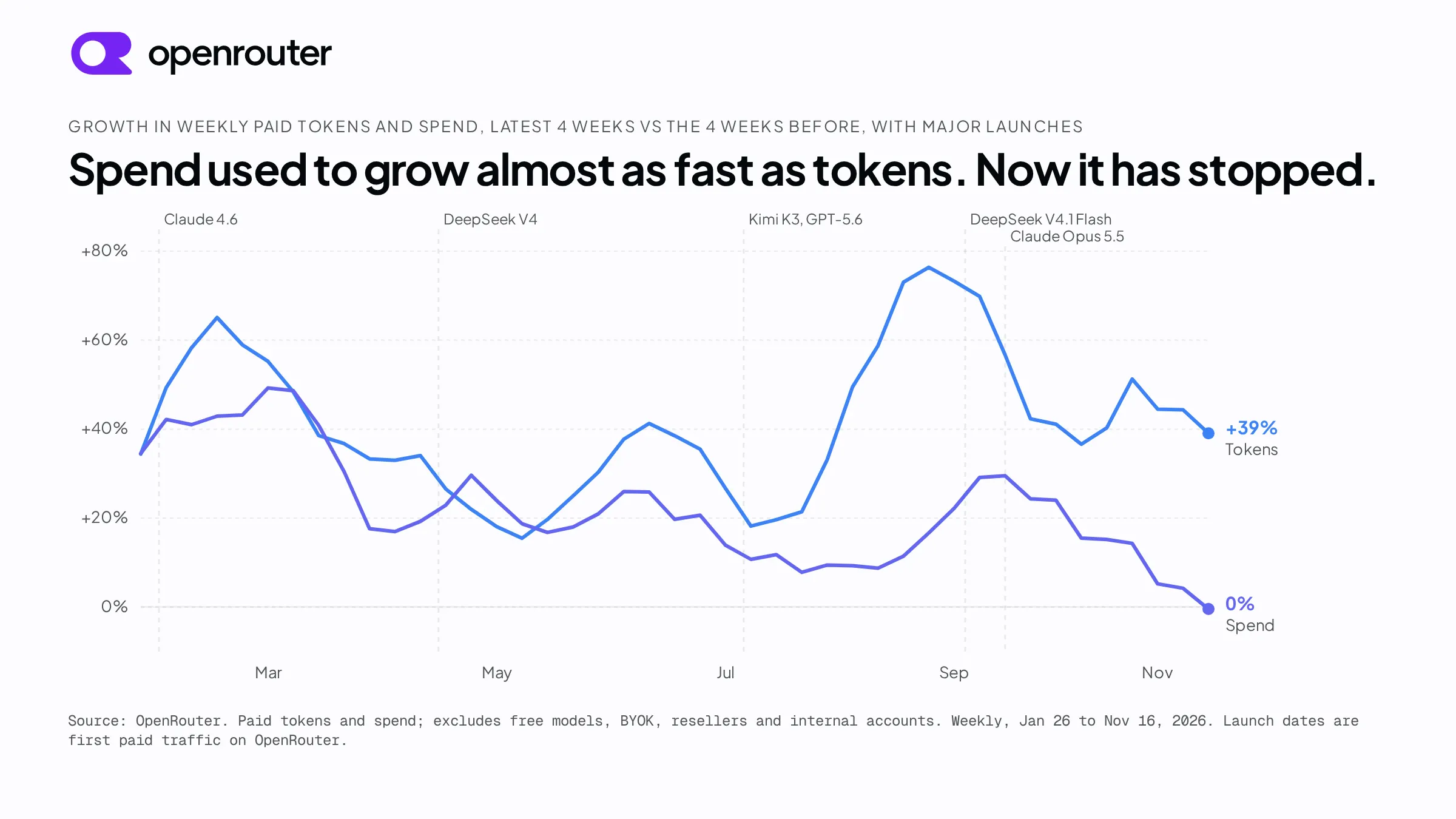
Conversely, native AI startups and fast-moving independent developers continue to push consumption higher, leveraging every price reduction to expand features, run complex autonomous agent loops, and train sophisticated workflows. Yet, even among this highly active segment, the aggregate market impact of these volume increases has not been enough to maintain the steep revenue growth curves observed earlier in the year.
Broader Financial Implications for the Global AI Boom
The cooling of price elasticity arrives at a precarious moment for the global technology sector. Investors and financial analysts are increasingly scrutinizing whether the monumental capital commitments directed toward AI infrastructure will generate sufficient financial returns. Market jitters have been palpable; by late November, shares of semiconductor titan Nvidia had crashed nearly 48% from their record highs achieved earlier in October, triggering widespread alarm across Wall Street regarding the sustainability of the AI hardware and data center boom.
Financial institutions have tracked these expenditures with growing urgency. JPMorgan estimates that global capital expenditures dedicated to artificial intelligence will scale to an astonishing $900 billion over the course of 2026 alone, with cumulative spending projected to reach $5.5 trillion by the year 2030. Furthermore, major banking analysts have highlighted a mounting reliance on external debt and complex financial structuring to fund the rapid, aggressive expansion of power-hungry data centers.
The structural implication of OpenRouter’s research is profound: if the cost of accessing AI processing power falls at a rate that outpaces the growth in total volume demand, selling more tokens will no longer translate into higher top-line revenue for model providers and API facilitators. For the venture capital firms, private equity funds, and mega-cap technology corporations financing the construction of multi-billion-dollar data centers, sustained revenue growth is essential to recovering upfront infrastructural expenditures. If revenue growth decouples from compute consumption, the timeline for profitability on these generational investments could stretch out significantly.
Nuances, Caveats, and Market Realities

While OpenRouter’s telemetry provides a fascinating window into developer behavior, industry analysts emphasize important nuances when evaluating the data. The study deliberately excluded free models, internal test accounts, third-party resellers, and customers utilizing their own direct API keys. Moreover, the dataset does not account for software subscription revenues—such as flat-fee tiers for consumer-facing chat interfaces—nor does it capture enterprise software spending handled directly through proprietary vendor contracts with major labs like OpenAI, Anthropic, or Google.
Furthermore, computational tokens do not provide a standardized, direct measure of raw hardware resource consumption. Different AI architectures—ranging from dense transformer models to Mixture of Experts (MoE) frameworks—require vastly different levels of memory bandwidth, compute cycles, and GPU power to process or generate equivalent numbers of tokens. Additionally, falling token prices frequently reflect underlying structural improvements in hardware efficiency, compiler optimization, and algorithmic design. This means that flat spending by end-users does not necessarily translate into flat profit margins for underlying infrastructure providers, as the cost to serve each individual token is simultaneously shrinking.
Contextualizing the 2026 Timeline
The rollercoaster of price elasticity observed throughout 2026 follows a pattern of technological adoption and market digestion. OpenRouter attributes part of the explosive volume surge seen in the early months of 2026 to the rapid maturation and deployment of autonomous AI agents capable of executing complex software engineering and data-processing tasks with minimal human oversight.
Interestingly, historical telemetry from OpenRouter indicates that similar dips in price elasticity occurred previously—specifically recording readings near 1.0 in December 2024 and November 2025. On both of those prior occasions, market demand eventually rebounded following the release of groundbreaking model architectures that unlocked entirely new use cases for developers. Whether the upcoming generation of foundational models can once again stimulate a new wave of high-elasticity demand remains the central question facing the artificial intelligence industry as it navigates the close of 2026.
