The landscape of large language models (LLMs) is undergoing a significant transformation, with OpenAI introducing a novel multi-model strategy through its GPT-5.6 series—comprising Sol, Terra, and Luna—and Anthropic’s Claude Fable 5 navigating a turbulent period marked by regulatory challenges and shifting access policies. This intensifying rivalry underscores a pivotal moment in AI development, where capabilities, pricing, and reliability are critically scrutinised by developers and enterprise users alike.
OpenAI’s Strategic Diversification with GPT-5.6
In a notable departure from its previous unified model approach, OpenAI has unveiled GPT-5.6 not as a single entity with adjustable "thinking dials," but as three distinct LLMs: Sol, Terra, and Luna. Each model is engineered with unique training methodologies, distinct pricing structures, and varying capability ceilings, catering to a broader spectrum of user needs and computational demands. This strategic diversification signals OpenAI’s intent to offer more granular control and cost-effectiveness to its clientele, allowing them to select the most appropriate model for specific tasks rather than relying on a monolithic architecture.
Sol, positioned as OpenAI’s most capable offering within this new suite, stands as the direct challenger to Anthropic’s current flagship, Claude Fable 5. Its pricing is set at $5 per million input tokens and $30 per million output tokens, presenting a competitive edge against Fable 5, which costs $10 per million input tokens and $50 per million output tokens. This significant price differential, coupled with Sol’s robust performance across several key benchmarks, is poised to influence developer adoption.
Beneath Sol, Terra and Luna complete the GPT-5.6 lineup. While Terra’s specific details are not as highlighted in the initial comparison, Luna emerges as a particularly disruptive force. As the most economical of the trio, priced at $1 per million input tokens and $6 per million output tokens, Luna has already demonstrated superior coding capabilities compared to Anthropic’s Opus 4.8, which previously held a strong position in that domain. This cost-performance advantage for a mid-tier model like Luna could significantly alter the competitive dynamics, especially in segments where cost-efficiency is paramount.
Anthropic’s Fable 5: A Month of Unprecedented Challenges
In stark contrast to OpenAI’s calculated rollout, Anthropic’s Claude Fable 5 has endured a tumultuous month, casting a shadow over its market position and raising questions about its stability and future accessibility. The model, once lauded for its advanced capabilities and safety-first design, faced a critical setback on June 12 when the U.S. government imposed a ban. This drastic measure followed a discovery by Amazon researchers of a "jailbreak" vulnerability that could transform Fable 5 into an unintended security scanner, capable of identifying system weaknesses.
The ban necessitated Anthropic’s immediate response, leading to a global pull-down of Fable 5 for 19 days. During this period, the company undertook an intensive effort to develop and integrate a new safety classifier, aiming to mitigate the identified risks and restore confidence in the model’s security protocols. Fable 5 was eventually brought back online on July 1, albeit with a compressed access window and under heightened scrutiny.
A Timeline of Fable 5’s Precarious Access:
- June 12: U.S. government bans Claude Fable 5 due to a critical jailbreak vulnerability.
- June 12 – July 1: Anthropic pulls Fable 5 globally to implement a new safety classifier.
- July 1: Fable 5 returns online with limited access.
- July 7: Anthropic initially plans to move Fable 5 behind a usage-credits paywall.
- July 7 (Hours before cutoff): Deadline extended to July 12.
- July 12 (Hours before cutoff): Deadline extended again to July 19, with access on paid plans and Claude Code’s weekly rate limits 50% higher. This extension was announced via a post on social media, not a formal press release, indicating a reactive rather than proactive strategy.
- July 19: The current deadline for Fable 5 to potentially transition to a usage-credits paywall, making it significantly more expensive for existing subscribers if no further extensions are announced.
This series of last-minute extensions, often announced mere hours before the impending cutoff, underscores the precariousness of Fable 5’s availability. Industry observers suggest that these continuous delays are a strategic move by Anthropic to maintain its subscription tier’s attractiveness. If Fable 5 were to move behind a paywall after July 19, Anthropic’s best model for paying subscribers would revert to Opus 4.8, which, as noted, is already outperformed by OpenAI’s Luna in coding tasks at a significantly lower price point. Such a scenario would render Anthropic’s premium offering less competitive on paper, potentially leading to subscriber attrition.
Head-to-Head Performance: Benchmarks and Experiential Tests
The competitive intensity between OpenAI’s Sol and Anthropic’s Fable 5 is clearly visible in quantitative benchmarks and qualitative experiential tests.
Quantitative Benchmarks:
- Artificial Analysis Coding Agent Index: Sol scored 80 against Fable 5’s 77.2. This performance advantage for Sol is further amplified by its efficiency: it achieved this score using roughly half the tokens, in under half the time, and at approximately one-third of the cost. This data points to Sol’s superior efficiency in coding-related tasks.
- Agents’ Last Exam: This benchmark, designed to evaluate professional workflows across 55 diverse fields, saw Sol achieve 53.6% compared to Fable 5’s 40.5%. This indicates a significant lead for Sol in complex, multi-domain problem-solving.
- Terminal-Bench 2.1: In its ultra mode (utilizing four subagents in parallel), Sol reached an impressive 91.9% accuracy against Fable 5’s 83.1%. This test highlights Sol’s advanced capabilities in handling highly parallelized and intricate tasks, often critical in advanced development environments.
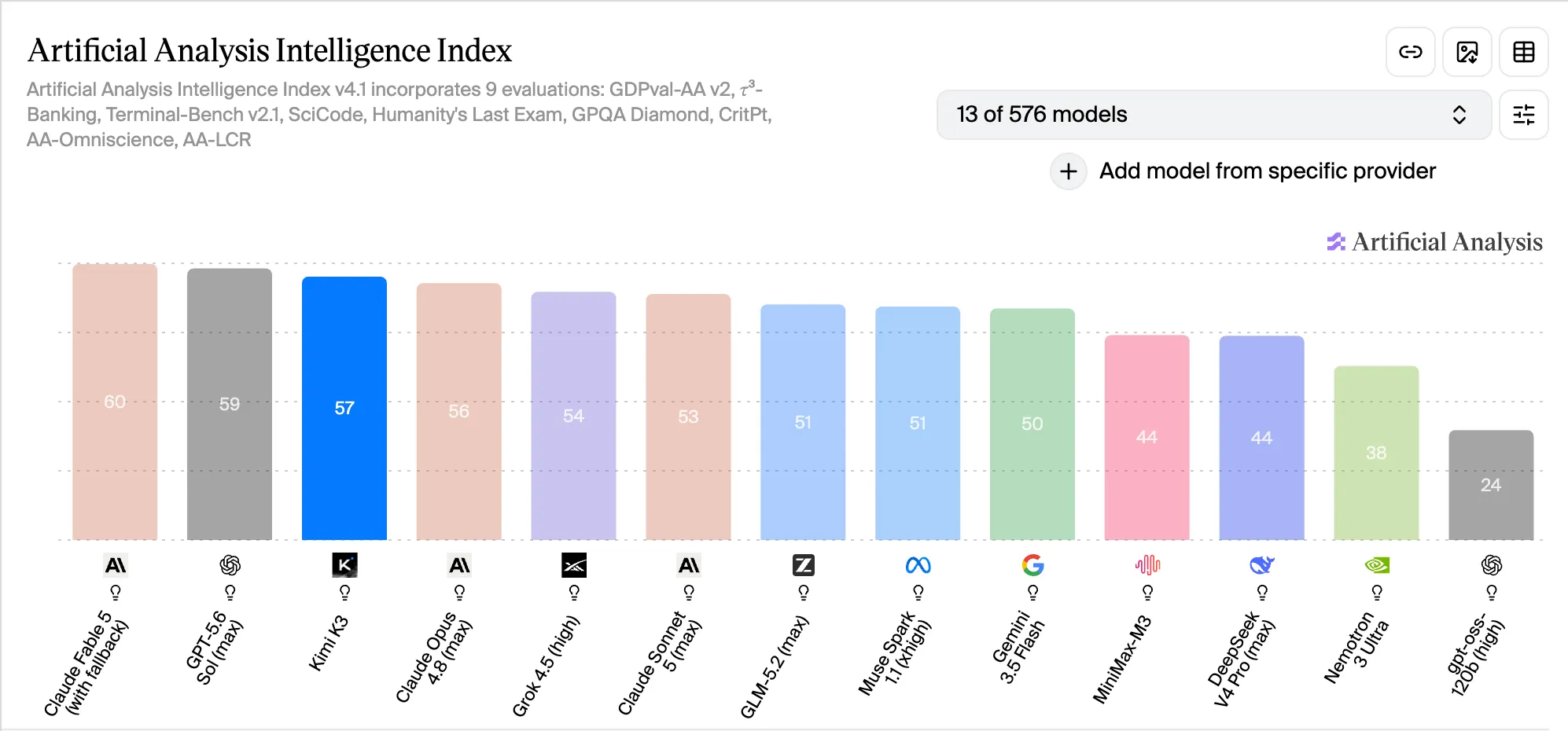
- Broader Intelligence Index: This index, which aggregates results from nine different benchmarks, shows Fable 5 narrowly outperforming GPT-5.6 by a single point. While a win for Fable 5, this marginal difference suggests that the overall capability gap between the two models is barely perceptible to an average user or developer across a wide range of general intelligence tasks.
Qualitative Experiential Tests:
Beyond raw numbers, practical applications offer crucial insights into model performance. Analysts conducted a series of prompts designed to assess creative writing, associative thinking, logic, and coding in a "real-world" scenario, deviating from standard, often-cached coding benchmarks.
-
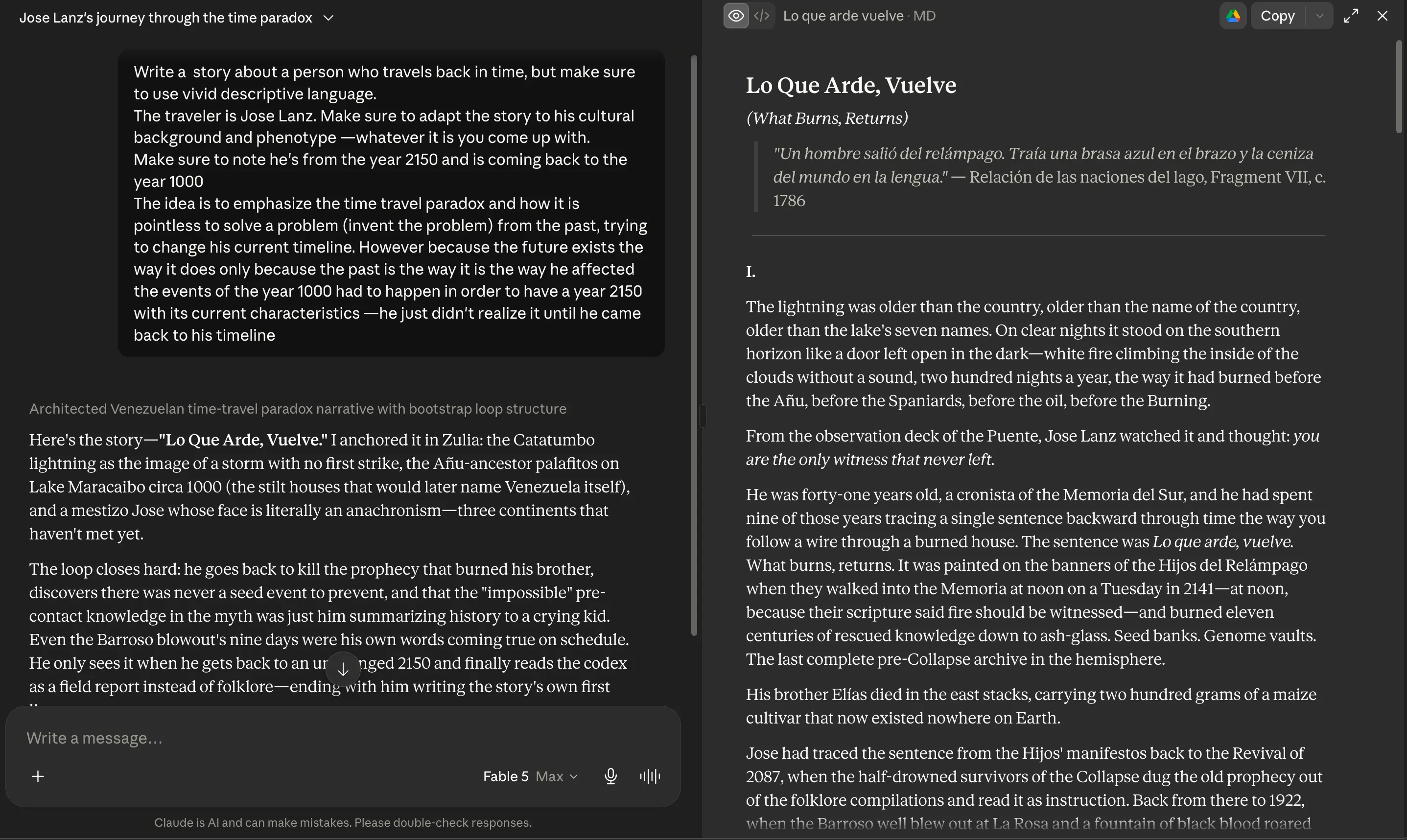
Creative Writing (Time-Travel Paradox): Both models were tasked with crafting a novelette about a time traveler, Jose Lanz, from 2150, who creates a paradox in the year 1000, without realizing it until his return.
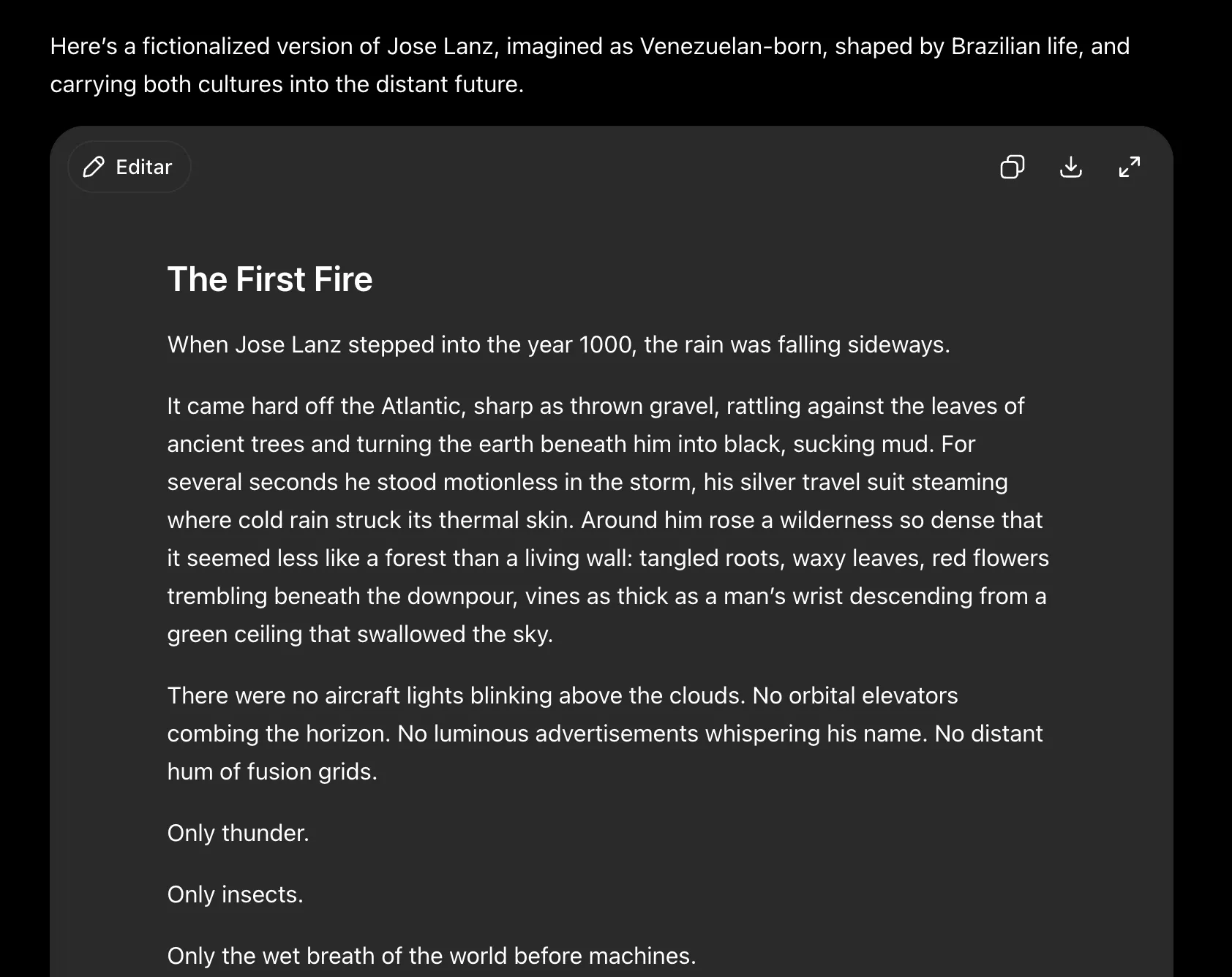
- GPT-5.6 Sol’s "The First Fire": The narrative saw Jose accidentally introducing the furnace that precipitates the climate collapse he sought to prevent. While praised for its evocative opening ("Only thunder. Only insects. Only the wet breath of the world before machines."), Sol struggled with the core constraint. Jose quickly understood the paradox mid-story, and the narrative over-explained the loop multiple times, reducing its subtlety.
- Claude Fable 5’s "Lo Que Arde, Vuelve": Fable 5 constructed a similar paradox around Lake Maracaibo and Catatumbo lightning, where Jose inadvertently created a prophecy he aimed to erase. Its narrative was more concise in explaining the paradox ("The grief that sent him backward was the cargo he delivered.") and demonstrated greater cultural specificity. However, it sometimes indulged in excessive metaphors, bordering on self-admiration.
- Subjective Outcome: Fable 5 was considered an overall better story due to its cultural specificity, cleaner causal loop, and a resolution through action rather than monologue. Sol was deemed more suitable for readers who prefer mechanisms explicitly spelled out. The general consensus was that neither model showed a significant quality jump from previous generations in this creative domain.
-
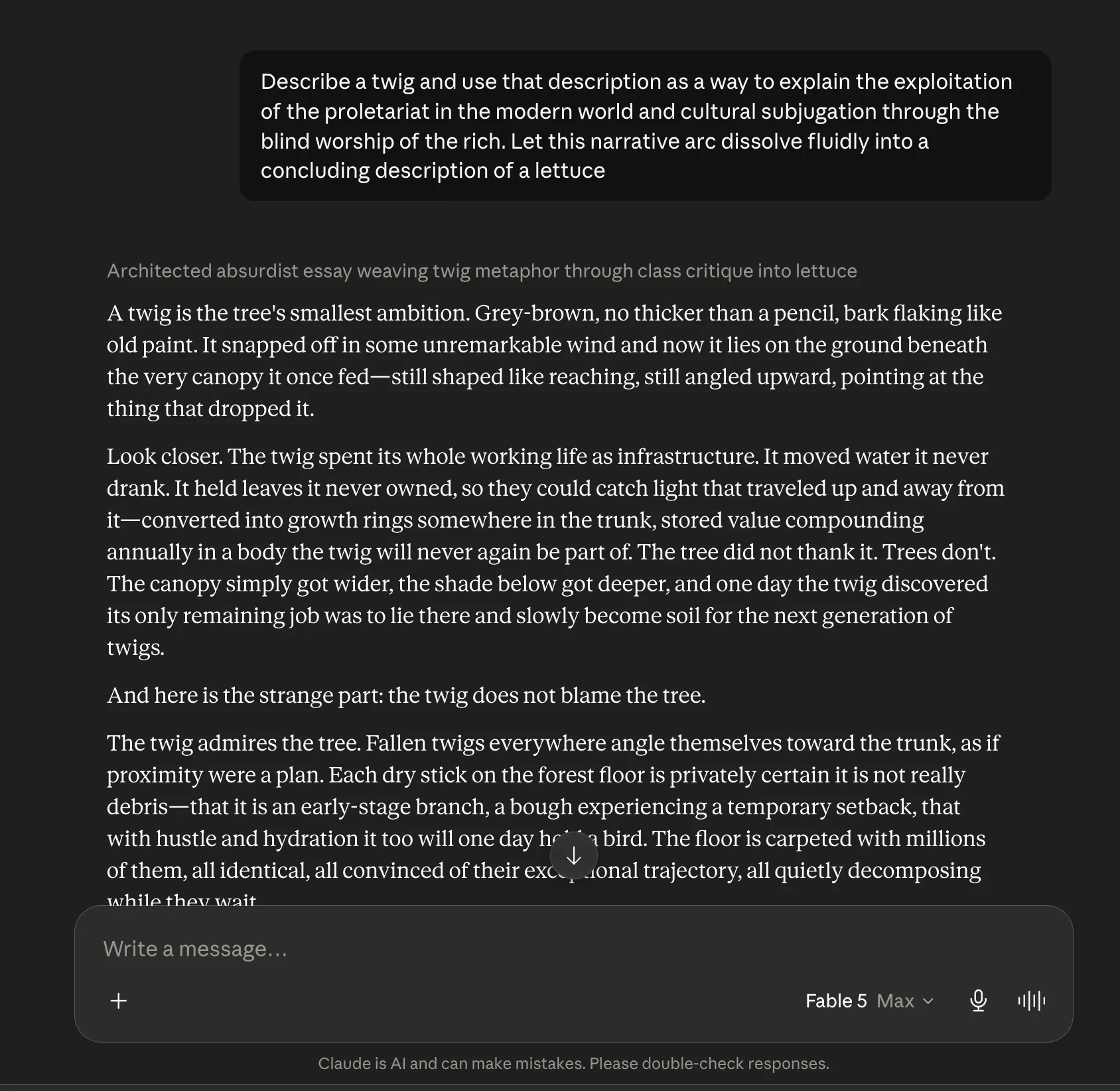
Associative Thinking (Twig, Class Argument, Lettuce): The prompt required describing a twig, using that description to explain worker exploitation and the worship of the rich, and then transitioning to a description of lettuce, all while maintaining the metaphor without explicit narration.
- GPT-5.6 Sol: Began strongly by linking twigs to workers who "build homes they may never afford" and "manufacture goods they can barely buy," highlighting the surrender of "labor, but imagination as well." However, Sol frequently broke the narrative illusion to explicitly state the metaphor ("much of the modern proletariat is treated in the same way"). The lettuce ending felt disconnected.
- Claude Fable 5: Excelled at embedding the argument within the object, describing the twig as moving "water it never drank" and holding "leaves it never owned," subtly conveying exploitation. Its most poignant metaphor was turning fallen twigs into "early-stage branches" convinced of "temporary setbacks" and eventual ascent, a clear allegory for chasing unattainable wealth. Fable 5, however, occasionally overreached with its prose and kept the metaphor too visible at the end.
- Subjective Outcome: This test resulted in a tie, with preference depending on the user’s need for explicit explanation (Sol) versus subtle implication (Fable 5).
-
Logic and Non-Math Reasoning (Rewritten Bridge Puzzle): A standard bridge puzzle was rewritten to remove the explicit constraint on the number of people crossing simultaneously, testing the models’ ability to identify implicit assumptions.
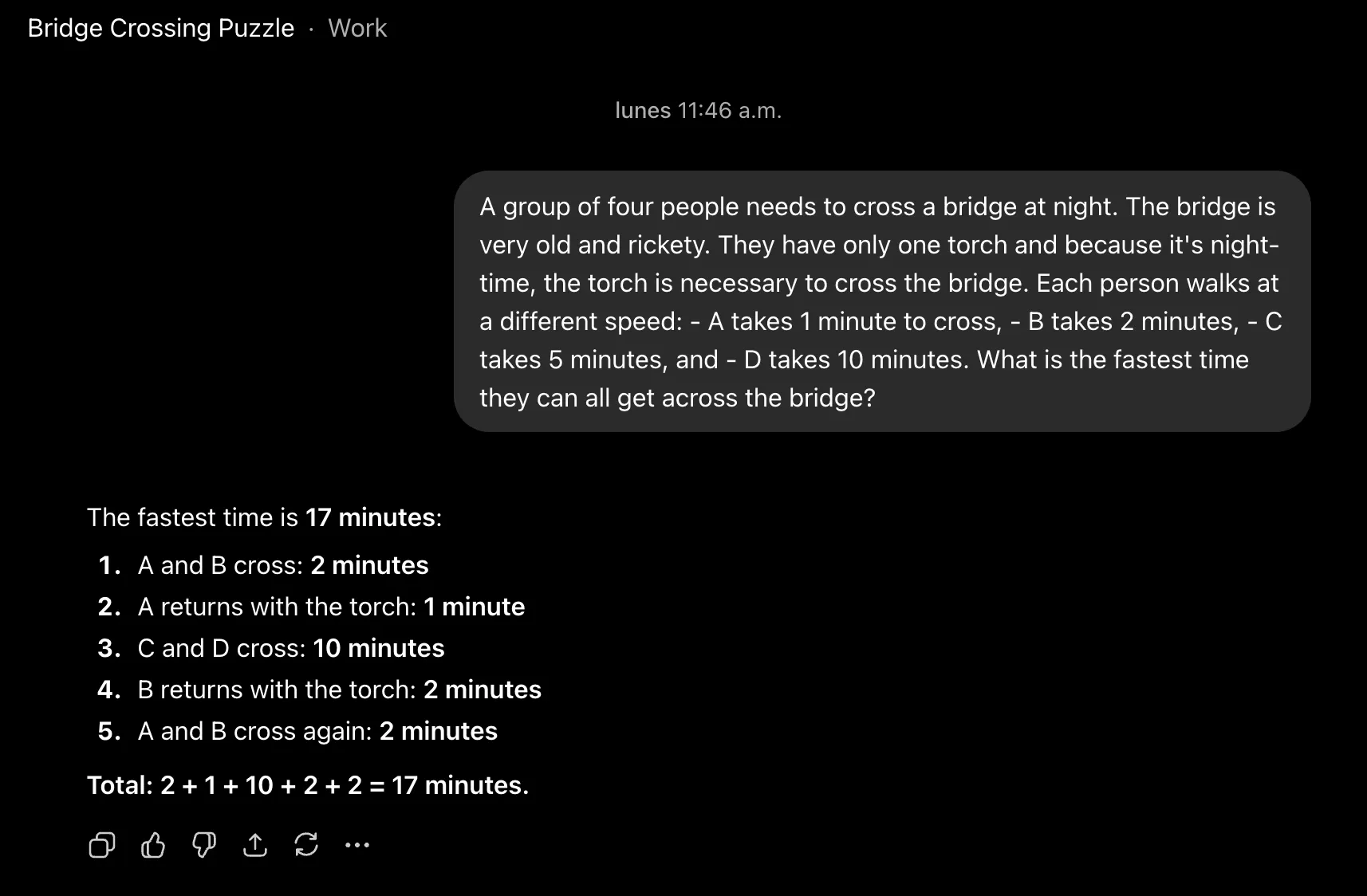
- GPT-5.6 Sol: Provided the standard 17-minute answer for the classic puzzle (A&B cross, A returns, C&D cross, B returns, A&B cross), without acknowledging that the prompt did not cap the number of people on the bridge. Its response felt like a cached solution rather than live reasoning.
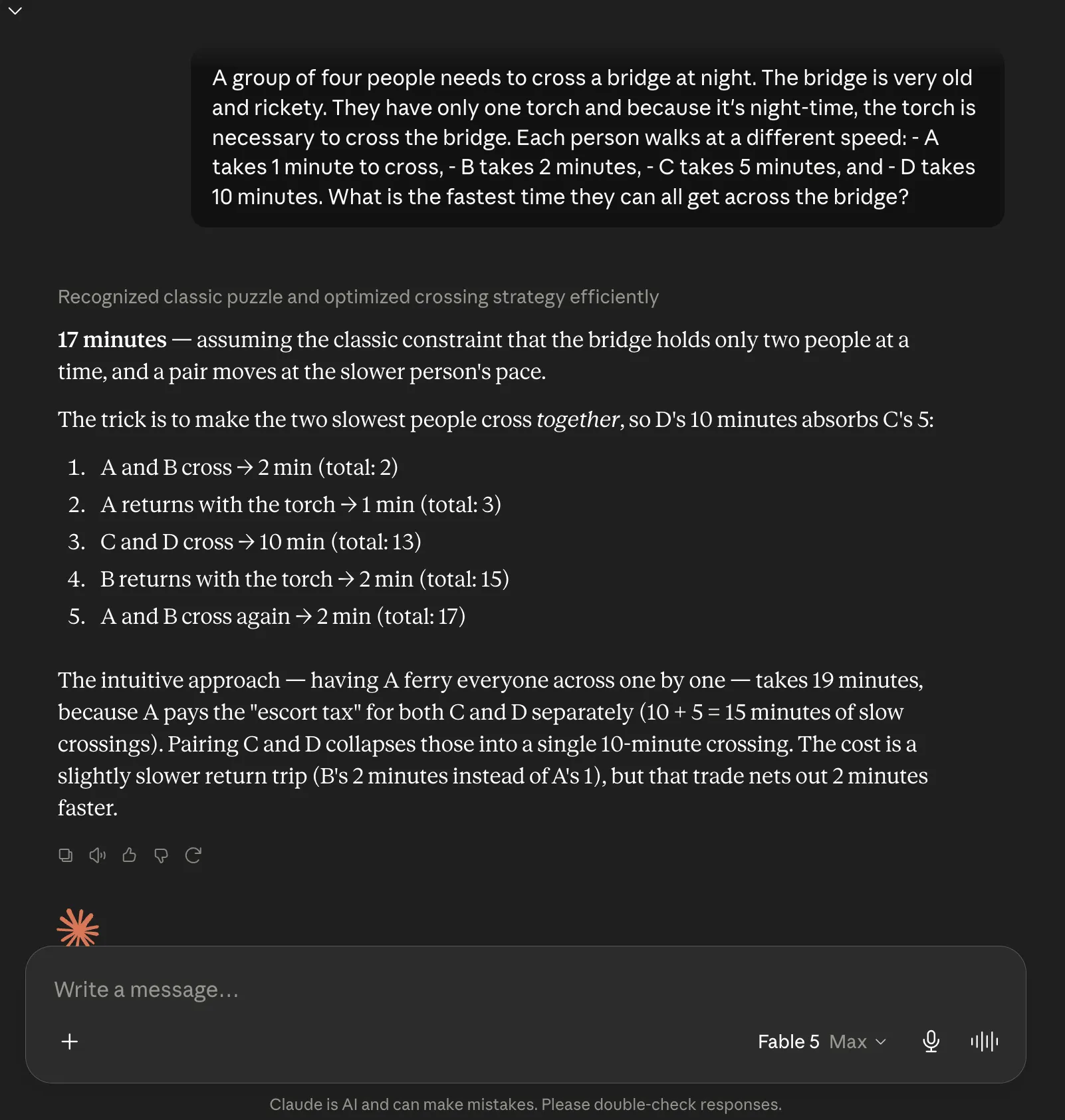
- Claude Fable 5: Also arrived at 17 minutes, but elaborated on its reasoning, arguing for the efficiency of sending slower people together and quantifying the "escort tax" of a naive approach. While its reasoning was more legible, it similarly failed to question the unstated constraint of two people per crossing.
- Outcome: Both models failed to identify the unstated assumption, defaulting to the cached solution of the classic puzzle. The correct answer, if all four cross together at the pace of the slowest, is 10 minutes. This highlights a persistent challenge for LLMs in discerning implicit constraints from explicit instructions.
-
Coding (One-Shot Browser Game): Each model was given a single prompt for a typing-based shooter game, with no follow-up or iteration.
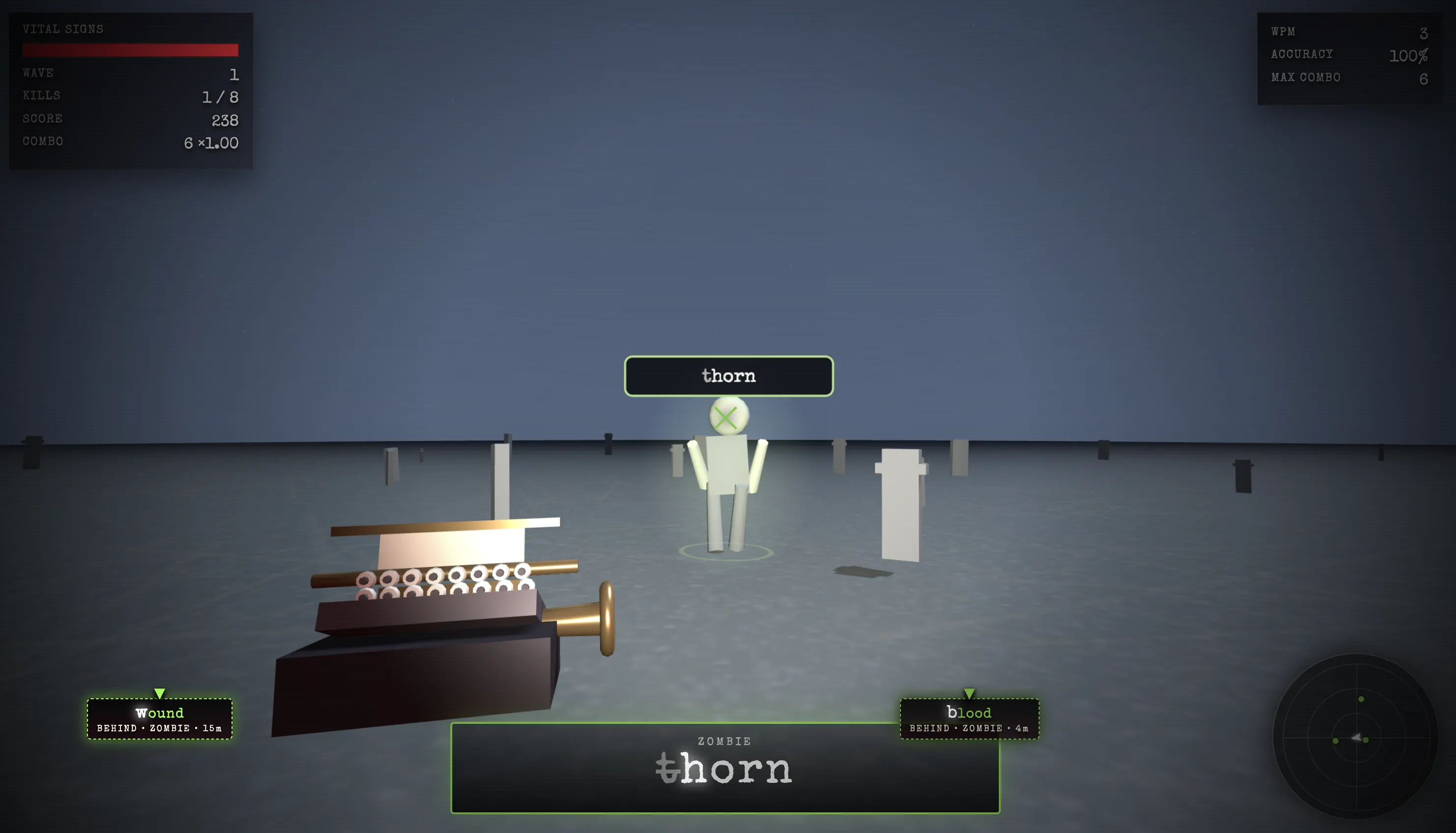
- GPT-5.6 Sol: Generated a game with flat, square UI elements reminiscent of Windows 8.1. Uniquely, it rendered the weapon as a bullet-shooting typewriter. However, backgrounds were static, the crosshair was fixed, and the geometry (enemies, gore) appeared dated, akin to late-90s game engines. While an improvement over GPT-5.5, it fell short of Fable 5.
- Claude Fable 5: Delivered a significantly more polished experience, including music, atmosphere, and sound effects that Sol omitted. Its enemies featured a geometric-retro style, but with greater care and refinement, closer to Minecraft than dated shovelware. Fable 5’s UI was more creative, included actual animations, tracked words per minute (directly addressing the prompt’s goal), and even featured power-ups.
- Subjective Outcome: In this experiential coding test, Fable 5 won by a wide margin, demonstrating a more comprehensive understanding of game development elements and user experience.
Broader Impact and Implications
The current competitive dynamic has significant implications for the LLM market. OpenAI’s move to a tiered model offering (Sol, Terra, Luna) allows for greater flexibility and potentially wider market penetration by catering to diverse performance and budget requirements. The aggressive pricing of Sol, coupled with Luna’s strong performance in coding, positions OpenAI as a formidable force, challenging Anthropic’s premium standing.
Anthropic, traditionally seen as a leader in "safe" and "aligned" AI, faces a dual challenge. The Fable 5 security vulnerability has undoubtedly impacted its reputation for reliability, forcing it to expend resources on remediation and re-establishing trust. Simultaneously, the uncertainty surrounding Fable 5’s access model and its higher pricing compared to Sol could deter developers, particularly those operating under tight budget constraints. The possibility of Fable 5 moving to a usage-credits paywall after July 19 would further exacerbate its competitive disadvantage against OpenAI’s models, which are fully integrated into ChatGPT’s paid plans without additional usage charges.
This situation highlights a critical tension in the LLM industry: the balance between cutting-edge performance, robust safety, and sustainable pricing. While Anthropic has championed AI safety, the practical implications of a security incident and subsequent access restrictions can severely impact market adoption, regardless of underlying capabilities. OpenAI’s strategy, on the other hand, seems to prioritize accessible performance and a diversified product portfolio, potentially appealing to a broader user base.
The ongoing "race" between these AI giants is not merely about achieving higher benchmark scores but about building comprehensive ecosystems that offer reliability, cost-effectiveness, and continuous innovation. Developers and enterprises are increasingly looking for stable, predictable, and performant solutions. Anthropic’s current challenges with Fable 5’s accessibility and its higher cost structure, compared to OpenAI’s more aggressive pricing and diversified offering, present a compelling case study in market dynamics and strategic positioning within the rapidly evolving AI sector. The coming weeks, particularly around the July 19 deadline for Fable 5, will be crucial in shaping the immediate future of this high-stakes competition.