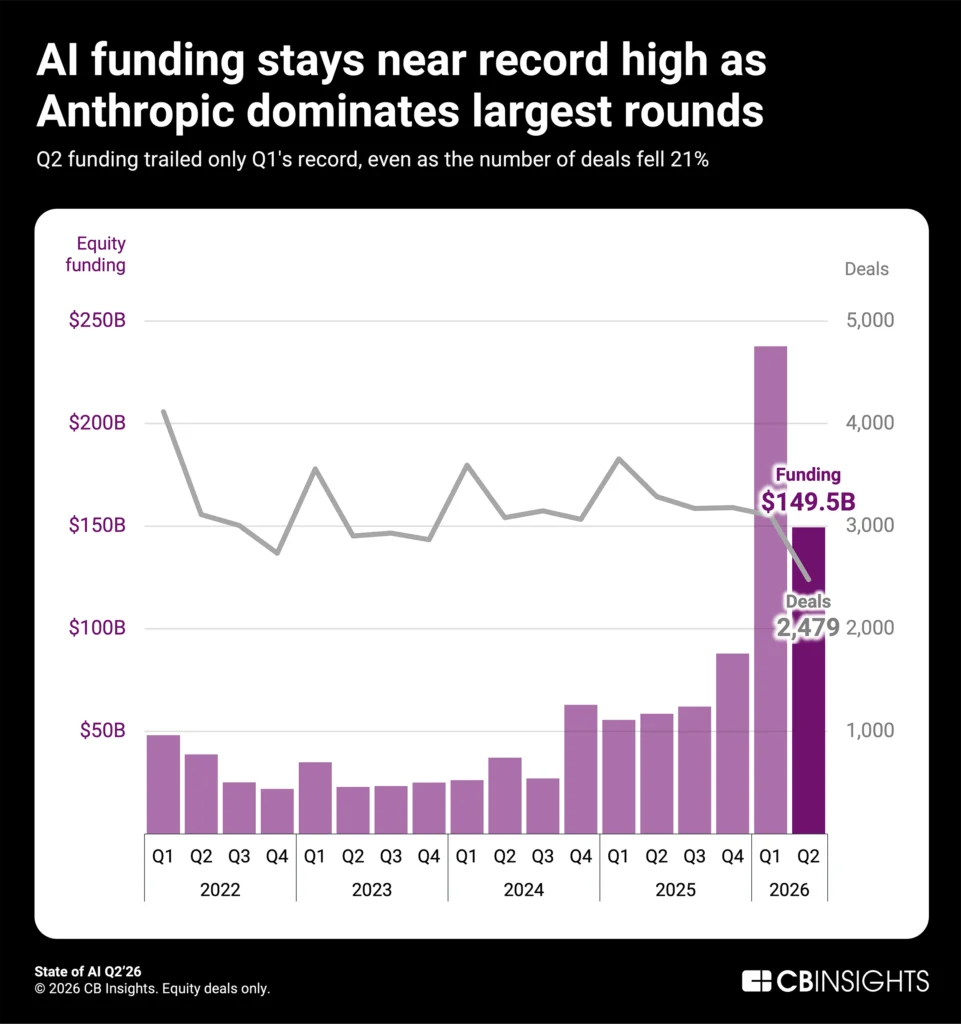
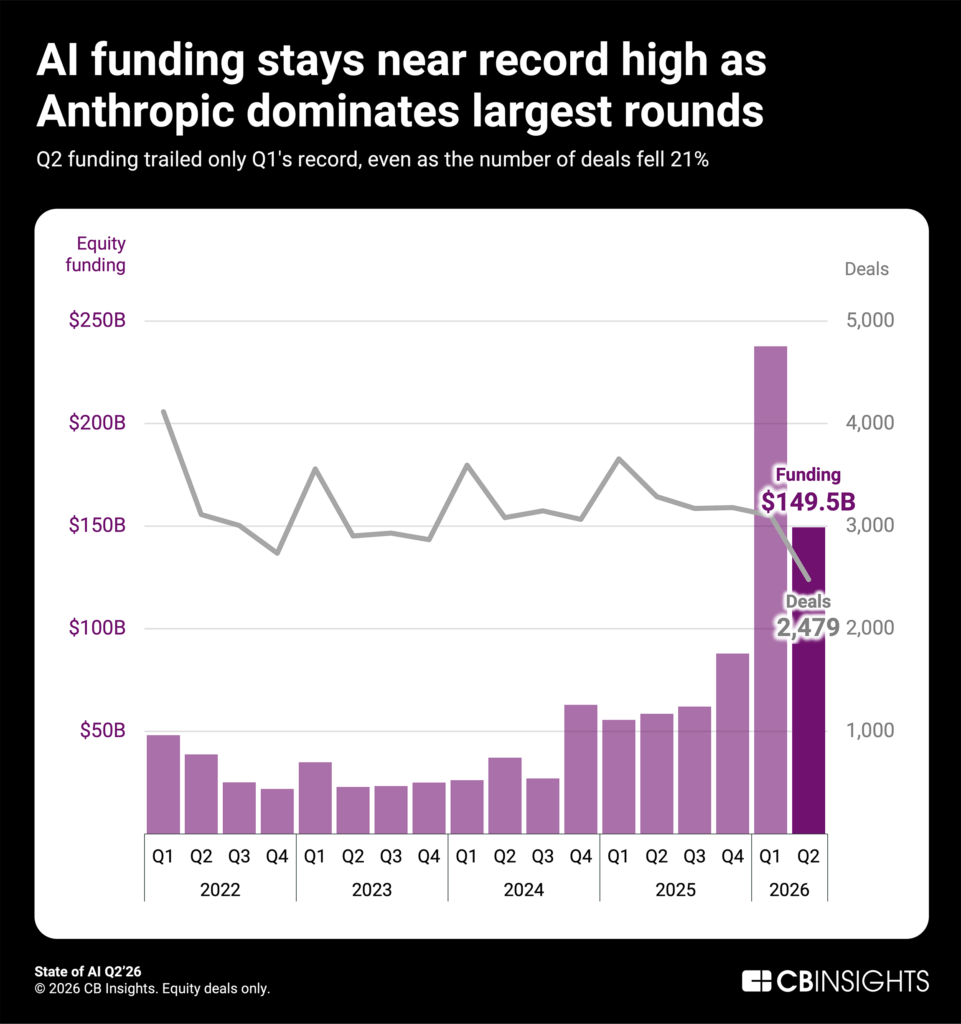
Global Artificial Intelligence equity funding experienced a significant downturn in the second quarter of 2026, plummeting to $149.5 billion from the record-breaking $237.6 billion recorded in the first quarter, according to the latest "State of AI Q2 2026" report by CB Insights. This contraction, however, belies a market increasingly dominated by a select few colossal funding rounds, which collectively absorbed nearly nine-tenths of the quarter’s investment capital.
The report highlights a stark dichotomy in the AI funding landscape. While the overall number of deals may appear to indicate a cooling investor appetite, the reality is that a handful of mega-rounds, each exceeding $100 million, accounted for an overwhelming 89% of all AI funding. These substantial infusions of capital, despite representing only 6% of the total AI deals, underscore a concentrated investment strategy targeting leading AI companies.
AI Mega-Rounds Drive Funding Figures
The dominance of mega-rounds is exemplified by the performance of AI companies in Q2 2026. A striking $132.5 billion was channeled into these large-scale funding events. Among the standout recipients was Anthropic, which alone secured three of the quarter’s five largest funding rounds, with individual investments of $50 billion, $10 billion, and $5 billion. These substantial capital injections position Anthropic as a major player in the ongoing AI development race.
Beyond Anthropic, other significant mega-rounds included Project Prometheus, a physical AI startup reportedly backed by Jeff Bezos, which raised $12 billion in its Series B funding. This round signifies strong investor confidence in the intersection of AI and tangible, real-world applications. Rounding out the top five largest rounds was DeepSeek, which secured $7.5 billion in its Series A funding, a remarkable achievement for an early-stage company and a testament to the burgeoning AI ecosystem in Asia.
The CB Insights report suggests that if these mega-rounds were to be excluded, the broader AI market would appear far more stable than the headline figures indicate. This points to a bifurcated market where a select group of well-capitalized companies are attracting the lion’s share of investment, while smaller or earlier-stage ventures may face a more challenging funding environment.
Exits Contract Amidst Continued Company Growth
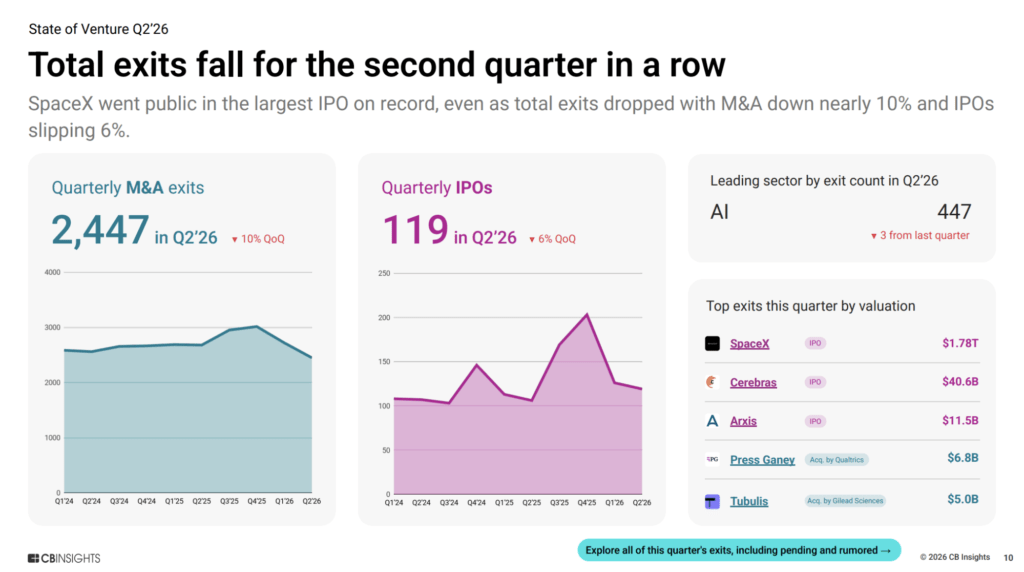
The second quarter of 2026 also witnessed a contraction in the exit market, with both mergers and acquisitions (M&A) and initial public offerings (IPOs) seeing a decline. M&A activity decreased by 10%, while IPOs slipped by 6%. Despite this overall dip in liquidity events, Artificial Intelligence maintained its position as the leading sector for exits, accounting for 447 deals.
Crucially, the companies that did successfully exit in Q2 2026 were not necessarily indicative of a struggling market. Analysis of these exits reveals a consistent trend: the companies involved were aggressively scaling their operations in the preceding periods. Data indicates that these firms were actively hiring and expanding their workforce, a strong signal that their exits were driven by strategic growth and market positioning rather than a forced response to a downturn.
The proactive hiring and expansion strategies employed by companies prior to their exits suggest that these liquidity events were not reactive measures. Instead, they were likely part of deliberate scaling strategies, aimed at increasing revenue, enhancing product development, or preparing for significant market consolidation. This suggests that while the volume of exits may have decreased, the underlying strength and growth trajectory of the companies achieving these exits remained robust.
AI Unicorn Creation Reaches Four-Year High
In a notable counter-trend to the overall funding contraction, the creation of new AI unicorns – privately held companies valued at $1 billion or more – surged in Q2 2026, reaching a four-year high. A total of 37 new AI unicorns were minted during the quarter, an increase from the 32 new entrants in Q1 2026. This brings the global count of AI unicorns to an impressive 671.
This surge in unicorn creation highlights sustained investor confidence in the long-term potential of AI technologies, even as the broader funding market experienced a recalibration. The ability of numerous AI startups to achieve billion-dollar valuations underscores innovation and market traction within the sector.
Geographical Shifts in AI Unicorn Landscape
While the United States continues to lead in the sheer volume of new AI unicorns, claiming 20 out of the 37 new entrants in Q2 2026, its relative share of these new valuations has seen a slight decrease. The US now accounts for 54% of new unicorns, down from its existing 67% share of the global AI unicorn stock.
Conversely, Asia demonstrated significant momentum in AI unicorn creation, contributing 9 new unicorns, which represents 24% of the quarter’s new additions. This figure is notably higher than Asia’s current 15% share of the global AI unicorn population, indicating a strengthening position and increasing influence in the global AI landscape.
The substantial valuation of DeepSeek ($59.2 billion) as the quarter’s highest-valued new unicorn was a significant contributor to Asia’s outsized performance. This valuation positions DeepSeek as a major force within the AI sector and a key indicator of the region’s growing capabilities. On the US side, Project Prometheus ($41 billion) led in terms of valuation among new entrants. The prominence of both a physical AI startup and a deep learning model company at the top of the valuation charts signals that investment is flowing into both the foundational infrastructure of AI and its practical, real-world applications.
Analysis and Implications
The Q2 2026 AI funding data presents a complex picture. The dominance of mega-rounds suggests a market consolidating around a few key players, potentially leading to increased competition and a more challenging environment for emerging AI startups. Investors appear to be favoring companies with proven track records and the potential for rapid scaling, willing to commit significant capital to secure stakes in what they perceive as future leaders.
The shrinking exit market, while concerning on the surface, appears to be a function of companies strategically choosing to grow rather than rush to exit. The emphasis on hiring and scaling prior to exits indicates a healthy underlying business momentum. This trend may lead to larger, more established companies eventually going public or being acquired, potentially at higher valuations.
The surge in AI unicorn creation is a strong indicator of ongoing innovation and investor optimism in the AI sector. The increasing share of new unicorns originating from Asia signifies a growing global distribution of AI talent and capital, challenging the long-standing dominance of the US. This diversification could lead to new centers of AI innovation and a more competitive global AI landscape.
The prominence of companies focused on both AI infrastructure and physical AI applications in the top funding rounds suggests a strategic focus on building the foundational components of AI alongside its tangible implementations. This dual approach is likely to drive future advancements and create new market opportunities across various industries.
The "State of AI Q2 2026" report by CB Insights provides a granular view of the dynamic AI market. The data suggests a period of strategic recalibration rather than an outright downturn. As AI continues to evolve and integrate into various sectors, investor strategies, exit timelines, and geographical distribution of innovation are likely to remain key areas of focus for industry observers. The future of AI investment will likely be shaped by the ability of companies to demonstrate not only technological prowess but also a clear path to sustainable growth and market leadership in an increasingly competitive global arena. The trends observed in Q2 2026 suggest that the AI revolution is far from over, but its trajectory is becoming more defined, with capital increasingly concentrated in the hands of a few, and innovation flourishing across multiple continents.