
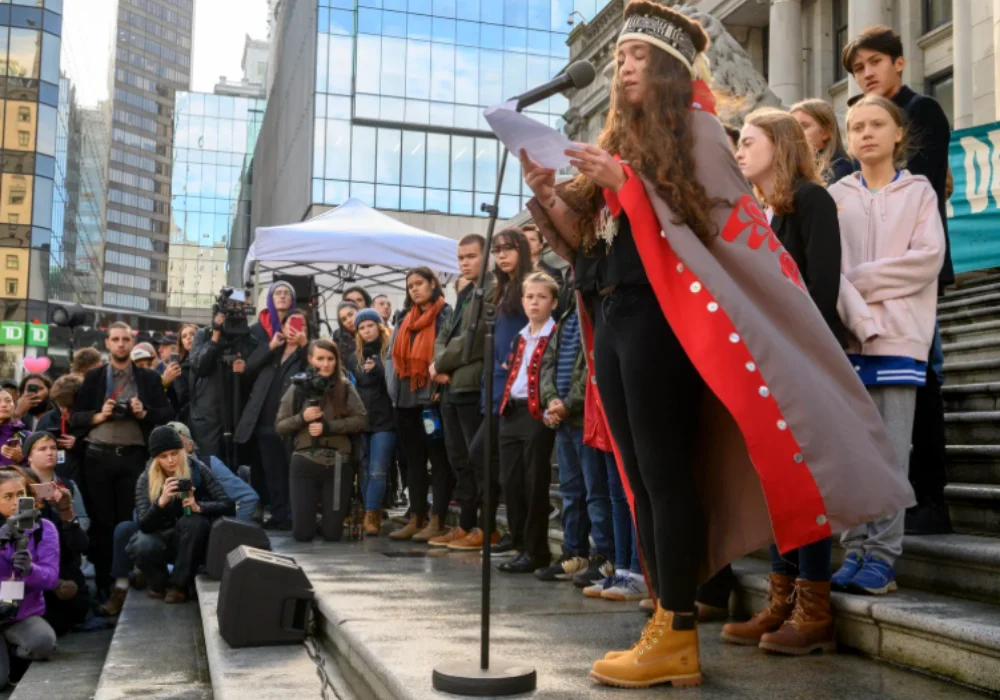
VANCOUVER — The night before Kira Young and her family evacuated their home in Yellowknife during the devastating wildfire season of the summer of 2023, she engaged in a hauntingly deliberate ritual. Wandering through the house where she had grown up, the then 17-year-old took meticulous photographs of every room, the long corridors, and even the kitchen cabinets. Stepping out onto her back deck, she looked out over her neighborhood and confronted a terrifying thought, one she later recounted under oath in a Vancouver courtroom: she wondered if it was the absolute last time she would ever lay eyes on her hometown.
Testifying on the opening day of a landmark youth climate lawsuit targeting the federal government, Young, now 20, recalled the profound psychological weight of living through a summer dominated by the looming threat and physical reality of wildfire smoke. Earlier that summer, a multi-day canoeing excursion with her family and friends had exposed them to choking palls of smoke deep in the wilderness. Within weeks of returning, the sky above Yellowknife frequently transformed into an apocalyptic shade of black or orange, while ash rained down from the atmosphere like snow. When the evacuation order finally came down in mid-August, Young experienced a volatile cocktail of terror, grief, and what she described as visceral anger. Years later, she carries a persistent, lingering fear regarding the viability and safety of her home community. The emotional scars remain fresh. Knowing the immense psychological toll that the evacuation exacted upon her, she harbors deep-seated anxieties about facing identical or worse climate-induced catastrophes in the future.
Young is one of 15 young Canadians participating in La Rose vs. Canada, a historic legal challenge against the federal government over its climate change policies. The youthful applicants assert that their fundamental constitutional rights are being actively infringed upon by the government’s lethargic and inadequate policy responses to escalating greenhouse gas emissions and global heating. This proceeding marks the first federal youth climate lawsuit in Canadian history to advance to a full evidentiary trial, placing it at the vanguard of a burgeoning global wave of climate litigation led by minors against national administrations. The ultimate judgment rendered by the court could carry sweeping legal implications for Canadian constitutional law, reshape national climate policy, and pave the way for a new generation of environmental accountability lawsuits.
Putting a Human Face on the Climate Crisis
For legal advocates representing the plaintiffs, the trial represents a rare and powerful platform. Andrew Gage, a staff lawyer for West Coast Environmental Law and a member of the plaintiffs’ legal team, emphasized the profound significance of the proceedings. One of the core strengths of the case, he noted, is the sheer power of granting young people the formal opportunity to stand under oath and articulate precisely what climate change has personally and fundamentally meant for their lives. Gage pointed out that this legal avenue introduces a tangible human face to the impacts of climate change—consequences that can frequently be treated as abstract or nebulous by policymakers sitting in distant capitals.
This trial unfolds against a backdrop of escalating international legal recognition concerning government duties toward the environment. Last year, the International Court of Justice issued a significant advisory opinion affirming that sovereign governments possess an explicit legal obligation to prevent significant harm to the natural environment and to mobilize all available measures at their disposal to combat the progression of climate change.
What the Plaintiffs Are Demanding from the Court
The plaintiffs in La Rose vs. Canada—who ranged in age from 10 to 18 when the litigation was initially filed in 2019, and who have each suffered demonstrable physical and mental health impacts tied to environmental degradation—are petitioning the court for declaratory relief. Specifically, they are asking the judiciary to formally declare that the conduct of the federal government violates their rights under Section 7 of the Canadian Charter of Rights and Freedoms. Section 7 guarantees every Canadian the right to life, liberty, and security of the person.
Furthermore, the applicants are requesting a mandatory court order compelling the federal government to design, develop, and implement a rigorous, science-based plan to drastically reduce greenhouse gas emissions and systematically decarbonize the nation’s energy infrastructure. They argue this plan must align precisely with the thresholds established by climate scientists as necessary to maintain a safe and stable global climate system.
The lawsuit specifically zeroes in on the federal government’s Net-Zero Emissions Accountability Act and its accompanying 2030 climate strategy. Enacted in 2021, the legislation establishes a statutory framework designed to guide Canada toward achieving net-zero carbon emissions by the year 2050. It mandates that the government establish incremental emission-reduction targets at designated intervals, formulated using the best available scientific data, alongside concrete strategic plans to meet those targets.
However, the plaintiffs contend that this legislative framework effectively sets an artificially permissible ceiling for emissions within Canada that is fundamentally incompatible with a safe, liveable future. They argue further that the unprecedented existential crisis posed by anthropogenic climate change creates unique constitutional circumstances. These circumstances, they maintain, impose a positive obligation on the government to take affirmative actions to protect the plaintiffs—and by extension, all children and youth residing in Canada—from further, irreversible harms to their Section 7 rights.
Legal scholars note that a judicial finding affirming a positive constitutional obligation in this context would constitute a monumental development in Canadian constitutional law. Catherine Savard, a lawyer and Canadian expert associated with the Sabin Center for Climate Change Law at Columbia University, observed in a recent analysis that establishing such a precedent would fundamentally alter the relationship between citizen rights and state environmental duties.
During her opening remarks on Monday, Catherine Boies Parker, counsel at Arvay Finlay LLP and a member of the plaintiffs’ legal team, underscored the urgency of the moment. She stated that the devastating impacts of climate change will only escalate exponentially in the absence of deep, immediate emissions reductions. Characterizing her clients as young and vulnerable, she argued that the Charter must afford them a degree of protection from their own government’s actions—actions that actively contribute to the single greatest threat to personal security that humanity has ever faced.
While acknowledging that climate change is an inherently global phenomenon and that the trajectory of the planet will be influenced by the actions of every nation, Boies Parker maintained that Canada retains agency. The nation, she argued, possesses the power to exacerbate the crisis or to actively work toward mitigating it.
Adding economic and demographic context to the legal arguments, Andrew Gage noted that Canada’s responsibility must be viewed through the lens of its disproportionate contribution to global emissions. Despite accounting for a mere 0.5 percent of the global population, Canada is responsible for roughly 1.4 percent of worldwide greenhouse gas emissions. Consequently, Gage asserted, the Canadian government plays a significant, outsized role in shaping the current environmental crisis.
Chronology and Legal Roadblocks
The path to a full evidentiary trial has been fraught with procedural hurdles. When the lawsuit was originally filed five years ago, its scope was considerably broader, targeting a sweeping array of government policies, infrastructure projects, and economic decisions. In 2020, an initial lower court ruling dismissed the case, concluding that the claims were overly broad and that the judiciary was an inappropriate forum to intervene in matters of high-level state policy.
However, the legal team regrouped and appealed the decision. In 2023, the Federal Court of Appeal delivered a pivotal ruling, determining that a narrowed, more focused version of the case—specifically targeting the 2021 Net-Zero Emissions Accountability Act—could proceed to trial. This legal narrowing paved the way for the current proceedings in Vancouver.
The Federal Government Defense
In response to the mounting legal pressure, federal lawyers have mounted a robust defense, arguing that neither the Canadian Charter of Rights and Freedoms nor Canada’s various international climate treaties establish an enforceable legal obligation for the government to mitigate global climate change.
Representing the federal government, legal counsel B.J. Wray argued before the court that Section 7 of the Charter is strictly defensive in nature. According to the government’s interpretation, the provision protects citizens only against direct government actions that actively deprive individuals of their rights, rather than imposing a positive constitutional duty on the state to proactively execute specific programs to safeguard those rights.
Furthermore, Wray pushed back against the plaintiffs’ assertion that Canada’s climate policies are failing. The government contends that the country has been on a measurable trajectory toward reducing its domestic emissions relative to 2005 levels. Highlighting the complexity of the crisis, Wray emphasized that climate change is fundamentally a global problem that cannot be resolved through domestic legal orders or judicial mandates. Instead, the government argued, meaningful environmental progress can only be achieved through complex, protracted international statecraft unfolding over many years.
Expert Testimony and Complex Scientific Evidence
Recognizing the profound technical and scientific complexity of the litigation, the plaintiffs were granted permission in June to call more than five expert witnesses to the stand. Over the coming weeks of the trial, a multidisciplinary panel of eight leading experts is scheduled to testify, providing the court with empirical data concerning atmospheric physics, climate modeling, public health repercussions, and intergenerational equity.
A Broader Movement of Youth Climate Litigation
The proceedings in Vancouver do not occur in a vacuum. They represent a prominent node in an expanding network of youth-led legal challenges confronting governmental and institutional bodies across Canada.
Among these parallel legal battles is Mathur et al vs. Ontario, a prominent case in which seven young individuals launched a Charter challenge against the provincial government of Ontario. That lawsuit targets the province for deliberately weakening its statutory 2030 emissions reduction targets under the auspices of the Cap and Trade Cancellation Act, utilizing the same foundational Section 7 constitutional arguments seen in La Rose.
Concurrently, environmental law charity Ecojustice filed a separate legal challenge in June on behalf of three young plaintiffs, also targeting the federal government’s Net-Zero Emissions Accountability Act. Although federal attorneys attempted to block that challenge from moving forward, the Federal Court formally dismissed the government’s motion to strike in September, allowing the case to advance.
Ecojustice is also spearheading a distinct legal challenge brought by four young plaintiffs against the Canada Pension Plan Investment Board (CPPIB). This lawsuit alleges that the massive pension fund is severely underestimating the financial risks associated with climate change and actively exacerbating those risks by directing capital into new fossil fuel projects. That case faces its first major procedural hurdle in mid-November, when the CPPIB will attempt to convince the court to halt its progression.
As the trial in Vancouver continues to unfold, legal scholars, policymakers, and environmental advocates across the globe will be watching closely. The outcome of La Rose vs. Canada threatens to redefine the boundaries of constitutional jurisprudence, testing whether the supreme law of the land can be successfully invoked to compel a national government to alter its environmental trajectory in the face of an unfolding planetary emergency.
