
OpenAI’s recent announcement regarding the protein design capabilities of its latest models has sparked a significant debate regarding the future of artificial intelligence in high-stakes industries like biotechnology and healthcare. The laboratory results, which indicated that OpenAI’s general-purpose models could outperform specialized tools like RFdiffusion on certain protein design benchmarks—scoring 43.7% in successful computational checks versus 27.8% for the specialist tool—initially appeared to signal a paradigm shift. However, a deeper examination of the technical landscape and the practical realities of clinical and pharmaceutical workflows suggests that the "model-as-a-commodity" narrative is incomplete. While general-purpose models are closing the quality gap in theoretical benchmarks, the competitive advantage for vertical AI companies remains rooted in proprietary data, regulatory clearances, and the complex human-in-the-loop workflows that define the healthcare sector.
The Technical Context: Benchmarks Versus Reality
The excitement surrounding OpenAI’s foray into protein design must be contextualized by the limitations of the testing environment. While the company demonstrated that its models could leverage reasoning and general-purpose coding tools to suggest protein sequences, the actual transition from a computational benchmark to a wet-lab environment tells a different story. In practice, researchers continue to rely on specialized, domain-specific models to propose sequences and validate designs.
OpenAI itself has been transparent about these limitations, acknowledging that their findings do not yet establish a capability to design binders without the assistance of specialized, purpose-built architectures. Furthermore, when evaluating the structural prediction of a protein from its sequence, industry-standard models like ESMFold2 continue to outperform generalist models by a significant margin. This discrepancy highlights a fundamental truth in the current AI cycle: generating a plausible output in a controlled, virtual benchmark is fundamentally different from providing a reliable, actionable, and safe solution in a clinical or research setting.
Chronology of the Vertical AI Shift
The progression of AI in healthcare has moved through three distinct phases over the last decade.
- The Early Predictive Phase (2015–2019): Early healthcare AI focused on narrow, specific tasks like identifying patterns in radiological images. These models were largely built from scratch using institutional data and lacked the generalization capabilities seen today.
- The Generalist Surge (2020–2024): The advent of large language models (LLMs) and foundation models changed the landscape. Suddenly, generalist models could draft patient notes, assist in coding, and summarize medical literature. This led to a brief period of uncertainty where observers questioned whether vertical AI startups were effectively "dead on arrival" against the massive compute budgets of labs like OpenAI or Google.
- The Integration and Proprietary Data Phase (2025–Present): The current market is defined by a realization that model quality is reaching a plateau of sufficiency. The differentiator is no longer the base model but the ability to fine-tune these systems on "dark data"—proprietary, non-public, or highly sensitive information that only vertical specialists possess.
Data as the Moat: The Case of AKASA
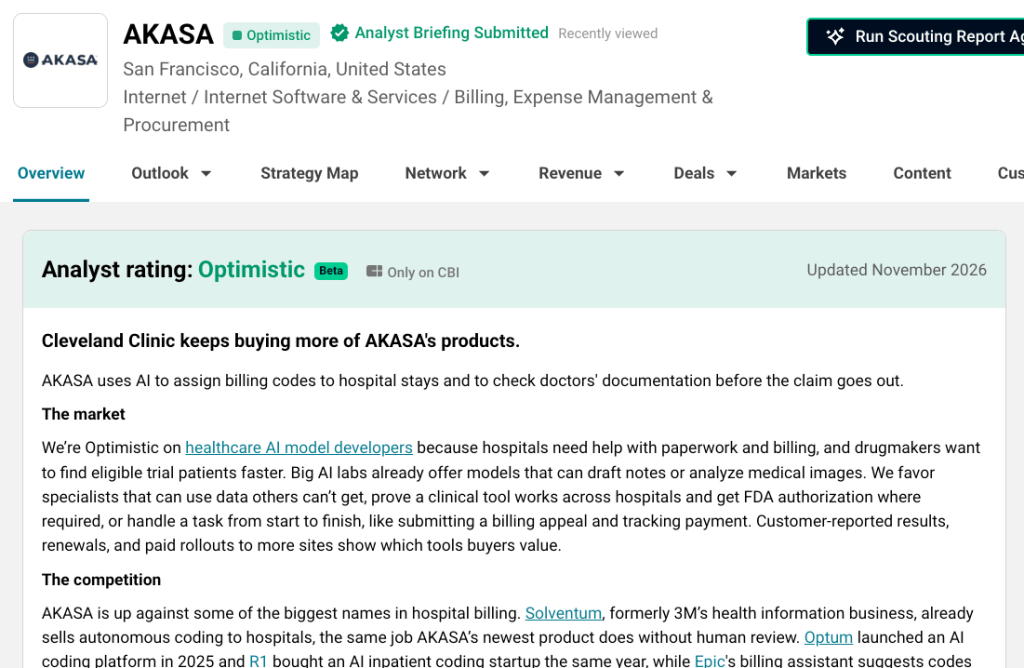
The competitive endurance of companies like AKASA, which specializes in automating hospital revenue cycle management and medical billing, serves as a primary case study for why model quality is not the ultimate arbiter of success. While a general-purpose model is capable of understanding billing codes, it lacks the specific institutional context required to ensure 100% accuracy within a complex, multi-facility healthcare system like the Cleveland Clinic.
AKASA’s competitive advantage is not derived from a more sophisticated transformer architecture; it is derived from its training dataset. By training on the unique, historical billing records of specific hospitals, the company creates a bespoke AI agent that understands the idiosyncrasies of local health system documentation. When this tool is deployed, it does not merely offer suggestions for human coders to review; it integrates into the hospital’s workflow to produce finished codes. This level of vertical integration creates "stickiness" and produces empirical evidence of efficacy—such as repeat contracts and measurable reductions in administrative overhead—that a standard benchmark score simply cannot replicate.
The Strategic Imperative: Why Vertical AI Firms Build Their Own Models
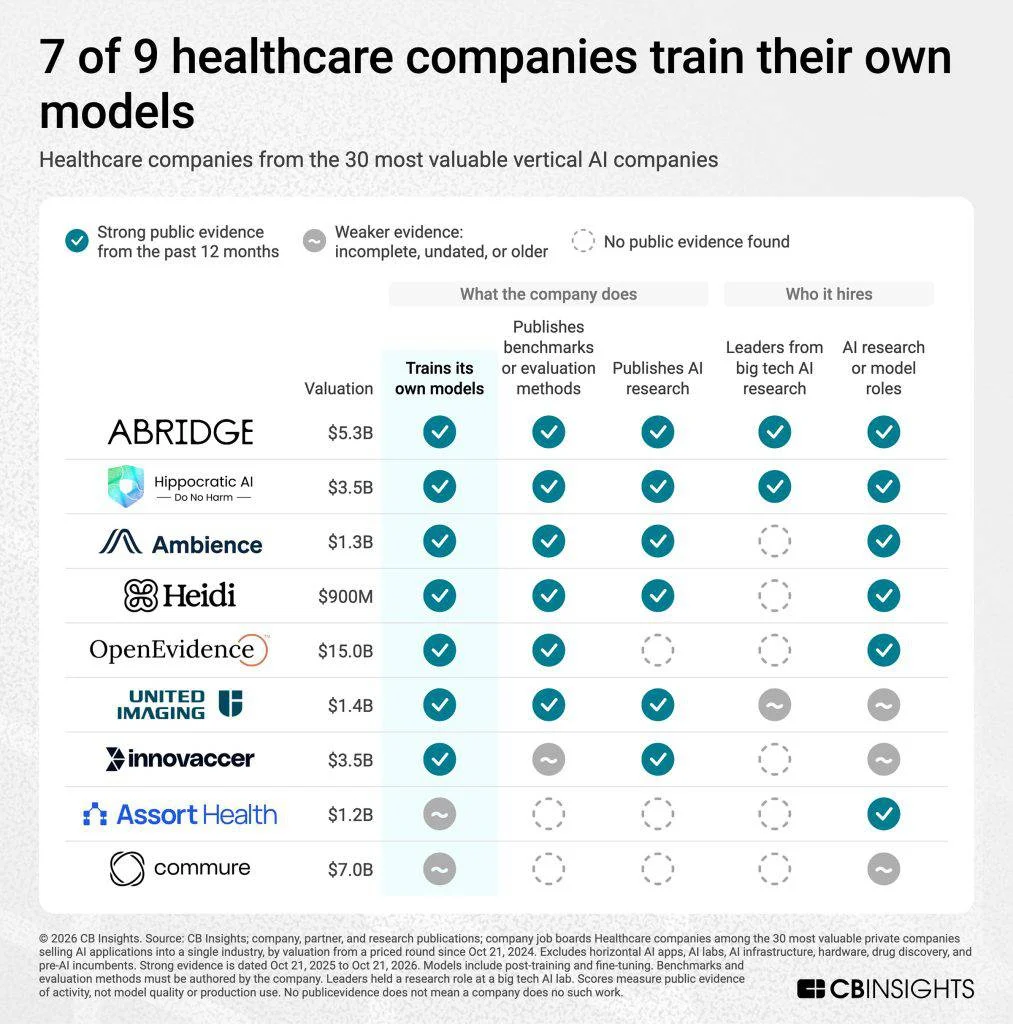
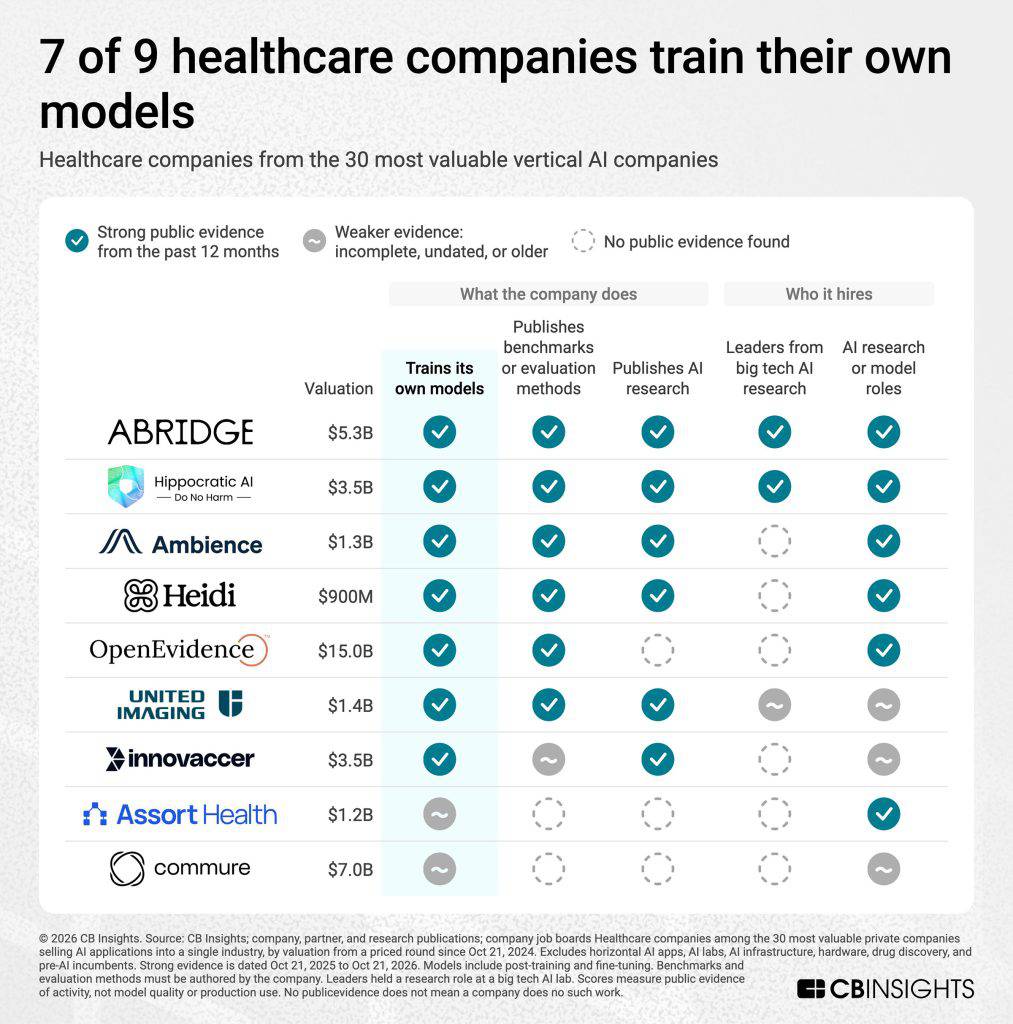
An analysis of the 30 most valuable vertical AI companies reveals a distinct trend: the majority, particularly those in the healthcare sector, are investing heavily in their own model development or deep fine-tuning processes. Data from recent market assessments indicates that approximately 77% of the top-tier healthcare AI startups train their own models.
This behavior is not driven by a desire to reinvent the wheel or build a rival to GPT-4, but rather by the necessity of "narrowing" a model to a specific job. In drug discovery, for instance, the model must understand the chemical and biological constraints of molecular interaction—data that is often siloed within pharmaceutical firms or specialized research institutes. By taking a foundation model and applying it to this niche, companies create a product that is defensible against the giants.
Executives in the drug development sector frequently cite that the primary constraint is not compute power but data architecture. Bruce Stuart Upbin of TetraScience has noted that no amount of additional compute can fix a broken data foundation. This sentiment is echoed across the industry; Nate Beyor, Chief Business Officer at Salt, has stated that the model itself is becoming a commoditized asset, while the scarce, high-value asset is the curated, structured data that allows a model to operate with domain-specific intelligence.
Regulatory and Clinical Validation
Beyond data, the "specialist edge" is solidified by the regulatory environment. Developing a model that can predict a protein shape is a breakthrough in research, but deploying a tool that assists in a clinical diagnosis requires FDA authorization and rigorous, ongoing clinical validation.
Vertical AI companies act as the bridge between raw algorithmic potential and the stringent requirements of healthcare compliance. They provide the "last mile" of implementation:
- Workflow Integration: Ensuring the model fits into existing electronic health record (EHR) systems without disrupting clinical flow.
- Auditability: Providing the explainability required for medical professionals to trust the model’s outputs.
- Liability Management: Offering a platform where the software developer assumes the burden of accuracy and reliability, a service that general-purpose labs are rarely equipped to provide at scale.
Future Implications: A Bifurcated Market
Looking forward, the AI market in healthcare is likely to evolve into a bifurcated structure. On one side, large, general-purpose labs will continue to provide the "engine" of intelligence—the foundational reasoning and natural language processing capabilities. On the other side, specialized vertical AI companies will provide the "chassis" and the "fuel"—the domain-specific fine-tuning, the proprietary data integration, and the regulatory navigation required to deliver actual medical outcomes.
The "win" that OpenAI claimed in protein design is an important indicator of progress, but it is not a disruption of the vertical business model. Rather, it confirms that general-purpose intelligence is becoming a reliable utility. For companies operating in the healthcare space, this actually lowers the barrier to entry for building specialized tools, allowing them to focus their capital on the true differentiators: clinical data acquisition, user experience, and the delivery of evidence-based results.
Ultimately, the most successful companies will be those that view models as a tool rather than a product. In a world where intelligence is becoming cheaper and more accessible, the value is shifting toward those who can capture, refine, and apply data in a way that is legally, clinically, and commercially robust. As the industry moves past the "benchmark era," the focus will shift from who has the most parameters to who has the most trusted and specialized impact in the field. Those who understand that the "bottleneck is data architecture" are the ones likely to lead the next decade of healthcare innovation.
