

The landscape of enterprise software has long been defined by a rigid dichotomy: off-the-shelf platforms that offer standardized functionality and custom-coded solutions that demand significant time, capital, and specialized engineering resources. However, a significant portion of a company’s most actionable intelligence—the proprietary scoring models, nuanced operational logic, and departmental workflows—frequently remains trapped in static spreadsheets or siloed documents. As businesses increasingly look to bridge this gap, the emergence of "vibe coding" platforms, such as Alaio Vibecode for Bitrix24, represents a shift toward democratizing the development of bespoke analytical tools. By leveraging natural language processing and AI-assisted development, organizations are now transitioning from manually aggregating data to deploying automated, context-aware applications directly within their existing CRM ecosystems.
The Evolution of the Low-Code/No-Code Paradigm
The trajectory of business automation has moved rapidly over the last decade. In the early 2010s, the focus was on simple data integration through rigid APIs. By the late 2010s, the rise of low-code platforms allowed non-technical users to build basic workflows. Today, the integration of Large Language Models (LLMs) into the development cycle—often termed "vibe coding"—allows users to articulate complex requirements in plain language, which AI agents then translate into functional code.
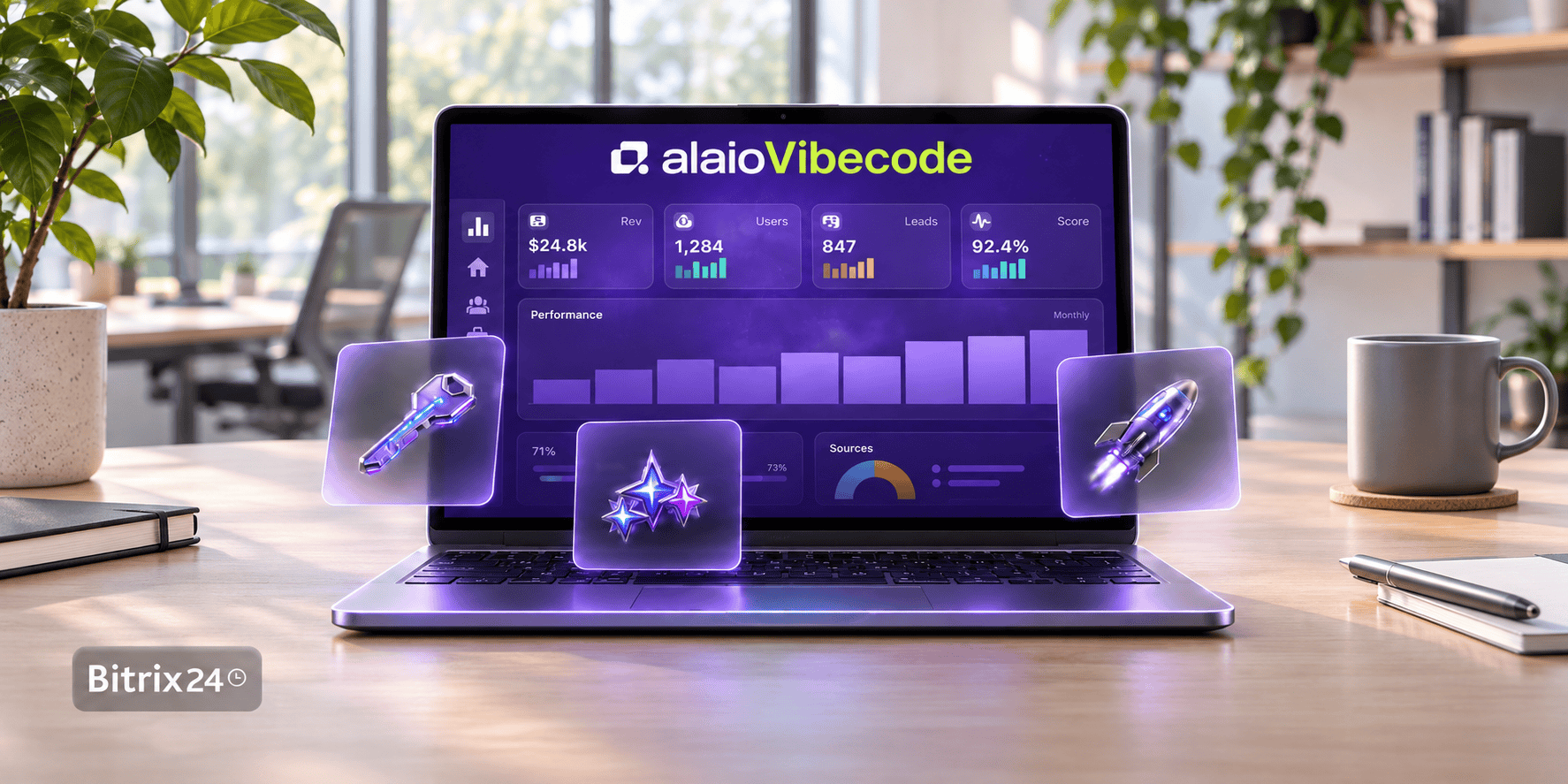
Alaio Vibecode operates at this intersection. By integrating with Bitrix24, which serves as a central hub for CRM, task management, and document storage, the platform enables the creation of highly specific tools—ranging from sophisticated lead scoring engines to automated project risk monitors—without the need for a full-scale software development life cycle (SDLC).
Bridging the Knowledge Gap: From Spreadsheets to Software
A typical sales team often employs a proprietary scoring model to evaluate the health of their pipeline. These models are frequently built on years of institutional experience, accounting for variables like account type, engagement frequency, and historical deal outcomes. Traditionally, this required a human operator to export CRM data into a spreadsheet, apply formulas, and manually interpret the output. This process is not only inefficient but also prone to human error and data latency.
With AI-driven app builders, these models can be codified into "live" applications. By instructing an AI agent—such as those integrated with Claude Code or OpenAI Codex—to connect directly to the Bitrix24 database, users can transform their static logic into a dynamic dashboard. For instance, a user might provide a prompt: "Build a CRM analytics dashboard that ranks open opportunities based on a 40/30/30 weighting of engagement, account fit, and closing potential." The platform then interprets this intent, executes the necessary API calls to the CRM, and renders a ranked table that updates in real-time.
Chronology of Implementation and Testing
The successful deployment of an AI-built analytical application follows a structured, iterative process designed to minimize risk and ensure data integrity.
- Phase 1: Requirement Specification: Stakeholders identify a recurring manual analytical task. The objective is to convert this into a set of programmatic rules.
- Phase 2: Initial Prototyping: The user employs natural language instructions to generate the application structure. At this stage, the AI establishes the connection to the Bitrix24 workspace.
- Phase 3: Decision Replay Testing: Before full-scale deployment, the application is run against historical data. This "decision replay" allows managers to compare the AI-generated results against previous manual assessments, identifying any discrepancies or flawed assumptions.
- Phase 4: Calibration: Based on the results of the replay, users refine the scoring weights or filters. This step is critical for aligning the machine logic with the actual business strategy.
- Phase 5: Deployment: The application is pushed to production, often embedded directly within the CRM interface for seamless adoption.
Technical Architecture and Data Security
A primary concern for enterprises adopting AI-driven tools is the security of proprietary data. Alaio Vibecode addresses this by maintaining a "data-in-place" philosophy. Instead of migrating sensitive CRM records into a secondary database, the platform allows applications to retrieve data directly from Bitrix24 via secure, permission-controlled APIs.
Furthermore, the environment is designed for internal compliance. Administrators can restrict the scope of data that an AI agent can access, ensuring that sensitive financial or personal customer information remains governed by existing organizational roles. For high-security environments, the architecture supports deployment on private servers, effectively insulating the application logic from the public internet.
Beyond Dashboards: Contextual Intelligence
Modern analytics are moving beyond mere visualization. The most effective tools are those that provide "contextual intelligence"—the ability to combine internal CRM metrics with external market signals.
The "Deal Radar" feature is an illustrative example of this capability. By querying external data sources regarding an account’s recent activities—such as funding news, executive leadership changes, or product announcements—and juxtaposing this with the internal CRM status, the application provides a synthesized briefing. This allows a sales representative to approach a client not just with a record of past interactions, but with an understanding of current external pressures or opportunities.
The Impact on Operational Efficiency
The broader implications for organizations are significant. By automating the "data preparation" phase of analytics, teams can pivot toward high-value interpretation.
- Priority Management: In project-heavy environments, such as marketing or operations, "Stale Task Monitors" use AI to identify bottlenecks before they impact deliverables. By calculating a risk score based on overdue dates and project importance, these tools ensure that management attention is directed toward the most critical risks rather than a general, overwhelming overview.
- Conversational Analytics: The integration of AI agents like the "Hermes" assistant allows team members to interact with their data through natural language. Rather than navigating through complex BI interfaces, a manager can query the system: "Which high-value accounts have not been contacted in the last 14 days?" The ability to get immediate, accurate answers to specific questions reduces the friction between data collection and decision-making.
Analysis of the "Vibe Coding" Trend
Industry analysts observe that the move toward "vibe coding" is a natural evolution of the democratization of technology. By removing the barrier of syntax-heavy programming languages, companies can empower the subject matter experts—the sales directors, the marketing managers, and the operations leads—to build the tools they actually need.
However, the shift necessitates a new form of digital literacy. While the "coding" aspect is handled by AI, the "logic" aspect remains the responsibility of the business user. The risk of "garbage in, garbage out" is amplified when the speed of development increases. Therefore, the role of the analytical professional is evolving from a data wrangler into a "logic architect," focused on defining the rules, validating the outputs, and ensuring the ethical and accurate use of AI.
Conclusion: The Future of Business Agility
The ability to turn a recurring Monday morning spreadsheet routine into an integrated, real-time application is no longer a luxury reserved for firms with large software engineering departments. As platforms like Alaio Vibecode continue to refine the interface between human intent and machine execution, the competitive advantage will increasingly belong to organizations that can iterate on their analytical processes the fastest.
For any business looking to adopt this approach, the recommendation is to start small. Identify one single, well-defined recurring task, document the logic behind it, and utilize AI-assisted development to prototype a solution. By validating these outputs against existing data and involving the end-users in the testing process, organizations can build a robust, scalable library of custom analytical tools that evolve alongside their business needs. The future of business analytics is not necessarily in more complex software, but in more accessible, highly tailored applications that help individuals make the right decision at the right time.
