
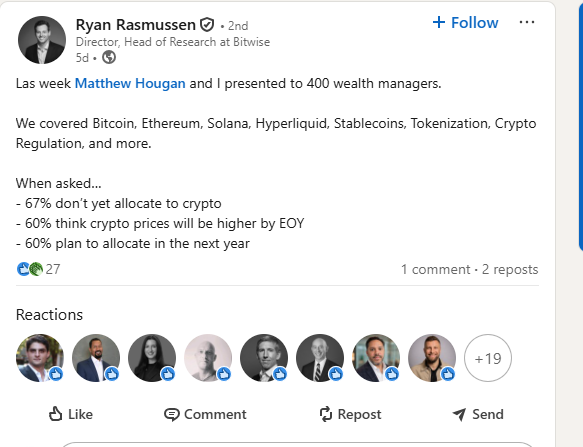
The modern landscape of financial advisory is defined by a persistent tension between rising client demand for digital assets and the cautious, deliberate pace of institutional adoption. This dichotomy was brought into sharp focus during a recent educational presentation hosted by cryptocurrency index fund manager Bitwise. According to an informal poll conducted during the session, approximately 67% of roughly 400 wealth managers in attendance currently maintain zero crypto allocation in their client portfolios. However, this lack of immediate exposure belies a strong undercurrent of future intent, with 60% of the surveyed professionals indicating plans to integrate digital assets into client portfolios within the next 12 months. Furthermore, 60% of the respondents expressed a bullish outlook, predicting that crypto market prices will finish the year 2026 higher than current levels.
While the poll’s sample size of 400 participants captured immediate sentiment in a controlled environment, it does not represent a randomized statistical survey of the broader global financial advisory industry. Attendees of targeted Bitwise presentations frequently comprise professionals who are already monitoring or actively researching digital assets. Consequently, the data illustrates a striking operational reality: the significant distance that still exists between enthusiastic market discussion and actual portfolio implementation within traditional wealth management firms.
The Event and Core Survey Findings
The informal poll was shared publicly by Ryan Rasmussen, Head of Research at Bitwise, following a comprehensive market presentation delivered alongside Chief Investment Officer Matt Hougan. The session was designed to unpack the evolving macroeconomic and regulatory landscape for digital assets, touching upon foundational assets like Bitcoin and Ethereum, alternative layer-one blockchains such as Solana and Hyperliquid, and structural innovations like stablecoins and real-world asset tokenization.
Interestingly, while Bitcoin traditionally anchors institutional dialogue as the primary digital reserve asset, Rasmussen noted that XRP generated the highest volume of audience questions during the session. This unexpected surge in inquiries regarding XRP highlights how wealth managers are looking beyond the primary market leaders to evaluate a diverse array of digital tokens, payment rails, and settlement layers.
Despite this multifaceted curiosity, the core findings of the Bitwise poll underscore a major structural lag. Two-thirds of the room manage client assets entirely divorced from the crypto ecosystem. Yet, the forward-looking indicators are decidedly optimistic. Sixty percent of the respondents intend to allocate capital to digital assets within a year, mirroring the percentage of managers who anticipate a bullish price trajectory through the close of 2026. Crucially, the survey did not disclose specific allocation sizes, preferred investment vehicles—such as spot exchange-traded funds (ETFs) versus direct custody—or the precise risk parameters governing these anticipated moves.
Broader Industry Trends: Contextualizing the Data

To fully understand the weight of the Bitwise audience poll, it must be contextualized within broader, more rigorous empirical research conducted by Bitwise and financial research firm VettaFi. The comprehensive Bitwise/VettaFi Benchmark Survey provides a multi-year macroeconomic view of financial advisor sentiment, revealing a steady, incremental upward trajectory in actual crypto adoption.
According to the benchmark survey, 32% of financial advisors successfully allocated crypto to client accounts over the course of 2025. This figure represents a notable acceleration from 2024, when adoption stood at 22%. Furthermore, the regulatory and compliance infrastructure enabling these investments has expanded dramatically. The benchmark data revealed that 42% of advisors possessed the authorization or institutional framework to purchase crypto for clients in 2025, compared to 35% in 2024 and a meager 19% in 2023.
When juxtaposed with the 67% non-allocation rate observed in the recent Bitwise presentation poll, these benchmark statistics help illuminate the middle ground of modern wealth management. The wider industry is slowly building the compliance bridges necessary to facilitate digital asset exposure, yet individual advisors frequently find themselves stalled by internal corporate policy, risk management frameworks, and the arduous process of client suitability education.
The Operational and Compliance Hurdles Delaying Allocation
The friction that prevents wealth managers from moving capital into digital assets is rarely a matter of personal conviction; rather, it is a complex web of institutional bureaucracy, compliance mandates, and fiduciary duty. While 60% of the managers surveyed by Bitwise intend to add exposure within a year, transitioning from theoretical interest to completed purchases requires navigating several formidable checkpoints.
First and foremost are internal compliance reviews. Before a wealth manager can allocate a single dollar to a cryptocurrency product, the firm’s investment committee must typically approve the asset class, select approved custodians, and establish rigorous risk disclosure protocols. Many traditional wealth management enterprises, particularly major wirehouses and independent broker-dealers, restrict advisors to approved product lists. If a digital asset vehicle—such as a spot Bitcoin or Ethereum ETF—is not explicitly greenlit by the firm’s central compliance office, advisors are legally barred from purchasing it on behalf of clients, regardless of their personal bullish outlook.
Second, the operational mechanics of custody and reporting present ongoing challenges. Unlike equities, fixed income, or traditional mutual funds, digital assets require specialized custody solutions that meet institutional standards of security, insurance, and regulatory compliance. Integrating these custodial accounts with legacy portfolio management software often requires significant software upgrades and operational overhauls.
Finally, wealth managers carry a strict fiduciary obligation to ensure that any investment aligns with a client’s risk tolerance, financial goals, and time horizon. Cryptocurrencies are historically characterized by high volatility, making them a difficult fit for conservative or risk-averse portfolios. Advisors must spend considerable time explaining asset volatility, tax implications, and appropriate portfolio sizing—often recommended to remain in the 1% to 3% range—before executing a trade. Consequently, even when an advisor is personally convinced of crypto’s long-term value, the prerequisite client education and suitability documentation can introduce months of delay.
Evolution of Institutional Dialogue: Beyond Bitcoin and Ethereum
The discourse within wealth management circles has matured significantly over the past several cycles. While early institutional conversations were dominated almost exclusively by Bitcoin as digital gold, the recent Bitwise presentation highlights a broadening scope of inquiry. Attendees actively engaged with complex topics spanning multiple layers of the digital asset economy.
Ethereum and Solana represent the expansion of smart contract platforms and decentralized application ecosystems, offering investors exposure to network utility and decentralized finance (DeFi) activity. Meanwhile, discussions surrounding emerging networks like Hyperliquid point to a growing institutional interest in high-performance derivatives infrastructure and scalable trading environments.
Furthermore, the inclusion of stablecoins and real-world asset (RWA) tokenization in the presentation reflects a fundamental shift in how traditional finance views blockchain technology. Rather than merely viewing crypto as a speculative asset class, wealth managers are increasingly examining distributed ledger technology as a settlement layer capable of modernizing global payments, reducing transaction friction, and tokenizing traditional securities such as treasury bonds and real estate. The intense audience interest in XRP further underscores a desire to understand cross-border liquidity solutions and enterprise-grade payment rails.
Implications and Outlook for 2026 and Beyond
The data captured in the informal Bitwise poll and the broader 2026 benchmark surveys paint a clear picture of a transition phase. The wealth management industry is currently standing at the precipice of mainstream crypto integration. While two-thirds of surveyed professionals have yet to make their first allocation, the intent to buy—coupled with a constructive price outlook—suggests that a substantial wave of institutional capital could enter the ecosystem as compliance frameworks mature.
However, the speed of this adoption will be dictated entirely by regulatory clarity, the expansion of approved product offerings, and the institutionalization of custody solutions. As regulatory bodies continue to refine guidelines for digital assets and as more asset management firms introduce structured, risk-managed investment vehicles, the gap between interest and implementation is expected to narrow.
For the digital asset market, the potential conversion of these hesitant wealth managers represents a massive untapped liquidity pool. If even a fraction of the 60% of managers intending to allocate within the next year successfully navigate their compliance hurdles, the influx of traditional wealth could profoundly reshape market dynamics, driving further maturation across Bitcoin, altcoins, and blockchain-based financial infrastructure through 2026 and beyond.
