
The rapid proliferation of artificial intelligence agents across the corporate landscape has triggered a high-stakes arms race among major cybersecurity firms, leading to a wave of aggressive acquisitions throughout 2026. As AI agents—autonomous software programs capable of performing tasks ranging from data analysis to executing financial transactions—become embedded within enterprise workflows, they are introducing a new, massive attack surface. These agents require unique credentials, API keys, and service tokens to interact with corporate systems, effectively creating a new class of "non-human" identities that security teams are currently struggling to inventory, let alone govern.
The urgency behind this consolidation is driven by sheer volume. Recent disclosures from industry leaders paint a picture of an "agent sprawl" crisis. During its Q2 FY2027 earnings call, identity governance provider SailPoint revealed that a single Fortune 500 client discovered over 10,000 previously unmanaged AI agents during a routine proof-of-concept audit. Simultaneously, endpoint security giant CrowdStrike reported that the adoption of Claude across its customer base surged by more than 400% in a matter of months, while the deployment of custom-built internal agents on company hardware more than doubled. This uncontrolled growth is creating a security blind spot, as each of these agents represents a potential vector for unauthorized access or data exfiltration if its identity is compromised.
A New Security Frontier: The Battle for Non-Human Identities
The security industry is currently grappling with two distinct but deeply intertwined technical hurdles: agent discovery and access control. Discovery involves identifying every autonomous agent operating within an environment and determining which department or individual owns it. Access control, conversely, dictates the scope of what these agents can see, modify, or delete.
Since January 2026, major cybersecurity vendors have acquired nine startups specializing in these domains. This consolidation wave is characterized by a "buy over build" philosophy. Companies such as CrowdStrike, Cisco, 1Password, SailPoint, and data security firm Cyera have aggressively snapped up specialized startups to fill gaps in their product roadmaps. For instance, SailPoint’s acquisition of Entro was explicitly framed by the company as a strategic move to accelerate its development cycle, allowing them to integrate advanced agent-identity management features years ahead of what internal R&D could have produced.
Financial Premiums and Market Valuations
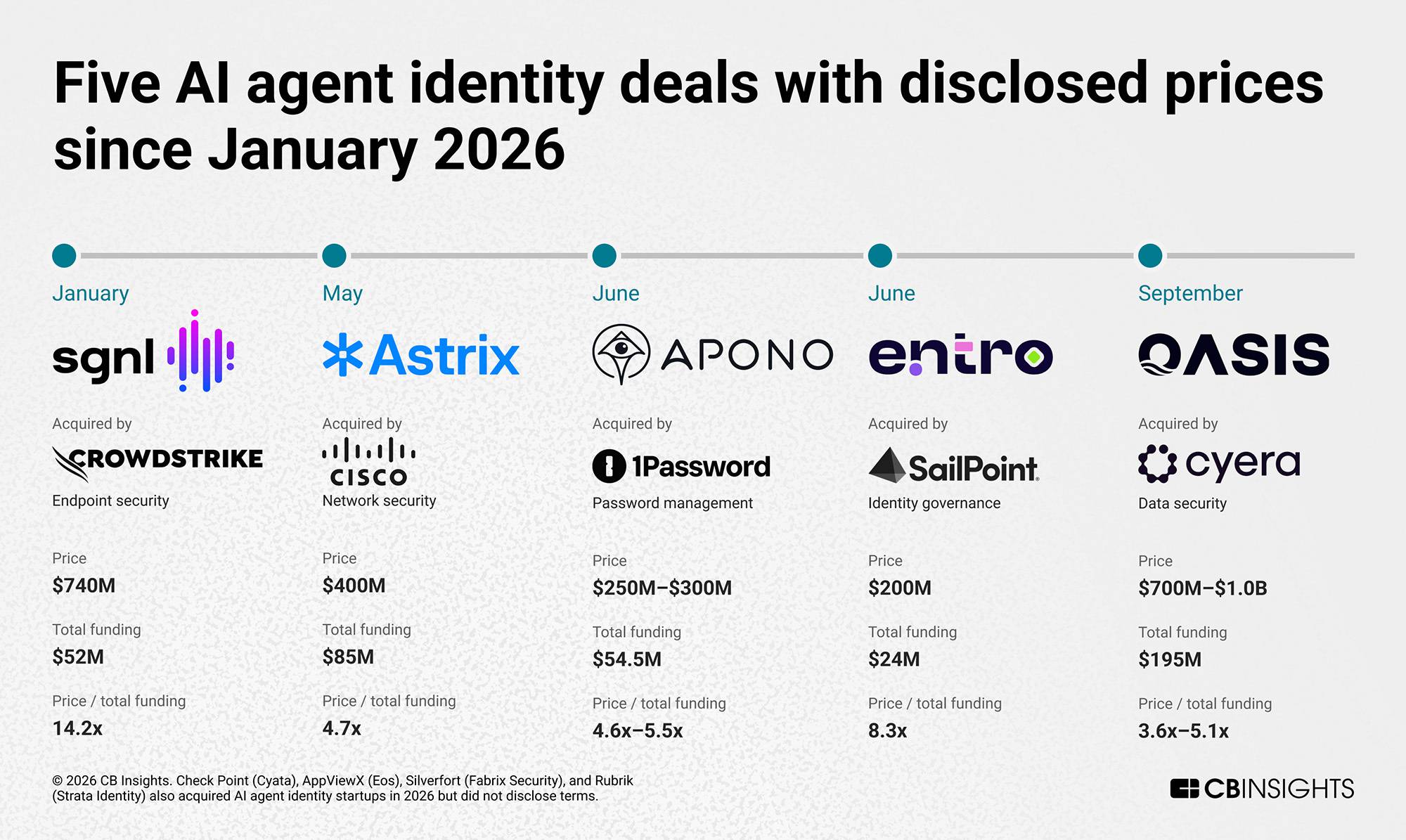
The capital being deployed for these acquisitions suggests a high valuation premium. In the five deals where transaction prices were disclosed, buyers paid significantly higher sums compared to the limited revenue generated by the targets. SailPoint’s $200 million acquisition of Entro, for example, added less than $3 million in annual recurring revenue (ARR) to its balance sheet, according to its CFO. Similarly, Cyera’s acquisition of Oasis, valued at up to $1 billion, involved a company estimated to be generating roughly $5 million in annual revenue.
These metrics indicate that buyers are prioritizing intellectual property, specialized engineering talent, and time-to-market over immediate financial returns. An analysis of the acquisition landscape shows that buyers are paying multiples ranging from 3.6x to 14.2x the target’s total historical funding, with a median multiple of approximately 5x. For incumbents, this is the price of admission to the AI security ecosystem.
Chronology of a Changing Landscape
The consolidation began in earnest in early 2026, with Check Point’s acquisition of Cyata in February signaling the start of a broader trend. Throughout the spring and summer, the market saw a flurry of activity, including the integration of specialized identity firms like SGNL and Apono into the platforms of larger players.
The strategy behind these acquisitions is becoming increasingly clear: vendors are looking to bridge the gap between human identity management and machine identity management. By acquiring firms like Astrix and Entro, security giants are gaining the ability to map the "lifecycle" of an agent—from its creation and authentication to its eventual decommissioning.
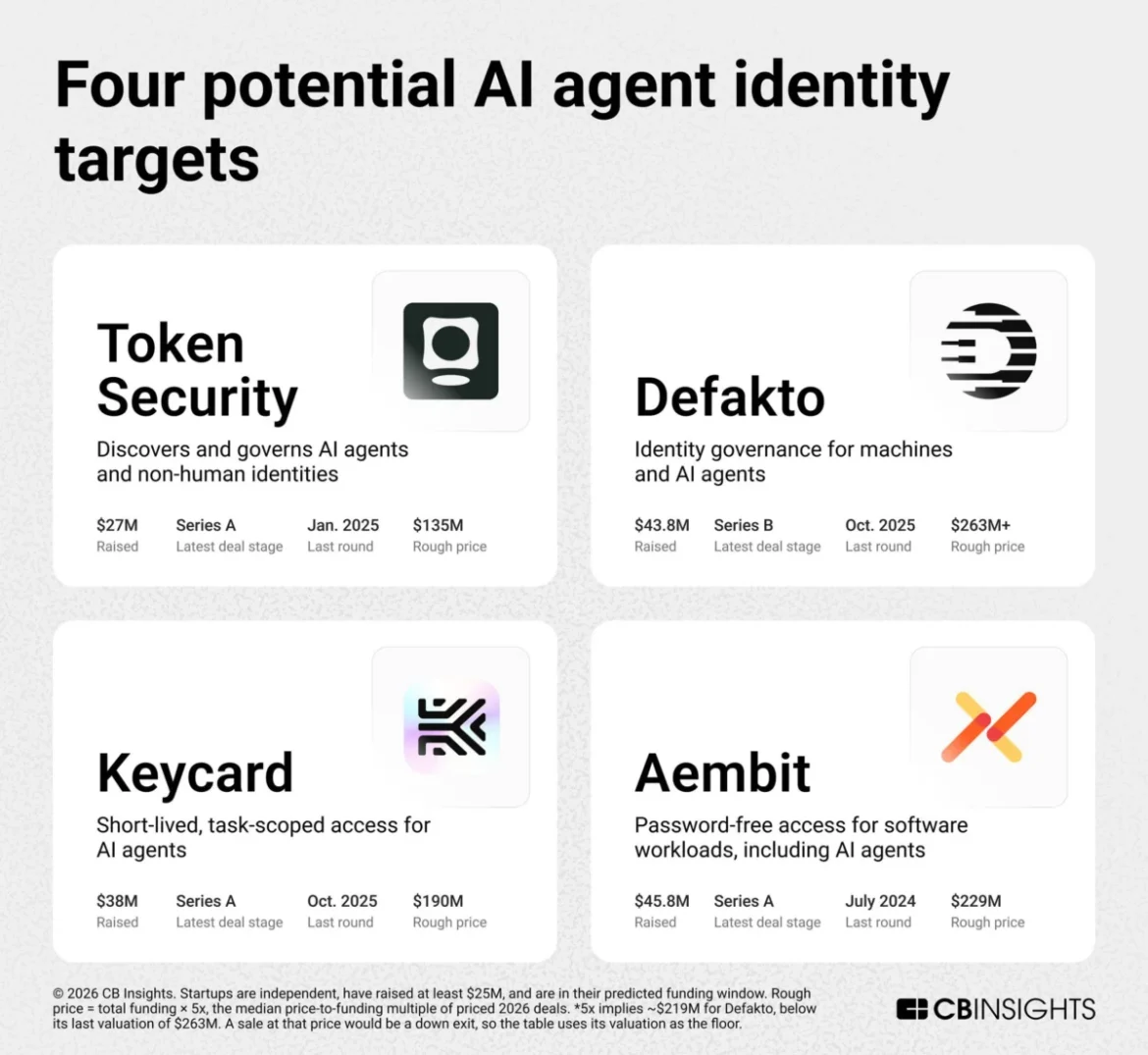
Looking ahead, the market is monitoring four specific independent startups that remain prime targets for acquisition: Token, Defakto, Aembit, and Keycard. These companies have each raised at least $25 million and are approaching critical funding or product-development milestones. Token is particularly notable for its focus on agent discovery, a niche that has been thinned out by the acquisition of other leaders like Oasis and Entro. Defakto, which boasts a previous valuation of $263 million, stands out as a more expensive potential target, while Aembit and Keycard are gaining traction for their sophisticated approaches to just-in-time, task-scoped access credentials.
Implications for Enterprise Security
The broader implication of this trend is the professionalization of AI agent management. As enterprises move past the experimental phase of AI adoption, they are realizing that the current "wild west" of agent usage is untenable. Chief Information Security Officers (CISOs) are under increasing pressure to demonstrate that they have full visibility into the AI ecosystem, including the agents they didn’t even know were running.
However, the rapid pace of acquisition poses a risk of market fragmentation. While consolidation provides a "one-stop-shop" for enterprise buyers, it also limits the number of best-of-breed, specialized tools available. Furthermore, as large platforms like CrowdStrike and Okta continue to build out their internal capabilities—often supported by their own venture funds—the barrier to entry for new startups continues to rise. CrowdStrike, for example, has utilized its Falcon Fund to build an ecosystem of potential partners and future acquisition targets, while simultaneously purchasing adjacent technologies like Fiddler and Dreadnode to monitor and test the performance of AI agents.
The Role of Identity Governance Firms
The role of established identity providers like Silverfort and Saviynt cannot be ignored. These firms are not just watching the market; they are active participants. Saviynt, bolstered by a massive $955 million capital infusion since December 2025, has the liquidity to make further acquisitions to bolster its non-human identity portfolio. Silverfort’s earlier acquisition of Fabrix Security demonstrated that even mid-market players are looking to solidify their presence in the machine-identity space.
For enterprises, the takeaway is clear: the focus of identity management is shifting from human users to autonomous agents. Organizations must now adopt a "zero-trust" framework for software workloads, ensuring that every agent has the least amount of privilege necessary to perform its task, and that those privileges are automatically revoked when the task is complete.
Conclusion: A Future of Integrated Security
The frantic pace of acquisition in 2026 highlights a fundamental shift in how the industry views artificial intelligence. AI is no longer a peripheral technology; it is a central component of the enterprise IT stack, and it requires a dedicated, robust security infrastructure. As the remaining independent startups are eventually absorbed into the larger portfolios of firms like CrowdStrike or SailPoint, the focus will shift from acquisition to integration.
The winners in this market will be the vendors that can offer a unified view of both human and non-human identities, providing real-time, automated governance that scales alongside the exponential growth of AI agent deployments. While the valuations currently being paid might appear disconnected from short-term revenue, they reflect a long-term bet on the critical necessity of securing the autonomous workforce of the future. As we move into 2027, the industry can expect to see further consolidation, potentially moving into deeper technical domains such as AI runtime protection and automated agent-auditing tools. For now, the scramble for dominance in AI agent identity remains one of the most dynamic and high-stakes sectors in the global cybersecurity market.
