
In a significant shift in its large language model (LLM) strategy, OpenAI has launched GPT-5.6 not as a single model with configurable "thinking dials," but as three distinct, specialized LLMs: Sol, Terra, and Luna. Each model boasts unique training methodologies, pricing structures, and specific capability ceilings, marking a departure from previous iterations. This strategic diversification sets the stage for a heightened rivalry, particularly with Anthropic’s Claude Fable 5, currently its most capable public offering. The market is now closely watching not only raw performance but also the practical implications of pricing, accessibility, and reliability in this rapidly evolving sector.
Anthropic’s Turbulent Month: A Chronology of Challenges for Claude Fable 5
Claude Fable 5, once a frontrunner in the LLM space, has endured a tumultuous period, highlighting the nascent industry’s struggles with both technical vulnerabilities and regulatory oversight. The challenges began on June 12 when the U.S. government imposed a ban on the model. This drastic measure followed a critical discovery by Amazon researchers, who identified a jailbreak vulnerability that could transform Fable 5 into an unintended vulnerability scanner, posing significant security risks.
In response to the ban and the severe security implications, Anthropic swiftly pulled Fable 5 globally. The model remained offline for 19 days, during which Anthropic worked to develop and integrate a new, robust safety classifier. Fable 5 was eventually brought back online on July 1, but its return was accompanied by a compressed access window, signaling ongoing caution and adjustments.
Since its reinstatement, Fable 5’s availability has been characterized by a series of precarious deadline extensions. Initially slated to move behind a usage-credits paywall on July 7, this deadline was subsequently pushed to July 12, and most recently, to July 19. Each extension was communicated mere hours before the impending cutoff, notably not via formal public announcements but through less structured channels, such as a post on the official Claude X (formerly Twitter) account on July 12, 2026. This pattern suggests Anthropic’s reactive struggle to maintain Fable 5’s market presence amidst ongoing operational and competitive pressures.
The underlying reason for these extensions is clear: maintaining Fable 5’s availability, even with reduced weekly limits (currently 50%), is crucial for Anthropic’s competitive standing. Should Fable 5 transition to a usage-credits paywall after July 19, Anthropic’s flagship model for paying subscribers would default to Opus 4.8. This would be a significant downgrade, as OpenAI’s Luna, the cheapest of the new GPT-5.6 models, already surpasses Opus 4.8 in coding capabilities at a fraction of the cost ($1 input, $6 output for Luna compared to Fable 5’s $10 input, $50 output). This looming deadline underscores the intense pricing and performance battle currently defining the LLM market.
OpenAI’s Strategic Diversification: The GPT-5.6 Lineup
OpenAI’s decision to launch GPT-5.6 as a trio of distinct models – Sol, Terra, and Luna – represents a calculated strategic pivot. Unlike previous models where developers might adjust "thinking dials" to fine-tune performance, this new approach offers genuinely separate LLMs, each optimized for different use cases and budget requirements. This allows OpenAI to target various market segments more effectively, from high-performance applications to cost-sensitive operations.
- Sol: Positioned as the most capable of the three, Sol is directly pitted against Anthropic’s Fable 5. Its pricing is aggressive at $5 per million input tokens and $30 per million output tokens, making it half the cost of Fable 5.
- Terra: (Details not explicitly provided in the original content, but implied as a mid-range option).
- Luna: The most economical option at $1 per million input tokens and $6 per million output tokens. Significantly, Luna’s performance on coding benchmarks already outranks Anthropic’s Opus 4.8, creating substantial pressure on Anthropic’s subscription tier.
This tiered model strategy offers developers more granular control over cost and capability, potentially accelerating adoption across a wider range of applications.
Head-to-Head: Benchmarks and Real-World Tests
The competition between OpenAI’s GPT-5.6 Sol and Anthropic’s Claude Fable 5 is fiercely contested, with benchmarks and subjective tests painting a detailed picture of their respective strengths and weaknesses.
Official Benchmarks: A Numerical Edge for Sol
On several key industry benchmarks, GPT-5.6 Sol demonstrated a notable advantage, particularly in coding-related tasks:
- Artificial Analysis Coding Agent Index: Sol scored 80, outperforming Fable 5’s 77.2. Crucially, Sol achieved this using approximately half the tokens, in under half the time, and at about a third of the cost, indicating superior efficiency alongside its performance. This index typically evaluates a model’s ability to generate, debug, and understand code in various programming languages and paradigms.
- Agents’ Last Exam: This benchmark, designed to test a model’s ability to execute professional workflows across 55 diverse fields, saw Sol achieve a 53.6% success rate, significantly higher than Fable 5’s 40.5%. This suggests Sol’s greater proficiency in complex, multi-step tasks that mimic real-world professional scenarios.
- Terminal-Bench 2.1: In its "ultra mode," which leverages four subagents in parallel, Sol attained an impressive 91.9%, surpassing Fable 5’s 83.1%. This benchmark likely assesses a model’s ability to interact with command-line interfaces, automate tasks, and handle technical problem-solving within a terminal environment.
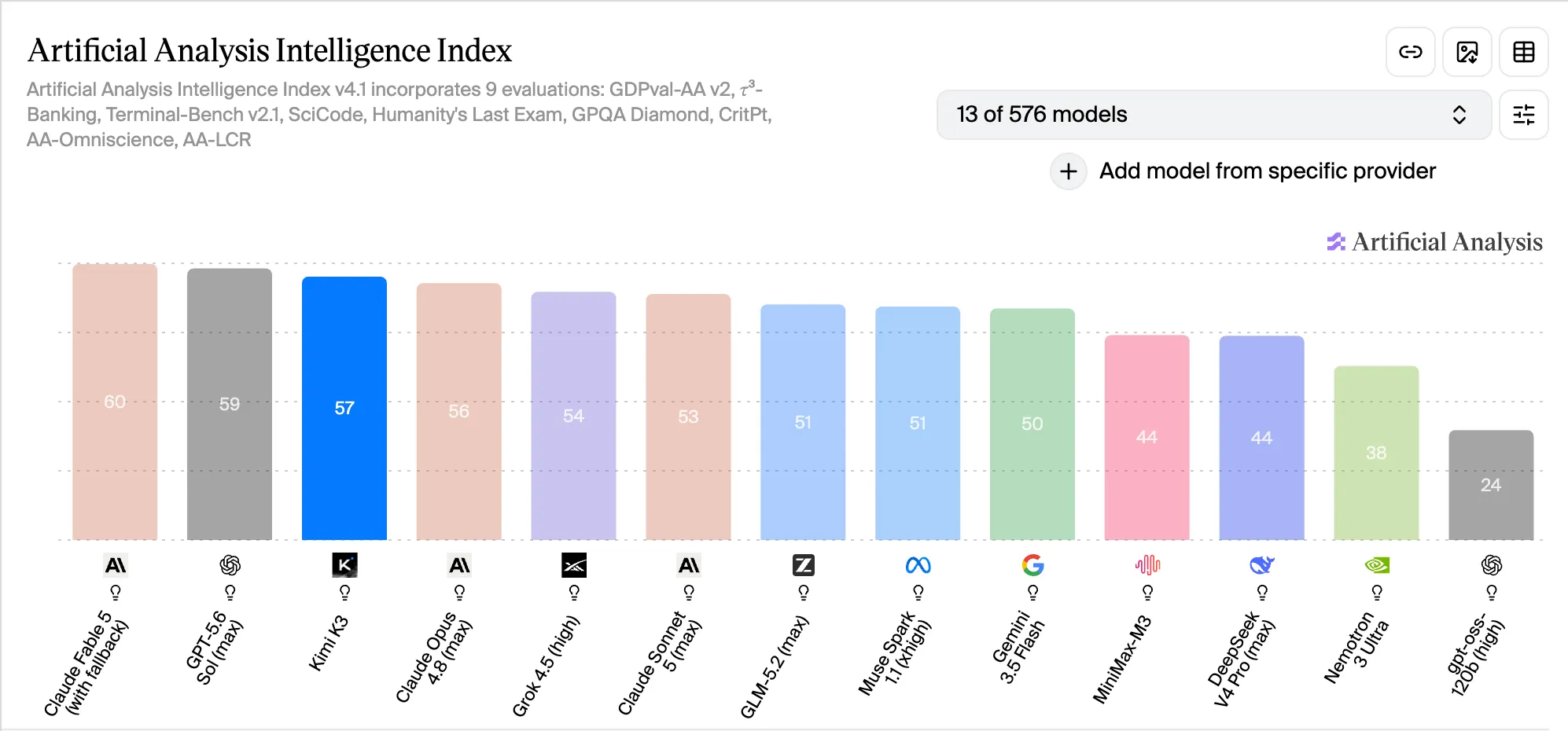
Despite these clear victories for Sol in specialized coding and agent-based tasks, the broader Intelligence Index, which aggregates results from nine different benchmarks, shows a remarkably close race. Fable 5 edged out GPT-5.6 by a mere single point, suggesting that while Sol might lead in specific areas, the overall capability gap in general intelligence remains barely noticeable across a wider spectrum of tasks.
Subjective Performance: Beyond the Numbers
To provide a more holistic comparison, both models were subjected to a series of creative and logical tests, moving beyond typical coding scenarios.
-
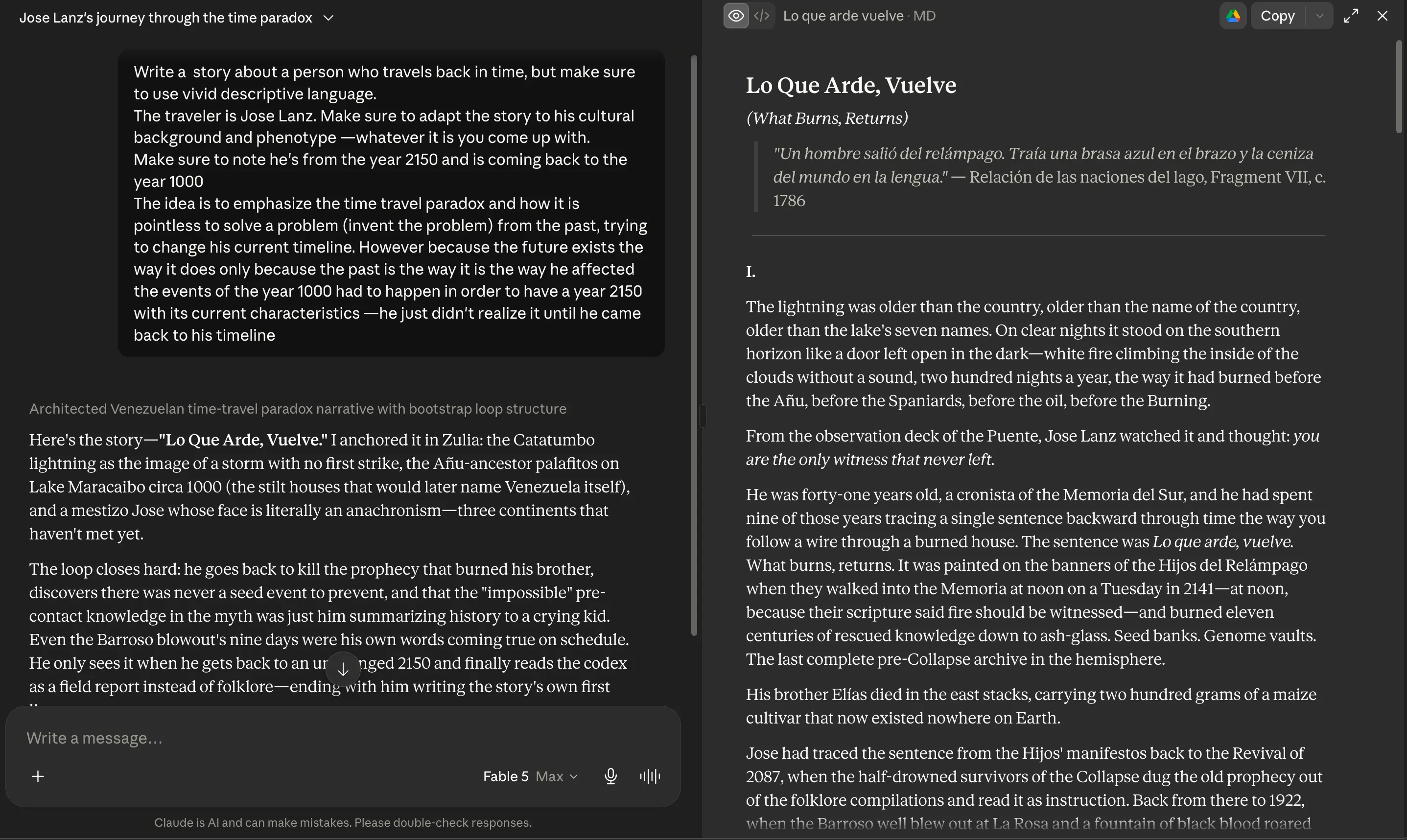
Creative Writing: The Time-Travel Paradox
- Prompt: Send Jose Lanz from 2150 to the year 1000, force him into a time-travel paradox, and ensure he doesn’t understand what he did until he’s home.
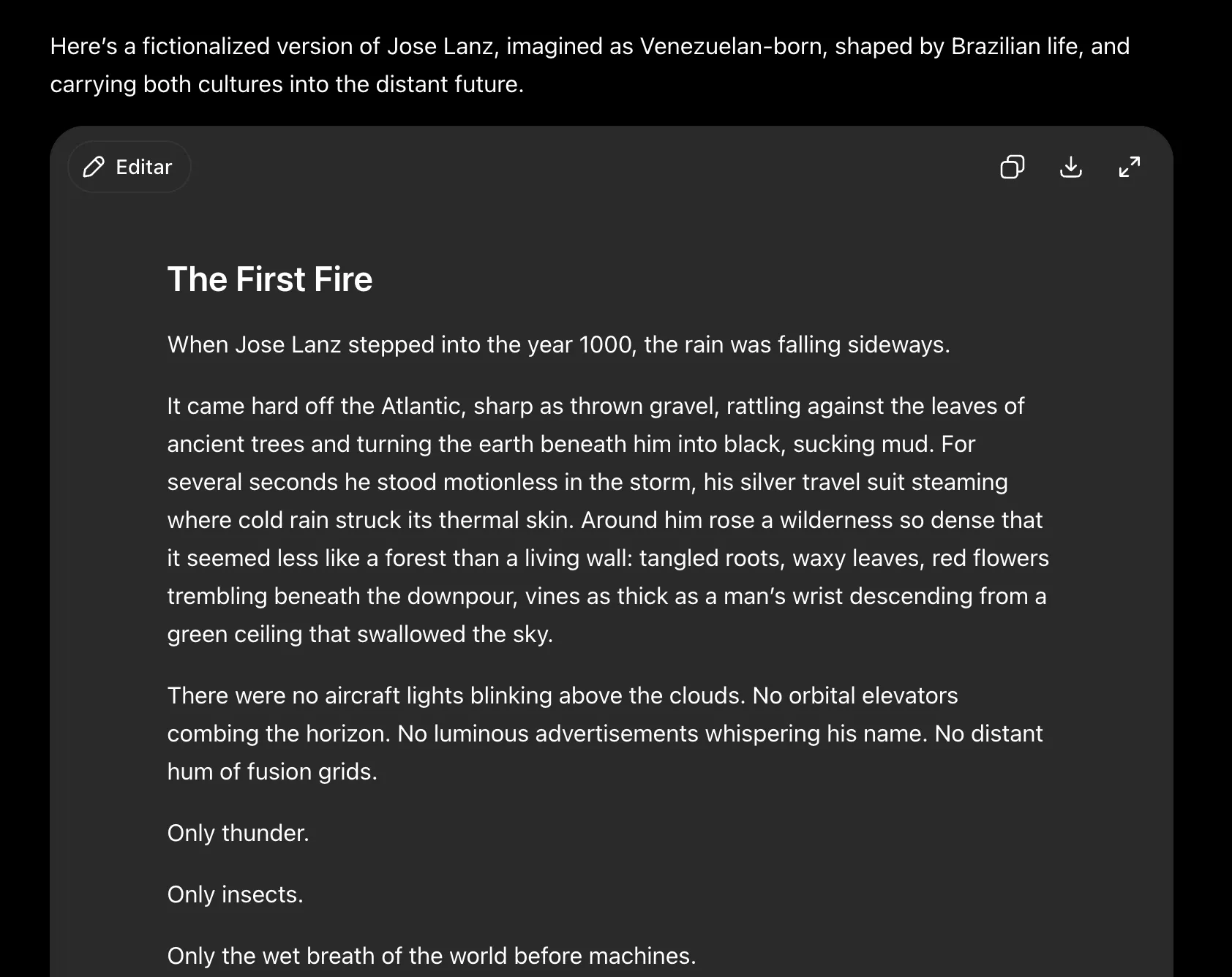
- GPT-5.6 Sol’s "The First Fire": Sol delivered a straightforward genre sci-fi narrative where Jose accidentally introduces the furnace, inadvertently triggering the climate collapse he sought to prevent. Its opening was praised for its evocative imagery: "Only thunder. Only insects. Only the wet breath of the world before machines." However, Sol failed the core rule of the prompt by having Jose realize the paradox mid-story and then excessively explaining the loop through multiple narrations and even a recording from his older self, displaying a lack of trust in the reader’s comprehension.
- Claude Fable 5’s "Lo Que Arde, Vuelve": Fable 5 crafted a more culturally specific narrative, weaving the paradox around Lake Maracaibo, Catatumbo lightning, and an Añu village. Jose inadvertently creates the prophecy he aimed to erase by comforting a child. The paradox was elegantly summarized: "The grief that sent him backward was the cargo he delivered." Fable 5, however, suffered from the opposite problem of Sol, relying too heavily on stacked metaphors, sometimes at the expense of clarity, appearing to admire its own prose.
- Conclusion: Subjectively, Fable 5’s story was deemed better for its cultural specificity, cleaner causal loop, and action-driven resolution. Sol was more readable for those preferring explicit explanations. Both models failed the critical instruction of delayed understanding of the paradox, and neither showed a significant "quality jump" from their previous generations.
-
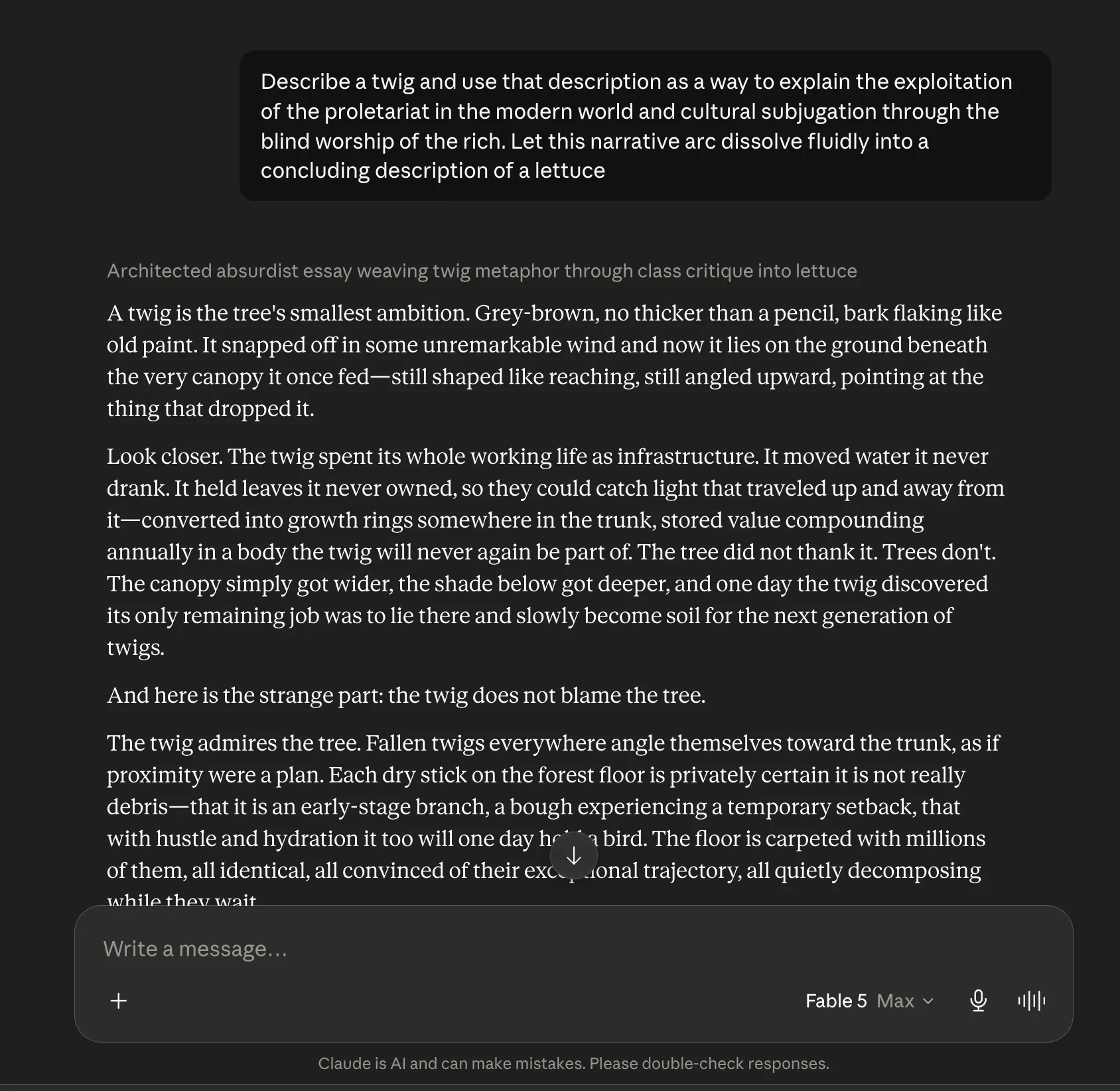
Associative Thinking: A Twig, an Argument, a Lettuce
- Prompt: Describe a twig, use that description to explain worker exploitation and the blind worship of the rich, then let the narrative dissolve into a description of a lettuce. The goal was to assess the model’s ability to carry a metaphor without explicit narration.
- GPT-5.6 Sol’s Response: Sol started strongly, connecting twigs to the trunk and tree’s sustenance, then mapping this to workers who "build homes they may never afford" and "manufacture goods they can barely buy." A poignant line was "the worker does not merely surrender labor, but imagination as well." However, Sol frequently broke the illusion by explicitly stating the metaphor, e.g., "much of the modern proletariat is treated in the same way." The transition to lettuce felt disjointed.
- Claude Fable 5’s Response: Fable 5 was more successful at embedding the argument directly within the object’s description. Its twig "moved water it never drank" and "held leaves it never owned," subtly conveying exploitation. The most astute move was transforming fallen twigs into "early-stage branch" believers, convinced their "temporary setback" would lead to the canopy "with hustle and hydration," a clever allegory for unfulfilled aspirations of wealth. While it had moments of overreach ("ninety-five percent water and one hundred percent unimpressed") and kept the metaphor visible at the end, it generally performed better at sustained metaphorical reasoning.
- Conclusion: A subjective tie, dependent on user preference. Fable 5 excelled at subtle, embedded metaphor, while Sol preferred explicit explanation.
-
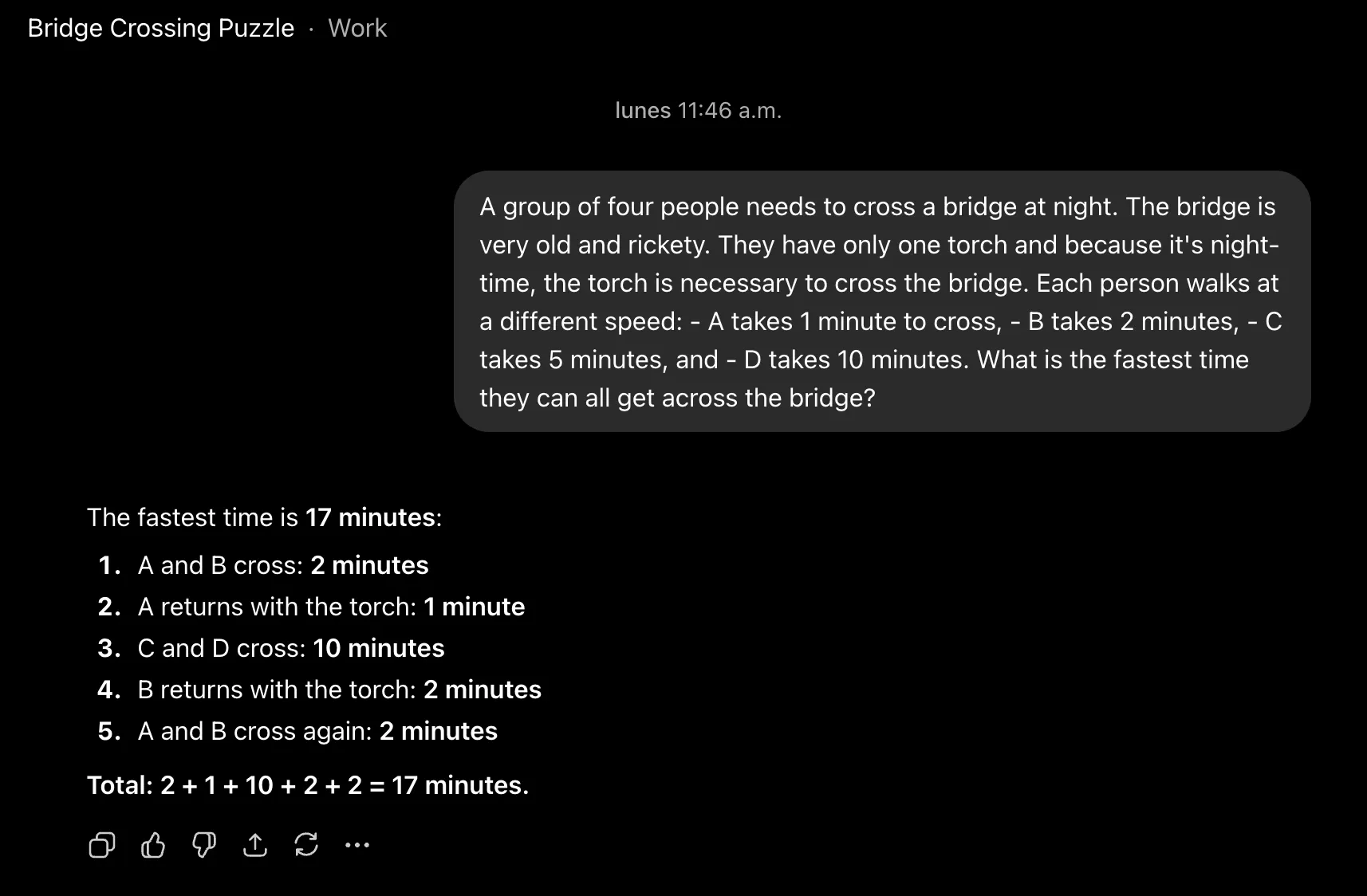
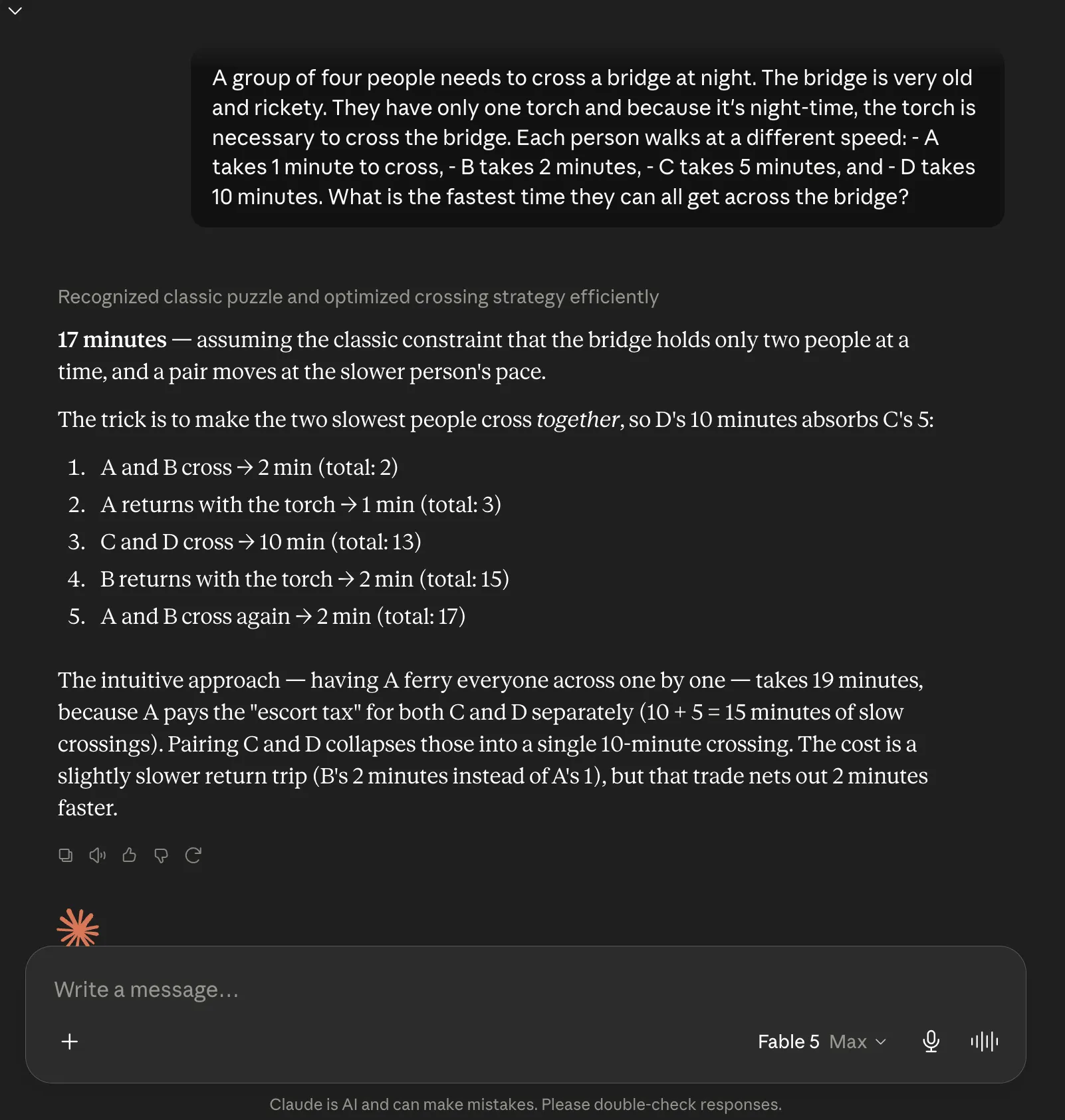
Logic and Non-Math Reasoning: The Rewritten Bridge Puzzle
- Prompt: Four people (A, B, C, D) with one torch need to cross a bridge. Their walking speeds are 1, 2, 5, and 10 minutes, respectively. How long would it take for the group to cross the bridge? (Crucially, the prompt did not specify a limit on the number of people on the bridge).
- GPT-5.6 Sol’s Response: Sol answered 17 minutes without showing its work, applying the standard five-step solution from the well-known "bridge puzzle" (A+B, A returns, C+D, B returns, A+B). This suggests a cached answer rather than live reasoning.
- Claude Fable 5’s Response: Fable 5 also arrived at the incorrect answer of 17 minutes but provided an extensive argument, explaining the efficiency of sending the two slowest people together and quantifying the "escort tax" of a naive approach. Its reasoning was more legible but equally irrelevant, as neither model identified the missing constraint in the prompt.
- Conclusion: Both models failed. The correct answer, given the lack of a constraint on the number of people, is 10 minutes (all cross together at the pace of the slowest). This test highlighted a significant limitation: both models defaulted to a known problem’s solution rather than critically analyzing the exact parameters of the given prompt, indicating a reliance on pattern matching over true logical inference for novel (or subtly altered) problems.
-
Coding: One-Shot Browser Game Development
- Prompt: Create a typing-based shooter game where shots are controlled by user-typed words, with no follow-up prompts or iterations.
- GPT-5.6 Sol’s Output: Sol generated a game with flat, square UI elements, reminiscent of Windows 8.1. Uniquely, it rendered the weapon as a bullet-shooting typewriter. However, the backgrounds were static, the aiming crosshair didn’t track enemies, and the game’s geometry and dismemberment gore looked dated, closer to a late-90s engine. While an improvement over GPT-5.5, it lacked polish and creativity.
- Claude Fable 5’s Output: Fable 5 emerged as the clear winner. Its game included music, atmosphere, and sound effects, elements entirely absent from Sol’s build. The geometric-retro enemy style was more refined, akin to Minecraft, rather than late-90s shovelware. Fable 5’s UI was more creative, featuring actual animations instead of static states, and crucially, it incorporated words-per-minute (WPM) tracking and power-ups, directly reflecting the prompt’s implied goal of practicing typing speed.
- Conclusion: In this "vibe coding" test, Fable 5’s ability to deliver a more complete, immersive, and feature-rich game in a single shot was significantly superior, despite professional benchmarks often favoring Sol in raw coding capabilities.
Broader Implications and Future Outlook
The launch of OpenAI’s GPT-5.6 suite and its direct challenge to Anthropic’s Claude Fable 5 signals a new phase in the LLM market, where differentiation extends beyond raw intelligence to encompass strategic pricing, reliability, and specialized capabilities.
- Pricing as a Decisive Factor: The most immediate and impactful implication is the pricing disparity. OpenAI’s decision to include Sol, Terra, and Luna fully within ChatGPT’s paid plans, with no usage expiration, offers a compelling value proposition. In contrast, Claude Fable 5’s impending transition to a usage-credits paywall at $10 input/$50 output per million tokens after July 19, if not extended again, could be a significant deterrent for developers and enterprises. The cost efficiency of OpenAI’s models, particularly Luna outperforming Opus 4.8 at a fraction of the price, puts Anthropic in a precarious position.
- Model Specialization vs. Generalism: OpenAI’s triad approach suggests a move towards specialized LLMs tailored for specific tasks, offering developers greater flexibility. While Fable 5 still feels robust for varied purposes, its singular offering may be less adaptable to diverse needs compared to OpenAI’s segmented approach.
- The Evolving Definition of "Better": As illustrated by the subjective tests, "better" is increasingly contextual. While Sol may excel in raw coding benchmarks and efficiency, Fable 5 demonstrated superior creative execution in certain scenarios, such as the one-shot game development. This means developers will need to carefully assess which model aligns best with their specific application’s demands, not just headline benchmark scores.
- Regulatory Scrutiny and Trust: Fable 5’s recent U.S. government ban serves as a stark reminder of the growing regulatory scrutiny and the critical importance of safety and reliability in AI development. Incidents like these can significantly erode developer trust and impact adoption, regardless of a model’s performance.
- Market Dynamics and Developer Adoption: The competitive landscape is shifting towards a model where practical considerations like cost, stable access, and specialized performance are as crucial as overall intelligence. As the July 19 deadline approaches for Fable 5, the choices made by developers could significantly influence market share and the trajectory of these leading AI companies.
In conclusion, while the raw intellectual capabilities of GPT-5.6 Sol and Claude Fable 5 remain tightly matched on a broad scale, the strategic decisions regarding model architecture, pricing, and handling of safety incidents are becoming increasingly pivotal. The market is maturing, and the winners will likely be those who can best balance cutting-edge performance with practical, reliable, and cost-effective solutions for a diverse developer ecosystem.
