
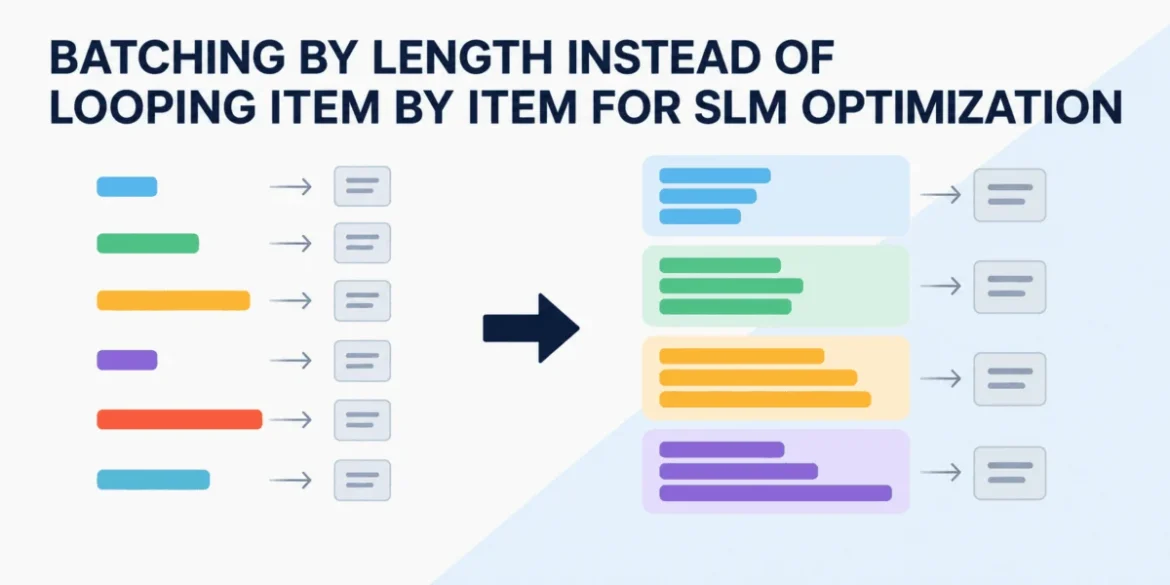
Processing individual data points through Small Language Models (SLMs) in a sequential loop is one of the most significant performance bottlenecks in modern machine learning pipelines. As organizations increasingly rely on models like Qwen2.5-0.5B-Instruct for narrow, high-frequency automation tasks—such as automated customer support ticket classification—the architectural inefficiency of "item-by-item" processing has become a primary target for optimization. By transitioning from sequential processing to length-bucketed batching, developers can achieve substantial throughput improvements, often without requiring additional hardware or compromising model accuracy.
The Architectural Inefficiency of Sequential Processing
In a standard production environment, the "one-at-a-time" inference pattern treats the model as a black box, feeding it a single input and waiting for the corresponding output before moving to the next item. On modern hardware, including CPUs and mobile-class architectures like the M2 chip, this approach leaves the processor largely idle.
When a model processes a single sequence, it is typically memory-bandwidth bound rather than compute-bound. The hardware must stream the entirety of the model’s weights from memory to the processor to perform the necessary arithmetic for a single token, only to repeat the process for the next input. Because the arithmetic units are underutilized, the system spends more time waiting for memory transfers than performing actual calculations.
Batching is the traditional solution to this problem, as it allows the model to process multiple inputs simultaneously, amortizing the cost of reading weights across several sequences. However, naive batching introduces a secondary problem: "padding waste." Because matrix operations require consistent input dimensions, all sequences within a batch must be padded to match the length of the longest sequence in that set. In datasets with high variance in token length—a common trait in real-world support tickets—padding to the global maximum can result in a significant portion of the computation being spent on null values.
A Chronological Shift in Optimization Strategies
This shift toward length-bucketed batching represents the third pillar in a systematic approach to SLM optimization. The trajectory of this evolution began with the optimization of the output space, where developers restricted the model’s generation scope to known labels, thereby ensuring each request requires only a single forward pass.
Following this, the focus shifted to the implementation of Key-Value (KV) caching. By reusing prompt prefixes—such as system instructions or common email headers—developers avoided redundant computation. By caching the KV pairs for these static segments, the model only needs to process the unique portion of the new input, drastically reducing the latency of each individual request.
The final phase, length-bucketed batching, addresses the scheduling of these requests. By sorting inputs by their token length prior to forming batches, developers ensure that each batch contains items of similar size. Consequently, each batch only needs to pad to its own "local maximum," rather than the global maximum of the entire dataset. This strategy effectively minimizes wasted compute cycles while maintaining the benefits of parallelized weight reading.
Data Analysis: The Performance Gap
Benchmarks conducted on the Qwen2.5-0.5B-Instruct model illustrate the efficiency gains inherent in this methodology. In a test environment using 600 simulated support tickets with varying lengths, the "one-at-a-time" baseline processed items at a rate of 4.2 items per second. The total execution time for this sequential approach reached approximately 144 seconds.
When the same dataset was processed using length-bucketed batching with a batch size of 32, the performance metrics improved significantly. The system achieved a throughput of 7.5 items per second, completing the entire set in 79.6 seconds. This represents a near two-fold increase in efficiency.
Crucially, the padding overhead—a metric of how much computational energy is wasted on non-informative tokens—was reduced to approximately 7.6%. Had the system used a global padding strategy, the padding overhead would have been 3.7 times higher than necessary. The empirical evidence confirms that sorting by length provides a quantifiable optimization that bridges the gap between hardware bandwidth constraints and computational utility.
Technical Implications and Implementation Challenges
Implementing length-bucketed batching is not without technical nuance. For developers integrating this with existing optimizations like KV caching, careful management of tensor dimensions is required. Because most KV caches are configured for a batch size of one, scaling them to support a batch size of 32 requires expanding the key and value tensors to match the batch dimension, followed by precise cropping to avoid data contamination.
Furthermore, validation remains a cornerstone of the implementation process. Developers must ensure that the batched output remains identical to the sequential, unpadded baseline. If the inclusion of padding tokens alters the model’s logits or classification outcomes, the optimization must be considered a failure. In practice, this is verified by running a subset of the data through both the sequential and batched pipelines and ensuring a 100% agreement rate on predicted labels.
Broader Impact on Enterprise AI
The broader implications for enterprise AI are significant. As organizations look to deploy Small Language Models at the edge—where memory and compute power are strictly limited—the ability to optimize throughput without specialized hardware is paramount. By leveraging these techniques, companies can maintain high-performance AI services on standard infrastructure, reducing both cloud compute costs and latency for end-users.
Industry experts observe that this move toward "narrow automation" signals a maturing phase in the AI lifecycle. Rather than relying solely on the scaling laws associated with massive Large Language Models (LLMs), the focus has shifted toward refining the efficiency of smaller, more specialized models. By optimizing the data pipeline, developers can extract greater performance from existing models, making SLMs a more viable alternative for high-volume, repetitive tasks.
Conclusion: The Future of Efficient Inference
The journey from individual forward passes to sorted, batched inference reflects the broader industry trend toward algorithmic efficiency. As the demand for rapid, accurate, and cost-effective AI classification grows, the reliance on inefficient, unoptimized code will likely diminish.
The three-part series on SLM optimization—comprising output space constraints, prefix caching, and length-bucketed batching—demonstrates that substantial performance gains are not necessarily found in the models themselves, but in the engineering practices surrounding their execution. When combined, these techniques allow for a streamlined pipeline that maximizes hardware utility, minimizes latency, and ensures that computational resources are focused on the task at hand rather than the overhead of padding. For developers and data scientists, the message is clear: in the era of constrained resources, how you process the data is just as important as the model you choose to process it with. By adopting these methodical, verified optimization strategies, organizations can achieve a sustainable and scalable path to intelligent automation.
