
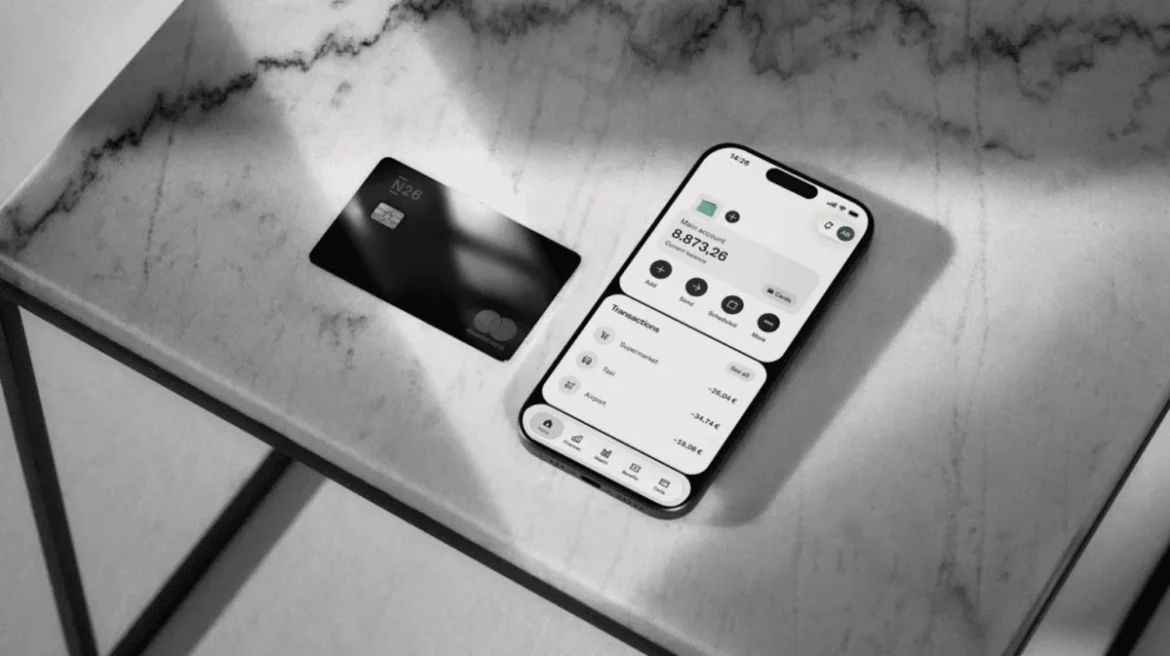
Digital banking giant N26 has officially entered the ultra-premium financial services market with the launch of Aura, a high-end account tier positioned as the company’s most exclusive offering to date. Unveiled in Germany for both personal and business customers, the €55-per-month membership represents a dramatic expansion of the Berlin-based fintech’s product portfolio. The introduction of Aura moves N26 further away from its origins as a straightforward mobile checking provider and deeper into the lucrative territory of lifestyle-integrated financial platforms.
Until the debut of Aura, N26 structured its personal account offerings across four distinct tiers: Standard, Smart, Go, and Metal. While the Metal account previously served as the pinnacle of the bank’s membership model, Aura more than triples that price point while introducing a significantly expanded array of lifestyle, investment, and travel benefits. The launch signals a calculated effort by N26 management to capture high-net-worth individuals, frequent travelers, and digital-native consumers who increasingly view financial applications as all-encompassing lifestyle hubs.
A Strategic Evolution Toward the Super-App Model
The release of Aura comes at a pivotal time for the European digital banking sector. As competition among neobanks intensifies, institutions are searching for sustainable revenue streams beyond traditional interchange fees and basic subscription models. By bundling high-value perks—such as unlimited airport lounge access, up to 15 fee-free trades per month, and complimentary subscriptions to services like Amazon Prime, Google AI Pro, and NordVPN—N26 is directly challenging established rivals.
Chief Executive Officer Mike Dargan emphasized that the new account reflects the changing expectations of modern consumers. “The launch of N26 Aura marks a major milestone in our broader strategy to further evolve N26 from a bank into a fully integrated financial platform,” Dargan said. “How our customers live, work, and express themselves is fluid, and Aura is designed to fit naturally into that modern rhythm—combining our highest tier of banking with an elevated, seamless banking experience.”
Priced at €55 monthly, Aura undercuts its primary direct competitor, Revolut’s top-tier Ultra membership, which costs €65 per month for new German subscribers. Beyond digital conveniences, N26 has outfitted Aura members with a physical status symbol: a ceramic mirror-finish payment card that replaces the brushed stainless-steel cards typical of lower premium tiers.
Market Dynamics and Competitive Positioning
The decision by N26 to introduce a €55 monthly account highlights a broader industry trend where financial technology firms attempt to capture consumer wallet share by acting as curators of digital life. By bundling subscriptions that consumers often purchase independently—such as streaming, cloud storage, privacy tools, and retail perks—N26 is testing the limits of consumer willingness to pay for consolidated digital convenience.
This strategy is designed to achieve several corporate objectives:
- Enhanced Recurring Revenue: Subscription-based banking tiers provide predictable, high-margin cash flow that cushions institutions against macroeconomic fluctuations and fluctuating interest rate environments.
- Customer Retention: Consumers who tie multiple lifestyle subscriptions and investment portfolios to a single bank account face higher friction when considering a switch to a competitor.
- Margin Expansion: High-tier accounts attract affluent users who maintain higher average deposit balances and engage more frequently in cross-border transactions and investment activities.
Market analysts note that while the addressable market for a €55 monthly bank account is inherently niche, the reputational halo effect of an ultra-premium product can elevate the brand’s perception across all customer segments, including those on free or low-cost tiers.
Chronology and Corporate Background
Founded in Berlin in 2013 by Valentin Stalf and Maximilian Tayenthal, N26 officially launched its consumer banking service in 2015. The company quickly expanded across Europe, pioneering a sleek, smartphone-first approach to everyday banking that resonated with younger demographics.
Over the past decade, N26 has experienced rapid growth followed by strategic realignment:
- 2013–2015: Company establishment and commercial rollout of the digital banking platform in European markets.
- 2019–2021: Aggressive global expansion, culminating in a major funding round in 2021 that valued the private company at more than $9 billion, having raised over €1.8 billion in total venture backing.
- 2022: N26 makes the strategic decision to exit the United States market to concentrate its regulatory and capital resources on its core European footprint. During this period, the bank also addresses compliance and anti-money laundering mandates imposed by German regulators.
- 2025: A watershed year for the fintech, as N26 reports its first full fiscal year of profitability. The company generates €501.6 million in revenue and posts a net income of €1.6 million, validating its path toward long-term financial sustainability.
- Late 2026: The official rollout of N26 Aura in Germany, marking the bank’s formal entry into the ultra-premium lifestyle banking category.
Today, N26 serves more than 5.6 million revenue-relevant customers across 24 European markets. Having successfully moved past its hyper-growth, cash-burning phase into sustained profitability, the bank is methodically broadening its product ecosystem to include automated savings, equities and cryptocurrency trading, and specialized insurance products.
Scope of the German Rollout and Future Outlook
At its initial launch, N26 Aura is restricted to eligible personal and business clients residing in Germany. The company has not yet provided a definitive timeline for expanding the Aura tier to other major European markets such as France, Italy, or Spain, opting instead to measure adoption rates, customer acquisition costs, and usage patterns within its domestic home market.
The controlled rollout allows N26 to monitor the operational complexities associated with fulfilling third-party lifestyle subscriptions and managing higher-tier customer support channels. Because the product combines banking compliance with third-party software and travel perks, seamless API integrations and reliable vendor partnerships will be critical to maintaining customer satisfaction.
As digital banking matures across Europe, the success of N26 Aura will likely serve as a bellwether for the viability of high-fee lifestyle accounts. If German consumers embrace the amalgamation of wealth-building tools and consumer perks, other European neobanks may be forced to recalibrate their premium strategies. Conversely, a muted response could prompt fintech leadership to reassess whether consumers view banking apps and lifestyle aggregators as distinct categories that are best kept separate. For now, N26 is betting that modern professionals are ready to consolidate their financial and digital lives under a single, mirror-finish ceramic banner.
