
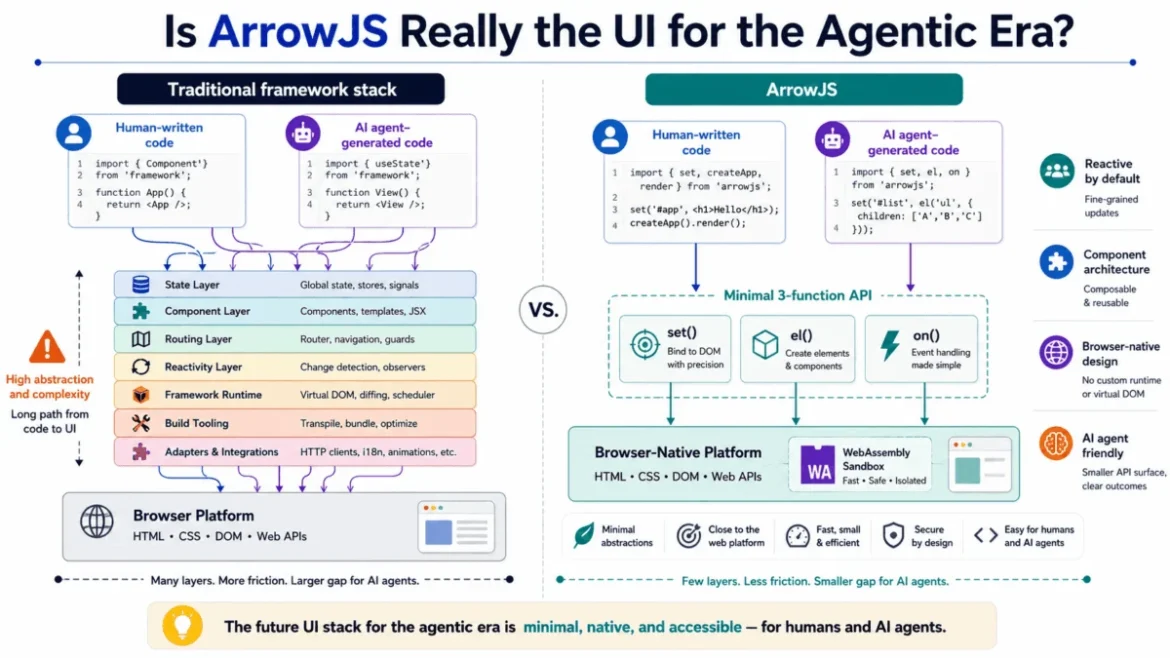
For the past decade, the JavaScript ecosystem has operated on a comfortable assumption: developers write the code, frameworks organize it, and browsers render it. React, Vue, Angular, and their ecosystems were all designed with a human at the keyboard. This paradigm, however, is undergoing a profound shift. The rapid maturation of AI coding agents such as Claude Code, GitHub Copilot, and Cursor has fundamentally altered the software development lifecycle. These agents now routinely generate significant portions of production-grade code, yet the frameworks they are tasked with using were never designed for non-human interaction.
The friction is becoming increasingly apparent. Modern frameworks often rely on complex abstractions, rigid hook-based rules, and proprietary compilation steps that frequently lead to hallucinated syntax or misapplied architectural patterns in AI-generated outputs. Enter ArrowJS, which achieved a stable 1.0 release in early 2026. Marketed as the first UI framework specifically engineered for the "agentic era," it represents a fundamental departure from the current status quo. By prioritizing simplicity and platform-native primitives, ArrowJS attempts to solve the reliability issues inherent in asking LLMs to navigate the Byzantine complexities of modern frontend stacks.
The Evolution of the Frontend Paradigm
To understand the necessity of ArrowJS, one must analyze the history of the web’s development tools. In the early 2010s, React introduced a virtual DOM and a component-based architecture that changed web development forever. However, the subsequent years saw an explosion of framework-specific requirements. React’s rules of hooks, for instance, dictate that state-management functions must be called in an exact, top-level order during every render cycle. While human developers learn these patterns through years of practice, LLMs—which function by predicting token sequences based on statistical likelihood—often struggle with the nuances of these constraints.
When an AI agent is tasked with building a React component, it must account for state, effects, prop drilling, and complex build configurations. If an agent lacks the "mental model" of these framework-specific constraints, it produces code that may look syntactically correct to the naked eye but fails to execute, causing memory leaks or state inconsistency. Vue.js and Svelte, while providing different abstractions, still require the agent to adhere to specific compiler directives. Each of these layers acts as a "translation" step between the agent’s intent and the browser’s reality, increasing the probability of error.
Chronology of the Agentic Shift
- 2013–2015: The rise of React and the standardization of component-based architectures.
- 2021: Early iterations of GitHub Copilot demonstrate the potential for AI-assisted coding, but reliance on human oversight remains absolute.
- 2023–2024: The "agentic" turn; tools like Cursor and Claude Code move beyond simple autocompletion, enabling agents to modify entire file systems and manage multi-step debugging tasks.
- Early 2026: ArrowJS reaches 1.0 maturity, specifically positioning its low-overhead design as a solution to the "agent-hostility" of legacy frameworks.
The ArrowJS Technical Philosophy
ArrowJS distinguishes itself through a "back to basics" approach that emphasizes the web platform’s native capabilities over heavy abstractions. The framework operates on three core principles:
- Elimination of the Build Step: ArrowJS utilizes tagged template literals—a standard JavaScript feature—to define UI components. By removing the need for JSX compilation or complex Webpack/Vite configurations, the framework drastically reduces the "surface area" of potential failure for an AI agent. There is no proprietary syntax to misinterpret; the code written is essentially the code that runs.
- Minimal API Surface: The entire framework is distilled into three functions:
reactive,html, andcomponent. This radical simplicity is not just for human readability; it is designed for LLM context windows. By limiting the documentation to a tiny fraction of a standard 200,000-token window, ArrowJS ensures that an agent can hold the entire framework’s documentation and source code in its active memory, leading to significantly higher code-generation accuracy. - Sandboxed Execution: Perhaps the most innovative feature is the inclusion of a WebAssembly-based sandbox. This allows agents to generate and inject UI components dynamically at runtime without the security risks associated with
eval()or the performance overhead of iframes. This capability is critical for "generative interfaces," where an application might need to render a custom data visualization or interactive form on the fly based on a user’s natural language prompt.
Comparative Analysis: Ecosystem vs. Capability
Despite its technical merits, ArrowJS faces a significant "network effect" hurdle. React remains the dominant force in the industry, supported by over 39% of web developers and bolstered by a decade of enterprise-grade libraries, design systems, and troubleshooting resources on platforms like Stack Overflow. For large organizations, the decision to adopt a framework is rarely based on technical purity alone; it is dictated by the availability of talent, the stability of the ecosystem, and long-term maintainability.
Furthermore, critics argue that the "agent-hostility" of current frameworks is a temporary issue. As AI models scale, their ability to reason about complex framework conventions is improving. Platforms such as v0.dev and Lovable have already demonstrated that with enough fine-tuning and specialized training data, agents can become highly proficient in React. In this view, the necessity for a "simple" framework may be a transitional requirement that will vanish as models grow more sophisticated.
Implications for Data Science and Machine Learning
For the data science community, the emergence of ArrowJS represents a specific, targeted opportunity. Data scientists are increasingly tasked with building "data products"—dashboards, LLM-powered interfaces, and automated reports—that require high levels of interactivity.
While tools like Streamlit and Gradio have successfully lowered the barrier to entry for Python-based web development, they often lack the granular control required for complex, adaptive UIs. If a data scientist is building a system where an AI agent needs to generate unique UI components based on real-time data analysis, the overhead of a full React stack may be prohibitive. ArrowJS provides a lightweight, performant alternative that integrates seamlessly into existing JavaScript environments, allowing for the deployment of truly "generative" interfaces.
Future Outlook and Industry Response
The industry response to ArrowJS has been cautiously optimistic. While few large-scale enterprises have migrated their core products to the framework, it has gained traction among indie developers and startups focused on AI-native applications.
"We are entering an era where software will increasingly be written by other software," says one industry observer. "The frameworks that succeed in the next five years will be those that prioritize the machine-to-machine interface as much as the human-to-machine interface."
Whether ArrowJS becomes a foundational standard or a specialized niche tool depends on the velocity of AI development. If coding agents continue to struggle with the "noise" of complex abstractions, the demand for "agent-first" tools will grow. If, however, general-purpose LLMs overcome these hurdles, the industry may find that the convenience of a massive ecosystem outweighs the benefits of a leaner framework.
Regardless of the outcome, ArrowJS has successfully identified a critical pain point in the modern development stack. It challenges the industry to reconsider the assumption that frameworks should be built solely for the comfort of the human developer. As the line between "coding" and "prompting" continues to blur, the tools that bridge that gap will likely define the next generation of web architecture. For professionals in the data science and machine learning fields, monitoring the adoption of such frameworks is essential for staying ahead of the shifting landscape of AI-powered application development.
