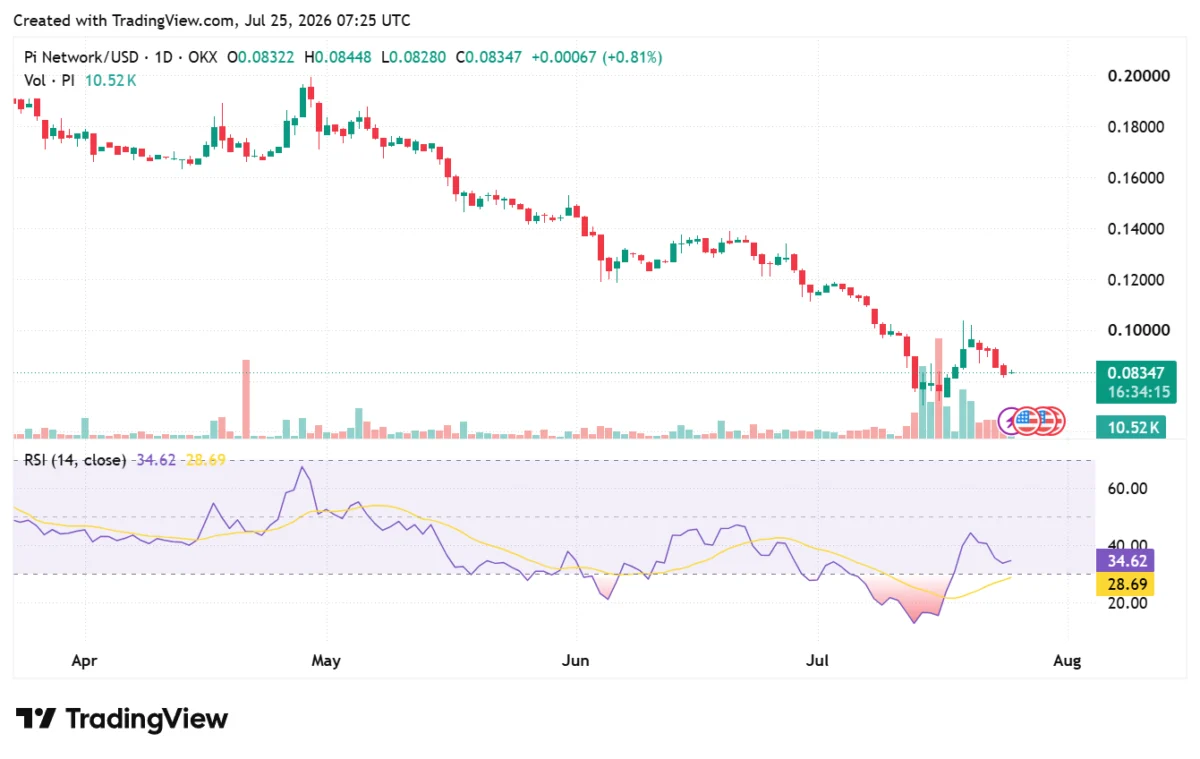
Pi Network, the blockchain project focused on mobile cryptocurrency mining, recently completed the distribution of its second Testnet token, SLICE, through the Pi Launchpad. This development occurred as the native Pi (PI) token experienced a modest upward movement of approximately 1.5%, reaching nearly $0.083, a notable divergence from the general trend of lower trading observed across most major cryptocurrencies during the same period. The completion of the SLICE distribution marks another iterative step in Pi Network’s ongoing development, aimed at refining its ecosystem and preparing for a more expansive future.
Background and Vision of Pi Network
Launched in 2019 by a team of Stanford PhDs, Pi Network has carved a unique niche in the cryptocurrency landscape by advocating for a mobile-first approach to digital currency accessibility. Its core premise revolves around enabling everyday users to "mine" cryptocurrency directly from their smartphones, without the heavy computational demands typically associated with traditional proof-of-work mining. This vision aims to democratize access to cryptocurrency, fostering a broad, inclusive user base often referred to as "Pioneers."
The project currently operates within an "Enclosed Mainnet" phase, a distinctive stage where the main blockchain is live but connectivity to external blockchains or traditional fiat gateways is restricted. This phase allows the Pi Core Team to rigorously test the network, iterate on its features, and allow Pioneers to use their mined PI for transactions within the Pi ecosystem, primarily through Pi-powered applications and peer-to-peer exchanges. Crucially, during this enclosed period, PI tokens are not officially listed on major cryptocurrency exchanges, and any reported price reflects speculative IOU (I Owe You) markets or unofficial derivatives, rather than a freely traded, liquid asset. This distinction is vital for understanding the context of PI’s price movements.
The Role of Pi Launchpad and SLICE Testnet Token
The Pi Launchpad serves as a crucial incubator within the Pi ecosystem, designed to facilitate the launch and distribution of decentralized applications (dApps) and tokens built on the Pi blockchain. Its primary function is to provide a testing ground for various tokenomic models and distribution mechanisms before potential deployment on the mainnet. The SLICE testnet token distribution is the second such exercise, building upon feedback gathered from the initial Launchpad trial.
The first phase of the Launchpad, which commenced around PiDay 2026 (March 14, 2026), saw significant engagement, attracting almost 480,000 users. This initial trial provided valuable data on user participation, token allocation preferences, and overall system robustness. Leveraging these insights, the Pi Core Team refined the process for the SLICE distribution, focusing on key improvements such as simplified participation steps, clearer commitment amounts, and a fair-access hold mechanism. The objective was to make the token allocation process more transparent and user-friendly, ensuring a smoother experience for Pioneers engaging with new tokens within the ecosystem.
The SLICE distribution, which ran from June 12 through June 28, 2026, allowed Pioneers to interact with a simulated token launch environment. Upon completion of the distribution on July 24, 2026, users gained the ability to review their individual allocations, observe simulated token prices, and explore the mechanics of liquidity pool access directly within the Pi Browser’s Launchpad app. A chart comparing SLICE with Test-Pi, the testnet version of the main PI token, was also made available. This feature allows Pioneers to understand how liquidity additions or removals can influence token prices, offering a practical education in market dynamics within a risk-free, testnet environment. The liquidity pool feature is particularly significant as it simulates one of the fundamental aspects of decentralized finance (DeFi), preparing users for potential future interactions with real-world liquidity provisions.
Market Performance and Technical Analysis of PI

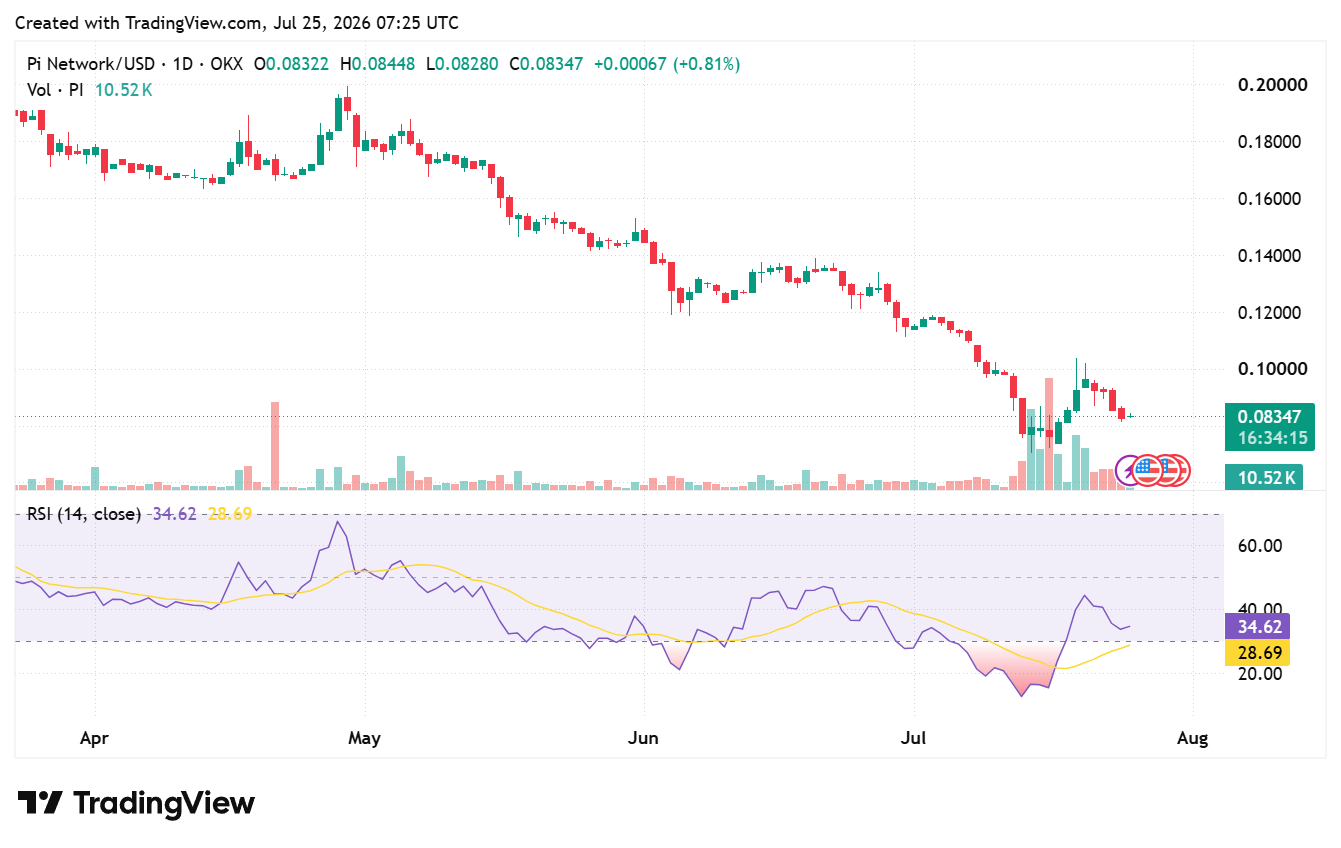
Despite the positive internal development news, the modest 1.5% price increase of PI to approximately $0.083 must be viewed within the broader context of its current market structure and the "Enclosed Mainnet" status. While it briefly bucked the trend of a wider cryptocurrency market downturn, the move did not fundamentally alter PI’s prevailing technical landscape.
PI has been trading near an important support area, having recently lost the $0.10 level. Earlier in July, the token touched a record low near $0.07, highlighting persistent downward pressure. An analysis of the four-hour chart reveals a clear pattern of lower highs and lower lows since late April, indicative of a bearish trend. Furthermore, PI remains significantly below its declining 200-period moving average, currently situated near $0.159, reinforcing the long-term bearish sentiment.
Immediate support for PI is identified between $0.080 and $0.082. This region has historically proven to be a critical defense line for buyers, and its sustained hold is crucial for preventing further declines. A decisive break below this support zone could expose lower price targets, potentially bringing $0.070 to $0.073 into focus, and in a more severe scenario, $0.065.
Conversely, PI faces significant resistance. The initial hurdle lies between $0.090 and $0.095. A stronger supply area, where previous recovery attempts have stalled, is found between $0.100 and $0.105. For any meaningful improvement in the broader market structure, bulls would need to demonstrate sustained buying interest, clearing these resistance levels. A move above $0.095, ideally supported by stronger trading volume, could pave the way towards $0.110 and subsequently $0.120. However, the path to a genuinely bullish reversal would require PI to surmount the $0.120 to $0.130 range, which represents a more substantial challenge.
The 14-period Relative Strength Index (RSI), a momentum oscillator, currently hovers near 37. This reading suggests weak momentum in the market but indicates that PI has not yet entered oversold territory (typically below 30). An RSI recovery above 45 would signal strengthening buying interest, while a break above 50 would offer more concrete evidence of a momentum shift in favor of the bulls. However, without a significant catalyst to drive genuine demand, these technical indicators suggest that PI remains in a precarious position.
Tokenomics and the Challenge of Supply Unlocks
One of the most significant factors exerting downward pressure on PI’s market structure is the impending schedule of token unlocks. According to market data, over 127 million PI tokens are slated to enter circulation in the coming weeks. Looking further ahead, an estimated 1.21 billion PI tokens may become available throughout 2026. These substantial releases of supply pose a considerable risk to the token’s value, particularly if demand does not increase proportionally to absorb the influx.
In an ecosystem operating under an "Enclosed Mainnet," the implications of such large unlocks are complex. Without direct access to major external exchanges for fiat conversion, the increased supply primarily impacts the internal, peer-to-peer trading environment and the nascent utility within Pi-powered applications. While the SLICE launch is a positive step in ecosystem testing, liquidity education, and Launchpad development, it does not directly address the fundamental issue of circulating supply reduction or the creation of guaranteed external market demand. The long-term stability and growth of PI will heavily depend on how effectively the Core Team can manage these supply dynamics in conjunction with expanding the utility and adoption of the network.
Broader Implications and Road to Open Mainnet
The completion of the SLICE testnet token distribution is more than just a technical milestone; it carries broader implications for Pi Network’s developmental trajectory and its vast user base.
Development Progress and Iteration: The successful execution of a second testnet token distribution through Pi Launchpad demonstrates the Pi Core Team’s commitment to iterative development. By gathering feedback from the first phase and implementing improvements, they are systematically refining the tools and processes essential for a robust decentralized ecosystem. This methodical approach is critical for building confidence in the network’s capabilities.
User Education and Engagement: The Pi Launchpad, particularly with features like liquidity pool access and price tracking against Test-Pi, serves as a vital educational tool for Pioneers. It demystifies complex cryptocurrency concepts such as token distribution, price discovery, and liquidity provision in a safe, simulated environment. This hands-on learning fosters a more informed and engaged community, which is essential for the long-term health and decentralization of the network. The impressive participation numbers in the first Launchpad phase underscore the community’s eagerness to engage with new functionalities.
Paving the Way for Open Mainnet: Each successful testnet phase, including the SLICE distribution, brings Pi Network closer to its ultimate goal: the "Open Mainnet." The Open Mainnet phase would remove the existing restrictions, allowing PI to be freely exchanged with other cryptocurrencies and fiat currencies on major exchanges. It would also enable external developers to build on and integrate with the Pi blockchain without limitations. The comprehensive testing of token launches and liquidity mechanisms is a prerequisite for ensuring stability and security once the network fully opens up to the broader crypto market. However, a definitive timeline for this crucial transition remains elusive, leading to anticipation and, at times, frustration within the community.
Challenges and Community Concerns
Despite the progress, Pi Network continues to face significant challenges and community concerns. The prolonged "Enclosed Mainnet" phase, while serving its stated purpose of testing and iteration, has led to a degree of impatience among some Pioneers who eagerly await the opportunity to fully utilize their mined PI tokens. The lack of a clear, publicly communicated timeline for the Open Mainnet contributes to this sentiment.
Furthermore, the article alludes to user reports of missing wallet balances and failed transactions to unknown addresses. These are serious allegations that, if widespread and unaddressed, could erode user trust and confidence in the network’s security and reliability. The absence of detailed official responses from the Pi Core Team on these specific reported cases in the supplied material highlights a potential communication gap that needs to be bridged to maintain transparency and user assurance. Addressing such issues promptly and transparently will be paramount for sustaining community engagement and safeguarding the network’s reputation.
Conclusion
The completion of the SLICE testnet token distribution marks a significant step in Pi Network’s development journey, showcasing the continuous refinement of its Pi Launchpad and a commitment to educating its vast user base on critical crypto mechanics. While the modest uptick in PI’s speculative price against a bearish market trend offers a momentary glimmer of positivity, the underlying market structure remains challenged by technical resistance, weak momentum, and the formidable pressure of impending token unlocks.
The future trajectory of Pi Network hinges on its ability to effectively navigate these dual realities: fostering continued development and user engagement within its enclosed ecosystem while simultaneously laying a robust foundation for an eventual transition to an Open Mainnet. The critical balance between managing substantial supply releases and cultivating genuine demand will dictate PI’s long-term viability. For the immediate future, PI is likely to continue consolidating within the $0.080 to $0.095 range, with market participants closely monitoring any confirmed break on either side for indications of its next short-term direction, all while awaiting further clarity on the path towards full market integration and addressing pressing community concerns regarding wallet integrity.