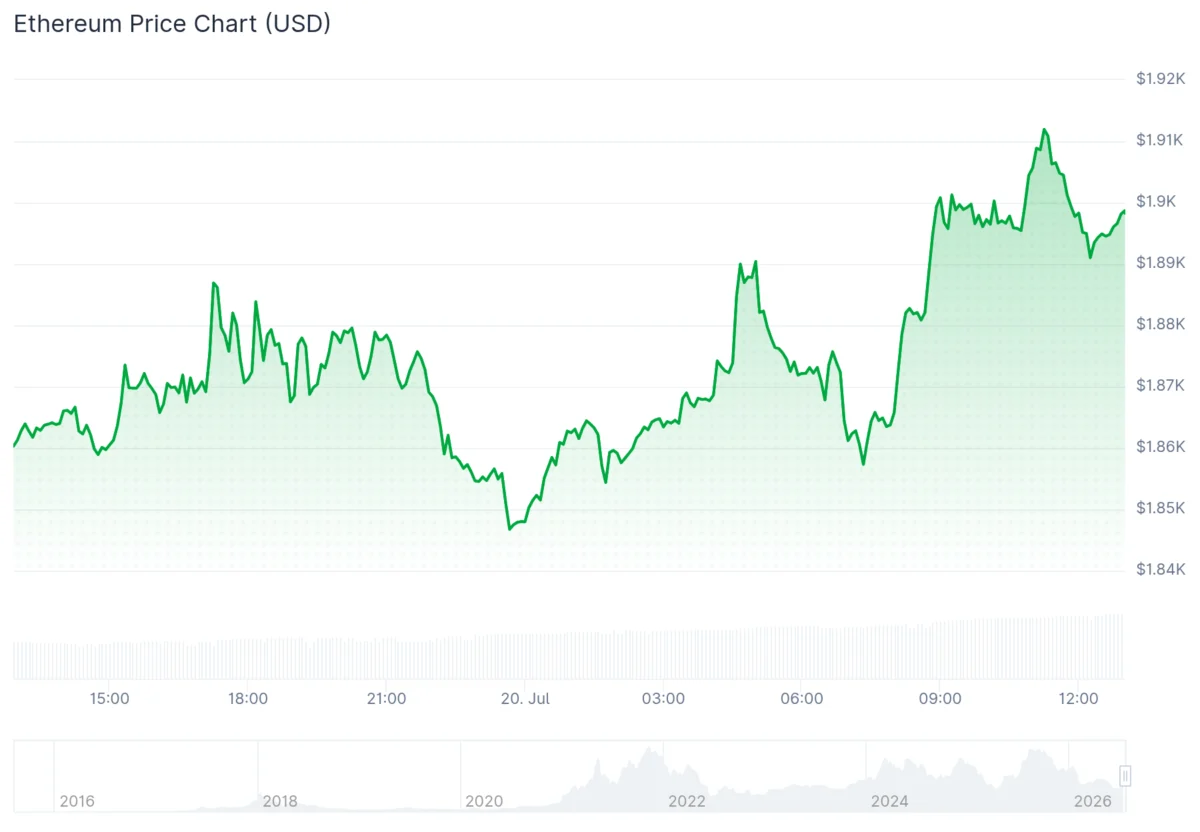
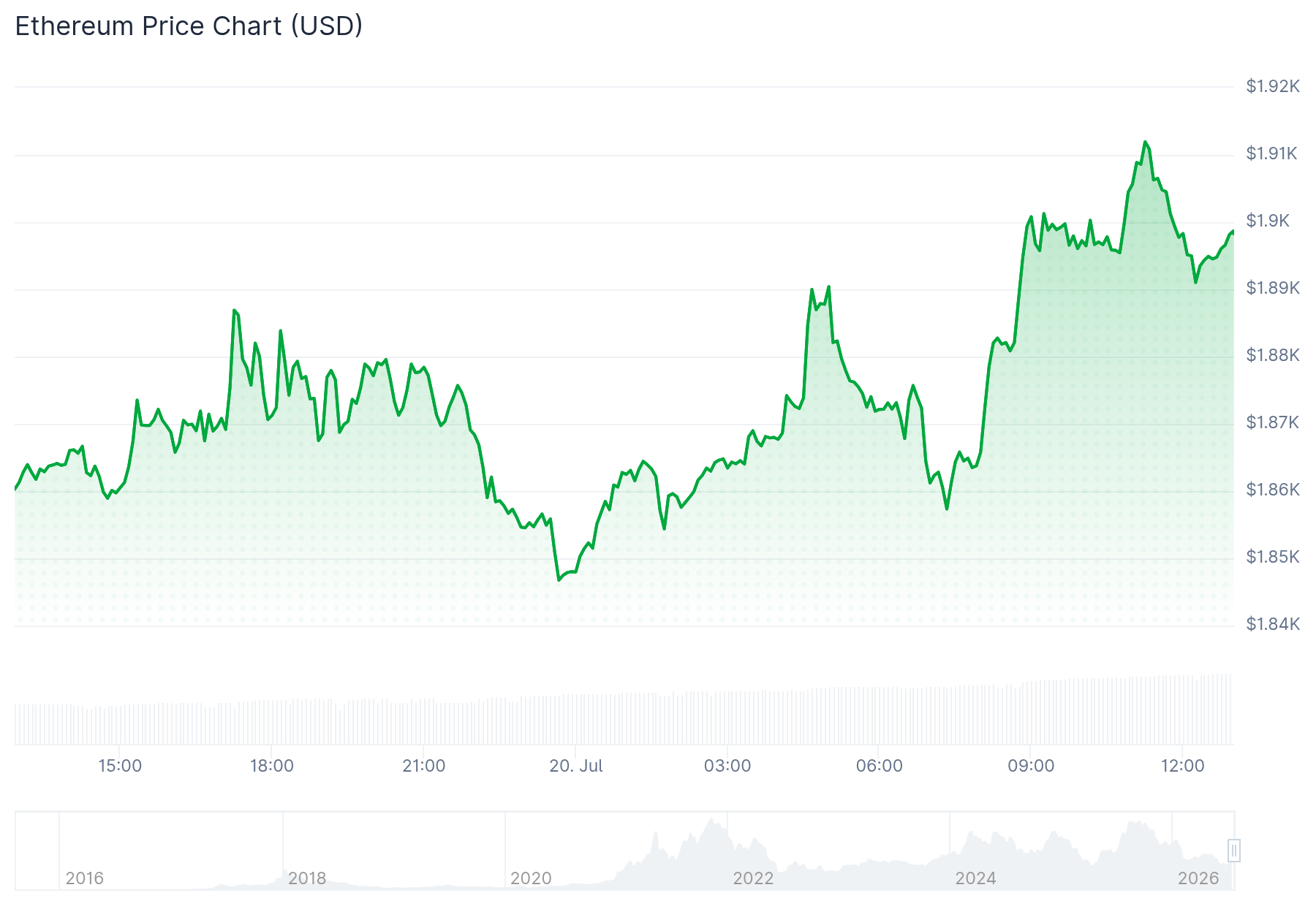
Ethereum’s on-chain activity has witnessed a significant uptick, particularly among large holders, as Wrapped Ether (WETH) transactions exceeding $100,000 recorded an impressive 113,000 instances over the past week. This surge, according to data from blockchain analytics firm Santiment, marks the highest weekly level of WETH whale activity observed since May 2021, signaling renewed interest and capital deployment within the Ethereum ecosystem. The substantial movement coincided with Ethereum’s native token, ETH, trading near $1,892.84, having posted a gain of 1.85% within a 24-hour window, reflecting broader market confidence.
Contextualizing the Resurgence in Whale Activity
The term "whale activity" in cryptocurrency markets typically refers to large transactions executed by significant holders, whose movements can often influence market sentiment and liquidity. In this instance, the focus on Wrapped Ether (WETH) is particularly telling. WETH is an ERC-20 compliant version of Ether (ETH), enabling its seamless integration and use across various decentralized finance (DeFi) protocols, lending platforms, decentralized exchanges (DEXs), and other liquidity systems that primarily operate with ERC-20 tokens. While these transactions do not explicitly confirm buying activity, their sheer volume and scale indicate a high degree of capital rotation and engagement within Ethereum’s sophisticated financial infrastructure, rather than mere passive storage. Santiment’s analysis specifically highlighted this as active engagement through "Ethereum’s financial rails," underscoring the operational nature of these large transfers.
The last time such intense WETH whale activity was recorded was in May 2021, a period characterized by the peak of the bull market, explosive growth in DeFi, and unprecedented demand for digital assets. The resurgence now suggests a parallel, albeit potentially more mature, phase of capital deployment into the Ethereum network, driven by a confluence of factors including new institutional investment avenues and an ever-expanding decentralized application landscape.

Institutional Demand Ignites Market Momentum
A significant catalyst for the current wave of Ethereum enthusiasm stems from the growing institutional adoption, particularly through the advent of U.S. spot Ether Exchange Traded Funds (ETFs). Following the landmark approval of these investment vehicles, traditional financial players are gaining regulated access to ETH, contributing to a measurable increase in demand. Farside data illustrates this trend vividly, with BlackRock’s iShares Ethereum Trust (ETHA) attracting substantial inflows. On July 14, ETHA recorded $58.3 million in new investments, followed by another $45.3 million on July 15. The momentum continued with an additional $31.7 million inflow on July 17, contributing to a total of $36.7 million in net inflows across all spot Ether ETFs on that particular day.
While these ETF flows, measured in tens of millions of dollars, may not directly match the colossal scale implied by 113,000 WETH transactions above $100,000 (potentially totaling billions), their combined impact signals a robust and diversified institutional engagement with Ethereum. The simultaneous rise in both regulated investment product inflows and significant on-chain activity suggests a deepening conviction among larger investors regarding Ethereum’s long-term value proposition and utility. This coordinated demand across various channels amplifies the significance of the observed whale movements, indicating a broad-based capital influx rather than isolated speculative plays.
Corporate Treasury Strategies and Ecosystem Development
Beyond spot ETFs, corporate treasury strategies continue to play a crucial role in reducing the liquid supply of ETH and demonstrating long-term institutional commitment. BitMine, a notable player in the crypto space, exemplifies this trend. During the week ending July 19, the company acquired an additional 7,430 ETH, bringing its total holdings to an impressive 5,777,468 ETH. This substantial treasury represents approximately 4.8% of Ethereum’s total supply, underscoring the scale of corporate accumulation.
A significant portion of BitMine’s holdings, specifically 4,917,189 ETH (roughly 85% of its treasury), is actively staked. This strategic staking removes a large volume of ETH from the readily tradable supply on exchanges, further tightening market dynamics. BitMine has publicly stated that its current staking operations are projected to generate $247 million in annualized revenue, highlighting the economic incentives driving such corporate strategies. The company has maintained a consistent pattern of weekly ETH purchases since the inception of its treasury strategy, indicating a sustained, long-term investment approach rather than short-term speculation. While the original source mentioned "June 2025" for the start of this strategy, given the context of current events, it is understood to refer to an ongoing or recent strategy that began in a prior period, likely mid-2023 or 2024, emphasizing its continuous nature.
Institutional interest in Ethereum also extends to supporting its underlying infrastructure and future development. Entities like BitMine, SharpLink, and prominent Ethereum co-founder Joe Lubin have backed Ethlabs, an independent organization dedicated to preparing Ethereum for even broader institutional adoption. Such initiatives focus on enhancing scalability, security, and usability, ensuring that the network can meet the demands of enterprise-level applications and traditional finance.
Concentrated Supply Dynamics and Network Infrastructure
A deeper dive into Ethereum’s supply distribution reveals a highly concentrated landscape, which requires careful interpretation when assessing "whale activity." The largest single holder of ETH is the Beacon Deposit Contract, which currently holds an astonishing 88.29 million ETH. However, this massive balance does not represent a discretionary whale wallet but rather a pooled repository for all ETH staked by validators on Ethereum’s Proof-of-Stake chain. It is a fundamental component of the network’s security and consensus mechanism, locking up a significant portion of the total supply.
Similarly, the Wrapped Ether (WETH) contract itself ranks as the second-largest holder, with approximately 2.44 million ETH locked as backing for the WETH tokens circulating in the ecosystem. Like the Beacon Chain contract, this is an infrastructural holding, ensuring the 1:1 peg between ETH and WETH, and not a speculative wallet.

Beyond these foundational contracts, exchange custody accounts for another significant portion of concentrated ETH supply. Binance, a leading global cryptocurrency exchange, controls approximately 3.19 million ETH across three identified wallets, representing a substantial volume of user funds and exchange liquidity. Robinhood, a popular retail trading platform, holds roughly 1.59 million ETH across two known addresses. Other major exchanges such as Upbit, Bitfinex, and Gemini also feature prominently among the largest exchange-linked wallets, collectively managing millions of ETH on behalf of their users.
Furthermore, the burgeoning ecosystem of Ethereum Layer-2 scaling solutions contributes to centralized ETH holdings. Arbitrum and Base bridge contracts, for instance, collectively hold more than 1.6 million ETH. These balances are crucial for facilitating the seamless movement of assets between the Ethereum mainnet and its various Layer-2 networks, which aim to provide faster and cheaper transactions. The recently launched Robinhood Chain, which utilizes ETH for gas fees, has also rapidly generated heavy decentralized exchange (DEX) activity since its debut on July 1, further increasing demand for ETH as a transactional asset within its ecosystem. These infrastructural holdings underscore the expanding utility and adoption of Ethereum across diverse applications and scaling solutions.
Market Performance and Outlook
The current surge in Ethereum whale activity and institutional demand is unfolding within a dynamic price environment. The immediate technical analysis places the $1,850 level as a critical first line of support for ETH. Maintaining price stability above this threshold would be a positive indicator, potentially allowing the cryptocurrency to target the 100-day Exponential Moving Average (EMA), currently positioned near $1,938. A decisive daily close above the 100-day EMA would signal strong upward momentum, potentially exposing higher resistance levels in the $2,000 to $2,100 range. This would represent a significant psychological and technical breakthrough, potentially attracting further investment.
Conversely, a failure to hold the $1,850 support level could shift market attention towards lower price targets. The 50-day EMA, typically a shorter-term indicator of trend, lies near $1,818, serving as the next potential support. A breach of this level could lead to a retest of the broader $1,775 support area, which has historically proven to be a robust zone for demand. The interplay of these technical levels, combined with the underlying fundamental drivers of institutional demand and on-chain activity, will dictate Ethereum’s near-term price trajectory. The current data, however, paints a picture of a resilient and increasingly utilized network, attracting substantial capital inflows from diverse segments of the market. The confluence of record-high WETH whale activity, consistent spot ETF inflows, and strategic corporate acquisitions collectively suggests a strengthening bullish sentiment and a more robust foundation for Ethereum’s future growth.