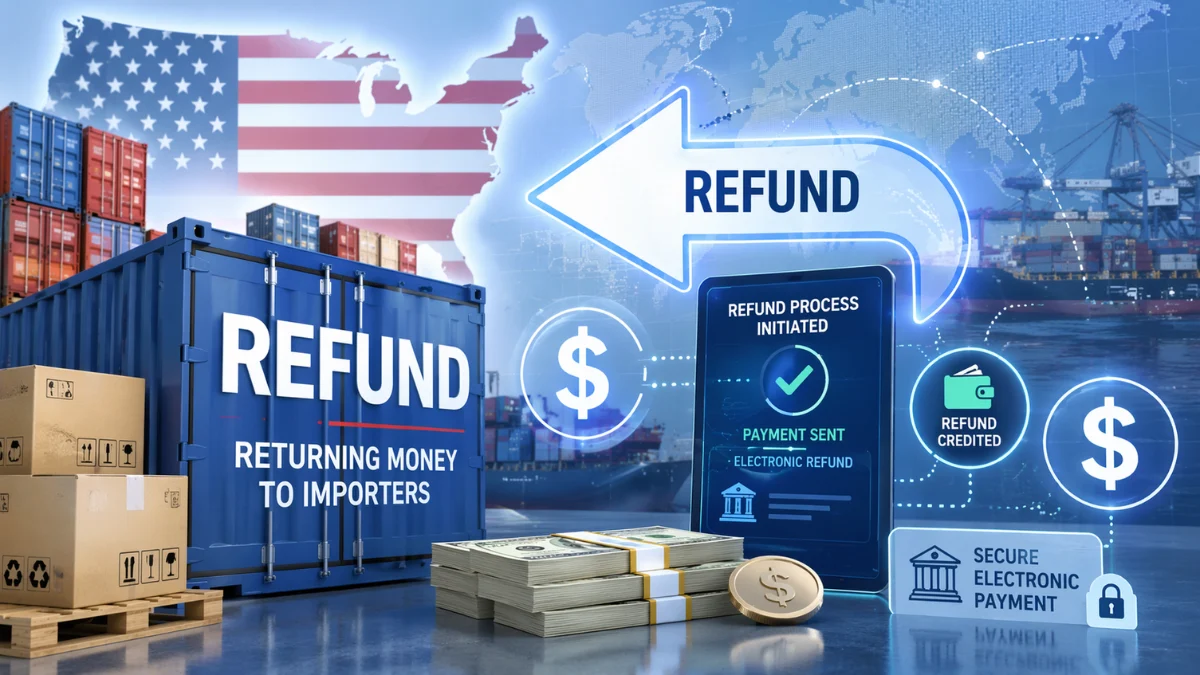
The United States government is finalizing the deployment of a sophisticated new financial infrastructure designed to facilitate the return of billions of dollars in tariff overpayments to thousands of domestic businesses. On April 20, U.S. Customs and Border Protection (CBP) will officially activate the Centralized Automated Processing Engine (CAPE), a system engineered to streamline the massive undertaking of refunding duties that were previously collected under executive actions later deemed unlawful by the federal judiciary. This initiative represents one of the largest administrative refund operations in the history of American trade, involving a staggering $166 billion in contested funds.
The move follows a series of landmark legal challenges that questioned the validity of specific trade levies imposed during the administration of former President Donald Trump. While the tariffs were originally intended to bolster domestic industry and provide leverage in international trade negotiations, the U.S. Supreme Court and the Court of International Trade eventually determined that the use of the International Emergency Economic Powers Act (IEEPA) to implement these specific duties exceeded the statutory authority granted to the executive branch. Consequently, the government is now legally obligated to restore these funds to the importing entities, along with applicable interest in many instances.
The Architecture of the CAPE System
The introduction of the CAPE system marks a significant technological shift for CBP. Traditionally, the process of liquidating entries and issuing refunds for imported goods was a fragmented, shipment-by-shipment endeavor. For large-scale importers moving thousands of containers annually, this resulted in a chaotic influx of small checks or electronic transfers, creating an administrative nightmare for corporate accounting departments.
CAPE addresses these inefficiencies by aggregating multiple refund claims into single, consolidated electronic payments. By grouping refunds associated with various shipments into a unified transaction, the system reduces the clerical burden on both the government and the private sector. The automation of this process is expected to drastically accelerate the timeline for reimbursement, which is critical for businesses that have seen significant portions of their capital tied up in litigation for several years.
Starting April 20, the rollout will proceed in a phased approach. The initial stage will focus on "simple" cases—shipments where documentation is complete, the importer of record is clearly identified, and the mathematical calculation of the refund is undisputed. By prioritizing these straightforward claims, CBP aims to clear the highest volume of cases early in the process, providing immediate liquidity to a broad swathe of the American economy.
A Massive Financial Undertaking: By the Numbers
The scale of the refund operation is nearly unprecedented in the realm of international trade. According to internal data and agency briefings, the total pool of refundable tariffs is estimated at $166 billion. This figure encompasses duties paid on approximately 53 million individual shipments of goods ranging from raw materials to consumer electronics.
The breadth of the impact is equally significant. More than 330,000 unique importers were affected by the unlawful tariffs. As of early April, approximately 56,497 of these importers—representing the most active and high-volume trade entities—had already completed the rigorous electronic registration process required to receive payments through the CAPE system. These registered entities alone account for roughly $127 billion of the total $166 billion owed.
However, the path to full restitution is not without obstacles. While the majority of the funds are expected to flow through the automated system, a significant subset of claims remains trapped in administrative complexity. Approximately $2.9 billion in refunds has been categorized as "complex." These cases involve discrepancies in shipping records, changes in corporate ownership since the tariffs were paid, or legal disputes over the specific classification of goods.
Brandon Lord, an official with U.S. Customs and Border Protection, has noted that these complex cases will require manual review by specialized trade officers. This manual intervention poses a logistical challenge, as it threatens to divert agency personnel from other critical missions, including trade enforcement and the interdiction of illicit goods at the border. The agency is working to balance the need for rapid restitution with the necessity of maintaining rigorous oversight to prevent fraudulent or erroneous claims.
Legal Precedent and the IEEPA Ruling
The genesis of this massive refund effort lies in the judicial interpretation of the International Emergency Economic Powers Act of 1977. The IEEPA was designed to grant the President broad authority to regulate international commerce during times of national emergency. During the previous administration, this law was utilized to bypass traditional legislative hurdles and impose tariffs on a wide array of imported products, most notably those originating from China.
The legal battle reached a crescendo when the U.S. Supreme Court scrutinized the application of the law. The court’s ruling emphasized that while the President possesses significant power during emergencies, that power is not infinite and must remain within the bounds of the specific statutes enacted by Congress. The court determined that the tariffs in question did not meet the criteria established under the IEEPA, rendering the collection of those duties unauthorized.
Following this decision, the Court of International Trade became the primary venue for thousands of individual lawsuits filed by importers seeking the return of their funds. The court has maintained close oversight of CBP’s progress in developing a refund mechanism, exerting pressure on the government to ensure that businesses are made whole in a timely manner. The launch of CAPE is, in many ways, the government’s direct response to this judicial mandate.
Economic Implications and Industry Reactions
The return of $166 billion into the private sector is expected to have a tangible impact on the domestic economy. For many small and medium-sized enterprises (SMEs), the tariffs had acted as a significant drain on cash flow, forcing some to raise prices for consumers and others to delay capital investments or hiring.
Earlier in the litigation process, many smaller importers expressed concern that the cost of hiring legal counsel and navigating the bureaucratic maze of customs protests would exceed the value of the refunds themselves. Some firms even sought third-party financing or "refund factoring" to manage their balance sheets while waiting for the courts to act. The automated nature of the CAPE system is specifically intended to mitigate these concerns by lowering the barrier to entry for claiming refunds.
Trade associations have generally welcomed the news of the April 20 launch, though some remain cautious. "While we are encouraged by the automation of these payments, the delay between the court’s ruling and the actual distribution of funds has been a significant burden for the trade community," noted one industry representative. "The inclusion of interest is a necessary step, but for some companies, the damage caused by the initial loss of liquidity cannot be fully repaired by a check years later."
The interest component mentioned by CBP is a critical detail. Under federal law, when the government is found to have wrongfully collected duties, it must often pay interest calculated from the date of the overpayment. Given that some of these tariffs were collected as far back as 2018 and 2019, the interest accrual could add several billion dollars to the final payout, further increasing the total cost to the U.S. Treasury.
The Broader Context of US Trade Policy
The launch of the CAPE system occurs during a period of intense volatility in U.S. trade relations. Even as the government prepares to return billions in unlawful tariffs, it is simultaneously considering new, aggressive trade measures. Recent signals from Washington suggest a potential 50% tariff risk for certain Chinese imports, particularly in response to concerns over arms proliferation and oil trade shifts involving Iran.
This creates a paradoxical environment for American importers: they are receiving massive refunds for past policy overreach while simultaneously bracing for a new era of protectionism. This "revolving door" of trade litigation and policy shifts highlights the ongoing tension between national security interests and the principles of free, predictable commerce.
The CAPE system may serve as a blueprint for future large-scale administrative actions. As global trade becomes increasingly digitized, the ability of customs agencies to process massive financial corrections through automation will be essential. However, the $2.9 billion in "complex" cases serves as a reminder that technology cannot entirely replace the need for expert human judgment in the nuanced world of international trade law.
Conclusion and Next Steps
As the April 20 deadline approaches, U.S. Customs and Border Protection is urging all eligible importers to ensure their electronic records are up to date in the Automated Commercial Environment (ACE) portal, which serves as the gateway to the CAPE system. The agency has committed to transparency throughout the phased rollout, promising regular updates to the Court of International Trade and the broader business community.
The successful implementation of CAPE will be measured not just by the speed of the payments, but by the agency’s ability to resolve the billions of dollars in complex claims without paralyzing its other enforcement duties. For the 330,000 businesses affected, the launch represents the beginning of the end of a long and costly legal odyssey, potentially providing a much-needed injection of capital into the American marketplace at a time of global economic uncertainty.