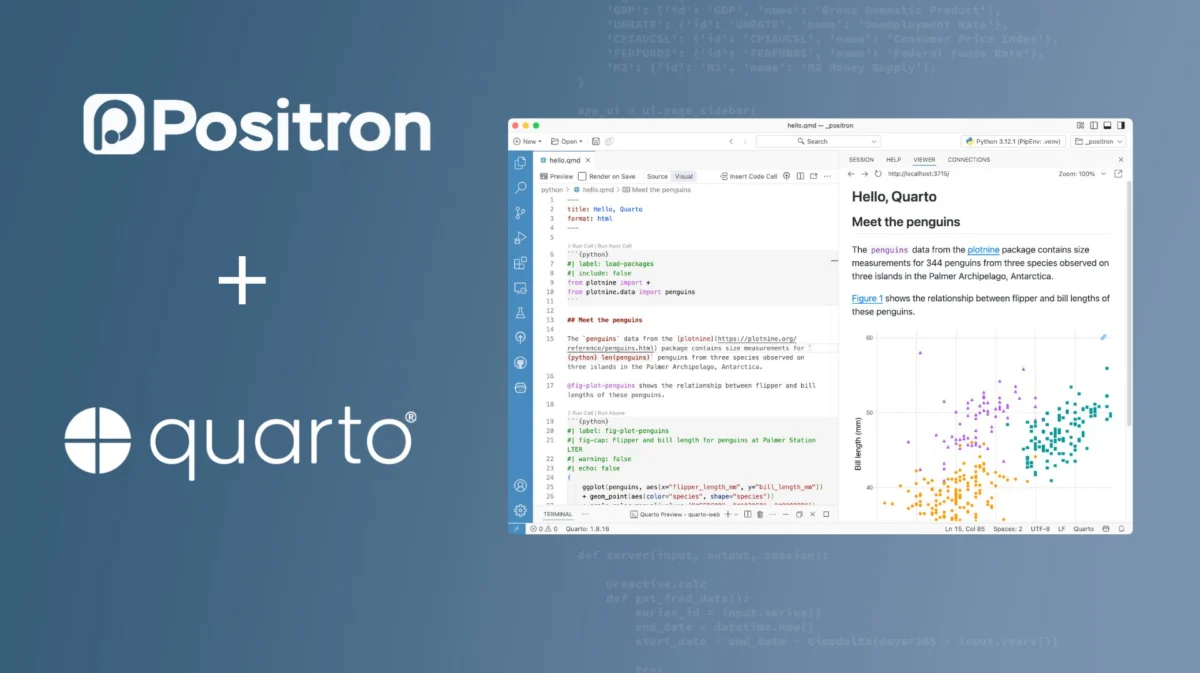
The evolution of scientific publishing reached a significant milestone on April 9, 2026, as Posit PBC, the developer of the RStudio IDE and the Quarto publishing system, announced comprehensive updates to its newest development environment, Positron. Led by Charlotte Wickham, the organization released an extensive tutorial and technical roadmap detailing how Positron has been optimized to handle Quarto documents, marking a pivotal shift in how data scientists, researchers, and technical writers interact with multi-language computational documents. By integrating the Quarto command-line interface (CLI) directly into the IDE’s core architecture, Positron aims to reduce the friction traditionally associated with setting up reproducible research environments, providing a "batteries included" experience that caters to both the R and Python communities.
The Strategic Emergence of Positron
Positron represents the next generation of data science IDEs, built upon the open-source Code-OSS (Visual Studio Code) framework but tailored specifically for the rigors of data exploration and statistical modeling. For years, the data science community was divided between the specialized, R-centric features of RStudio and the general-purpose extensibility of VS Code. Positron was designed to bridge this gap, offering a polyglot environment that feels familiar to modern developers while retaining the sophisticated data-viewing capabilities—such as the Variables and Plots panes—that made RStudio a staple in the scientific community.
The integration of Quarto into this environment is not merely a cosmetic update but a fundamental alignment of Posit’s software ecosystem. Quarto, which debuted in 2022 as the successor to R Markdown, was designed to be language-agnostic, allowing users to combine prose with code in R, Python, Julia, and Observable. By making Quarto a first-class citizen within Positron, the company is doubling down on its commitment to interoperability, ensuring that the transition between writing code and publishing insights is as seamless as possible.
Technical Architecture: A "Batteries Included" Philosophy
One of the primary barriers to entry for new data scientists is the "environment hell" associated with installing dependencies, configuring paths, and managing conflicting versions of command-line tools. Positron addresses this directly by bundling the Quarto CLI and the necessary extensions within the installation package. Users no longer need to navigate complex system paths to ensure their IDE can find the Quarto compiler; instead, versioning information is displayed directly in the Status Bar, providing immediate feedback on the environment’s capabilities.
However, the "batteries included" approach does not mean a lack of flexibility. The architecture recognizes that different projects require different engines. For documents containing Python code, Positron intelligently identifies the need for the jupyter package to manage code execution. Conversely, for documents utilizing R, the rmarkdown package remains the standard engine. This dual-engine support ensures that whether a researcher is performing deep learning in Python or longitudinal analysis in R, the rendering process remains stable and predictable.
Enhancing Developer Productivity via Intelligent UI
The April 2026 update highlights several UI enhancements designed to accelerate the authoring process. Beyond simple text editing, Positron treats Quarto documents with the same level of sophistication as standard script files. This includes:
- Context-Aware Code Completion: As users write code within Quarto code cells, the IDE provides real-time suggestions based on the active environment. This extends to library imports, function signatures, and variable names defined earlier in the document.
- YAML Intelligence: The header of a Quarto document, written in YAML, controls everything from the output format (PDF, HTML, MS Word) to the bibliography style. Positron now offers auto-completion for these Quarto-specific options, significantly reducing the need for users to consult external documentation. Furthermore, the IDE provides real-time linting, flagging invalid syntax or unsupported options before the user attempts to render the document.
- Integrated Execution and Visualization: Rather than requiring a full document render to see results, Positron allows users to send snippets of code from a Quarto cell directly to the Console. The resulting data frames can be inspected in the Variables pane, and visualizations appear instantly in the Plots pane, facilitating an iterative "exploratory" workflow.
A Chronology of Scientific Publishing Evolution
To understand the significance of the Positron-Quarto integration, one must look at the timeline of technical publishing over the last two decades.
- 2007–2012: The rise of Sweave and eventually R Markdown allowed R users to weave code into LaTeX and HTML. This era was characterized by a heavy reliance on R as the primary engine.
- 2014–2020: The Jupyter Notebook revolutionized the Python space, introducing a web-based, cell-by-cell execution model. However, version control remained difficult due to the JSON-based format of
.ipynbfiles. - 2021–2022: Posit (then RStudio) announced Quarto. Unlike its predecessors, Quarto was built from the ground up to be a standalone tool, independent of any specific IDE or programming language, utilizing plain-text
.qmdfiles that are version-control friendly. - 2024–2025: The initial release of Positron as a public beta. The focus was on core IDE stability and providing a "best of both worlds" experience for R and Python users.
- 2026: The current milestone, where Positron achieves deep integration with Quarto, effectively positioning it as the premier environment for high-stakes scientific communication.
Industry Implications and Market Reaction
The data science community has reacted with cautious optimism to these developments. Analysts suggest that by making Quarto easier to use within a VS Code-based environment, Posit is directly challenging the dominance of JupyterLab in corporate and academic settings.
"The move to integrate the CLI and provide YAML linting within Positron is a direct response to the ‘friction’ feedback we’ve seen from the Python community," says an industry analyst specializing in developer tools. "While R users have had a polished experience for years, Pythonistas often felt like second-class citizens in the old RStudio IDE. Positron levels that playing field."
Furthermore, the integration of an "Integrated Terminal" within the GUI allows power users to access the full suite of Quarto commands, such as quarto publish. This command simplifies the deployment of research to platforms like Quarto Pub, GitHub Pages, and Posit Connect, effectively turning the IDE into a complete distribution hub for scientific knowledge.
Data-Driven Insights into Tool Adoption
Recent surveys within the Open Science community indicate a steady shift toward plain-text computational documents. In a 2025 study of 5,000 data professionals, approximately 62% reported that reproducibility was their primary concern when choosing a publishing tool. Quarto’s ability to render to multiple formats from a single source file addresses this concern, and Positron’s streamlined setup further lowers the barrier to adopting these best practices.
Supporting data suggests that teams using integrated environments like Positron report a 15-20% reduction in "time-to-publish" compared to teams using disparate tools for coding and reporting. This efficiency gain is largely attributed to the reduction in context-switching and the elimination of manual configuration steps.
Looking Ahead: The Future of Reproducible Research
As Positron continues to mature, the focus is expected to shift toward even deeper collaborative features. Future iterations may include real-time collaborative editing of Quarto documents, similar to Google Docs but with the power of a full computational engine behind it. Additionally, as Large Language Models (LLMs) become more integrated into development workflows, Positron’s existing infrastructure for code completion and YAML support provides a robust foundation for AI-assisted technical writing.
The integration of Quarto in Positron is more than a software update; it is a statement of intent. It reinforces the idea that the future of data science is polyglot, open-source, and, above all, reproducible. By providing a professional-grade environment that handles the complexities of the Quarto ecosystem "out of the box," Posit is ensuring that the next generation of scientific breakthroughs will be documented with the same precision and rigor with which they were discovered.
For researchers ready to transition, the path is clear: Positron offers the power of a modern IDE with the specialized soul of a scientific tool. As Charlotte Wickham’s tutorial demonstrates, the journey from a blank document to a published, interactive report has never been shorter or more accessible. The era of fragmented data science workflows is drawing to a close, replaced by a unified vision of computational storytelling.