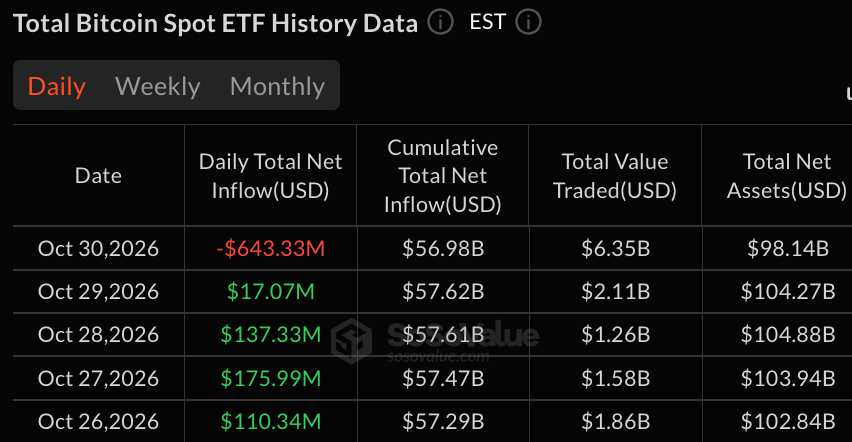
The United States spot Bitcoin exchange-traded funds experienced a dramatic reversal of fortune at the end of the trading week, logging a staggering $643.33 million in net outflows on Friday. This massive capital flight abruptly terminated a four-day consecutive streak of positive inflows, wiping out earlier weekly gains and leaving the broader crypto investment landscape reeling. The sudden wave of institutional redemptions was catalyzed by shockwaves rippling through the digital asset ecosystem following a historic $6.3 billion security breach at Binance, one of the world’s largest cryptocurrency exchanges. As traditional financial markets processed the severity of the weekend security crisis, investors rushed to de-risk, causing a sharp contraction across multiple major cryptocurrency funds, including those tied to Ether, Solana, and XRP.
The timing of the market turmoil could not have been worse for institutional sentiment. The monumental Binance breach occurred just after the closing bell of the United States stock market on Thursday, leaving Friday as the very first full trading session for traditional finance and ETF investors to react to the unfolding disaster. Consequently, trading volumes spiked exponentially, with Bitcoin fund trading values skyrocketing to $6.35 billion on Friday, compared to a relatively modest $2.11 billion the previous day. This surge in volume underscored the sheer panic and urgent portfolio adjustments undertaken by institutional market participants seeking to insulate themselves from systemic exchange counterparty risk.
Erasing Weekly Gains: A Breakdown of ETF Outflows
Before Friday’s catastrophic market downturn, US spot Bitcoin ETFs had enjoyed a relatively stable week, accumulating $440.73 million in net inflows from Monday through Thursday. However, Friday’s single-day exodus of $643.33 million completely eclipsed those gains, plunging the five-day aggregate period roughly $202.6 million into the red, according to data compiled by SoSoValue.
The selloff was comprehensive, affecting nearly every major issuer in the spot Bitcoin ETF arena. BlackRock’s iShares Bitcoin Trust (IBIT), which frequently dominates both inflows and trading volume, bore the brunt of the institutional retreat, recording $233.70 million in net withdrawals. Fidelity’s Wise Origin Bitcoin Fund (FBTC) closely followed, shedding $201.04 million. Other prominent funds also suffered significant capital bleeding: ARK 21Shares’ ARKB recorded $129.55 million in net withdrawals, Grayscale’s converted Bitcoin Trust (GBTC) lost $53.32 million, and Bitwise’s BITB experienced $25.72 million in outflows.

These net outflows indicate that during Friday’s trading session, the redemption of fund shares by investors heavily outpaced the creation of new shares by authorized participants. As a direct consequence of both capital withdrawals and the depreciating market value of underlying assets, the total net assets under management for US spot Bitcoin ETFs dropped below the psychologically crucial $100 billion threshold, resting at $98.14 billion by the end of the week.
A Multi-Asset Retreat: Ether, Solana, and XRP Products Hit Hard
The contagion triggered by the Binance exploit was by no means confined to Bitcoin investment vehicles. Across the broader cryptocurrency product ecosystem, institutional investors aggressively trimmed their exposure to alternative digital assets. United States spot Ether ETFs suffered a brutal blow, logging $155.85 million in net outflows on Friday alone. This marked the fifth consecutive session of net withdrawals for Ether-based funds, bringing their total weekly losses to approximately $431.5 million. BlackRock’s ETHA fund accounted for $76.64 million of Friday’s Ether-specific withdrawals.
Solana and XRP investment products fared no better under the prevailing market stress. Solana ETFs recorded $10.74 million in net withdrawals on Friday, culminating in a weekly total of roughly $71.5 million in capital flight. Meanwhile, XRP-linked investment vehicles also posted notable net outflows. These systemic declines reflected a generalized risk-off sentiment among institutional allocators who opted to liquidate speculative digital asset holdings in favor of cash and traditional safe-haven assets.
Anatomy of the Binance Breach and Exchange Response
The root cause of Friday’s institutional panic stems from a devastating security compromise at Binance, which revealed that malicious actors had siphoned approximately $6.3 billion in cryptocurrency from the platform’s hot wallets. The scale of the exploit immediately sent shockwaves through the global digital asset economy, raising fresh concerns over centralized exchange vulnerabilities, hot wallet security, and the systemic risks posed by large-scale liquidity pools.
In the wake of the breach, Binance executive leadership moved swiftly to contain the public relations and financial fallout. Representatives for the exchange disclosed that the attackers had utilized advanced, destructive self-destruct tools designed to obscure the forensic traces of the stolen funds and impede blockchain tracking efforts. Despite the unprecedented magnitude of the theft, Binance announced that it had proactively set aside more than $6.34 billion of its own corporate reserves to fully replenish the compromised assets.
The exchange issued a public guarantee assuring all affected customers that their funds would be made whole, emphasizing that the platform’s internal corporate balance sheet would absorb the entire financial impact of the hack. To ensure robust security moving forward, Binance outlined plans to resume platform withdrawals in a phased, highly monitored rollout slated for November 1, pending exhaustive security audits and infrastructure hardening.
Price Action and Technical Implications for Bitcoin and Altcoins
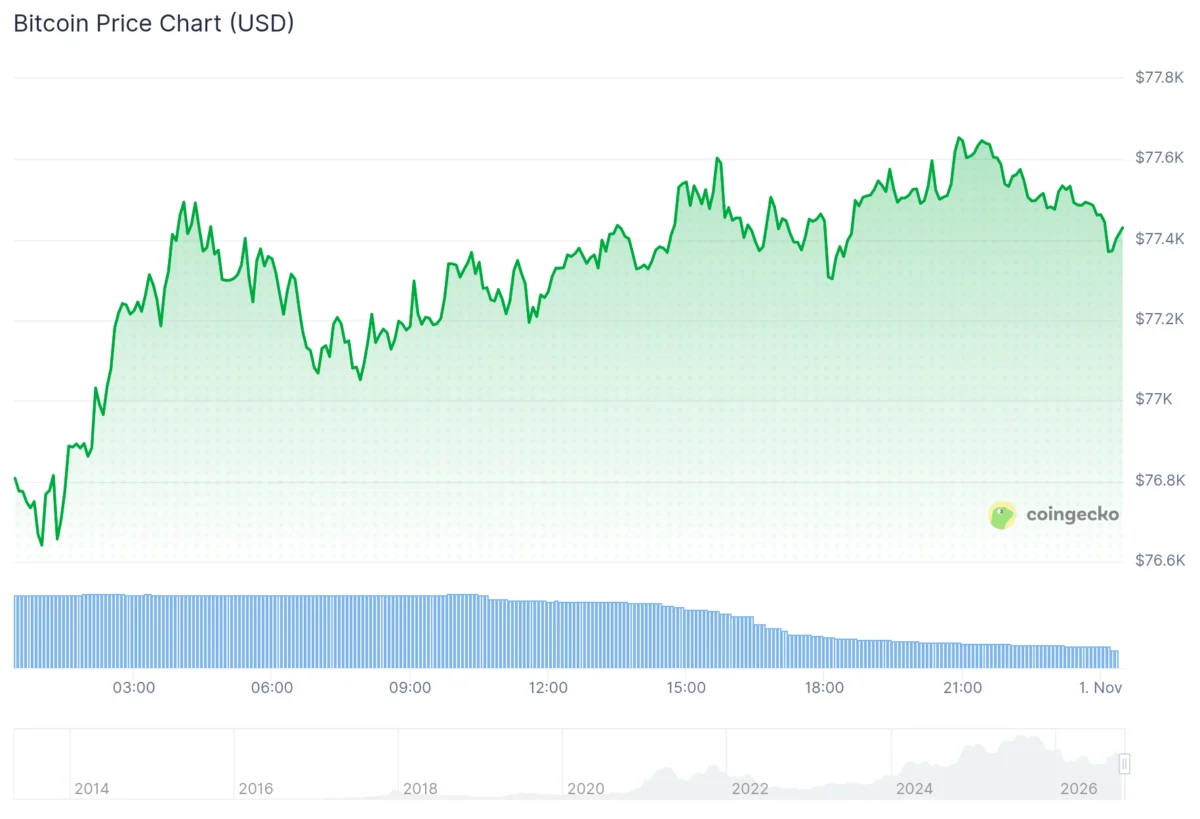
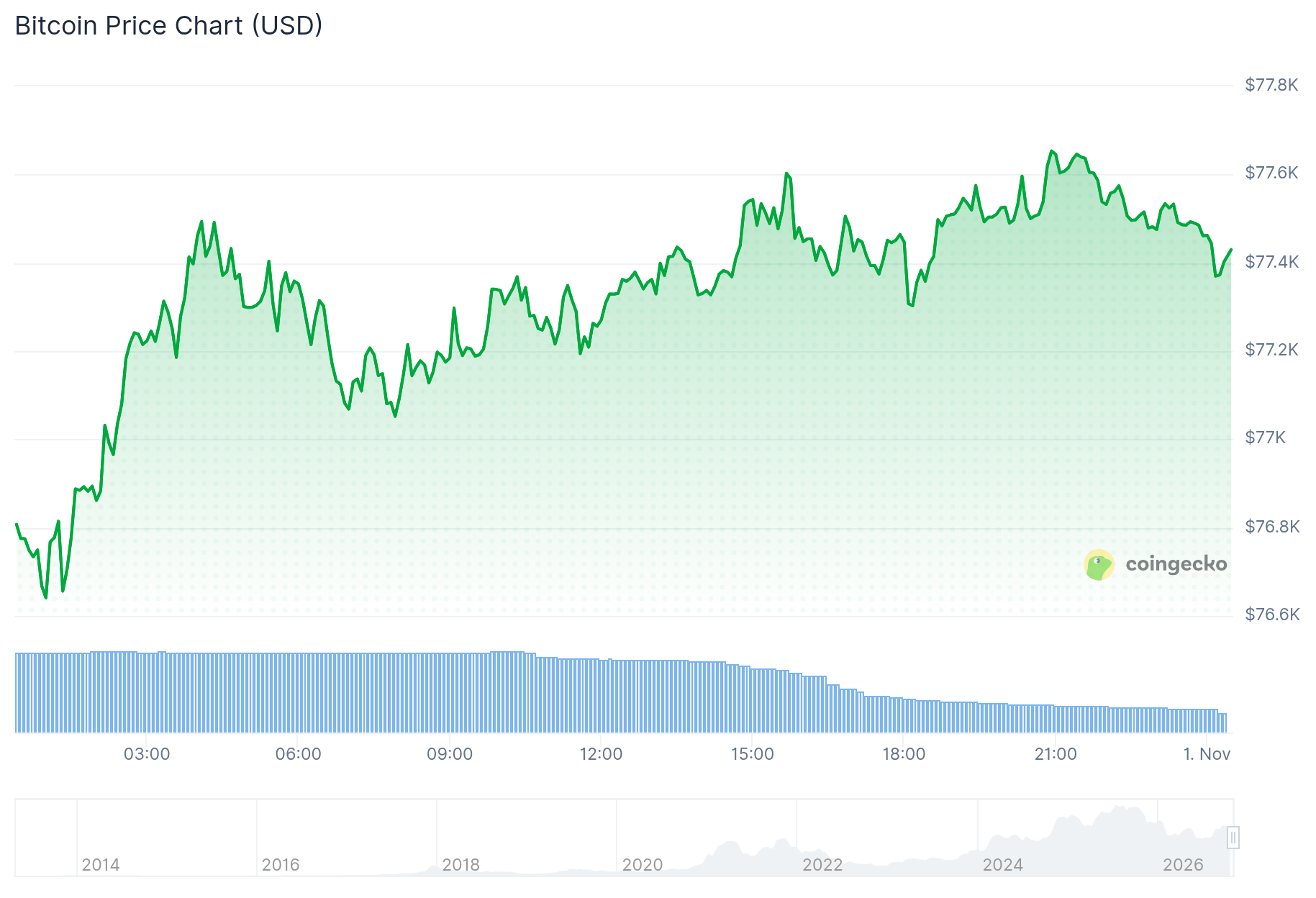
The immediate macroeconomic and security shocks exerted intense downward pressure on spot crypto prices. During Friday’s frantic selloff, Bitcoin breached the $77,000 psychological floor, touching intraday lows before staging a modest recovery to trade near $77,600 by Saturday. Technical analysts note that despite this minor stabilization, Bitcoin remains confined below the critical $81,000 to $82,000 resistance barrier that defined its pre-crash trading range.
Market participants are currently monitoring the $76,000 support region very closely. Chart analysts suggest that maintaining this level is vital for preventing a deeper correction; a decisive breakdown beneath $76,000 could expose the asset to significantly lower support tiers. Conversely, a sustained recovery back above the $78,000 mark would serve as an initial indicator of buyer exhaustion among sellers and a tentative step toward market stabilization.
The wider altcoin market absorbed even sharper drawdowns relative to Bitcoin. Comparative market metrics indicate that while Bitcoin experienced a relatively moderate pullback of approximately 6.5% from its recent local highs, native exchange tokens and major altcoins suffered disproportionately heavier losses. Binance Coin (BNB) plunged roughly 14% from its previous peak, with traders closely eyeing the $690 support zone as the exchange navigates its account restructuring and asset replenishment processes.
Ether suffered a steeper descent, retreating roughly 20.6% from its cited peak, with immediate technical support resting in a fragile zone between $2,170 and $2,200. XRP experienced a comparable correction, dropping approximately 23% from its local high and struggling to defend crucial support near the $1.20 threshold.
Fact-Based Analysis of Market Implications
The events of this past week underscore the delicate interplay between traditional institutional capital vehicles—such as spot ETFs—and native crypto market infrastructure. While the introduction of spot Bitcoin and Ether ETFs has successfully bridged the gap between Wall Street and digital assets, it has also created a direct transmission pipeline for macro and idiosyncratic crypto shocks.
When exchange security incidents of this magnitude occur, institutional investors holding ETF shares possess an immediate, highly regulated mechanism to liquidate their exposure during standard market hours. Consequently, bad news originating in the decentralized or centralized exchange spheres can rapidly manifest as massive structural outflows in mainstream brokerage accounts.
Furthermore, the simultaneous selloff across Bitcoin, Ether, and Solana products demonstrates that institutional allocators continue to treat digital assets largely as a unified asset class during periods of heightened systemic risk. Rather than rotating capital into perceived safe havens within the crypto ecosystem, risk management protocols often dictate a wholesale exit from the sector entirely until regulatory clarity and platform security assurances are reestablished.
As the market looks toward the upcoming week, the ability of Binance to successfully execute its phased withdrawal schedule on November 1, coupled with Bitcoin’s capacity to defend the $76,000 support floor, will serve as the primary barometers for determining whether this capital flight represents a temporary knee-jerk reaction or the beginning of a prolonged institutional cool-down period.