
The modern artificial intelligence landscape is undergoing a fundamental structural shift, moving beyond simple user interfaces, workflow automations, and go-to-market strategies to center on a much more contentious objective: the ownership of the intelligence layer itself. Industry leaders are increasingly warning against over-reliance on third-party frontier labs, framing the debate around operational autonomy, proprietary data protection, and long-term cost sustainability.
This paradigm shift was underscored recently when Palantir CEO Alex Karp publicly urged enterprises to “own the means of production.” Shortly thereafter, Microsoft CEO Satya Nadella echoed a similar sentiment during a technology summit, noting that renting intelligence from a frontier model provider carries a dual cost: financial expenditure and the surrender of proprietary organizational knowledge required to make those general-purpose models useful to a specific business.
As enterprises weigh these trade-offs, a growing number of industry pioneers are choosing to vertically integrate, shaping their own model weights and custom AI stacks. To examine this emerging trend, venture capital firm Sequoia Capital recently convened an exclusive gathering of prominent AI founders, researchers, and engineers. The event featured presentations from high-growth startups and infrastructure providers—including legal tech pioneer Harvey, alongside Mercor, LangChain, Trajectory, and Fireworks AI—offering a comprehensive look at the post-training stack and a strategic playbook for enterprises looking to seize control of their AI destiny.

The Catalyst: Maturation of Open-Weight Models and Post-Training Stacks
For years, building proprietary AI capabilities was considered an impractical treadmill for most enterprises. Fine-tuning an open-source model often meant that months of painstaking engineering could be instantly rendered obsolete by the sudden release of a superior frontier model. However, the dynamics of the market have shifted dramatically.
Recent advancements in open-weight architectures—exemplified by high-performing models such as Kimi K3 and GLM 5.2—have narrowed the performance gap between open-source alternatives and proprietary frontier models. Organizations no longer have to start from scratch or build on fragile baselines; they can now leverage robust open weights that sit remarkably close to the technological frontier.
Simultaneously, the independent post-training ecosystem has matured rapidly. Companies like Fireworks AI and Mercor now provide enterprises with modular access to the sophisticated infrastructure once exclusive to major research labs. This includes end-to-end tooling for data curation, model training, distributed inference, synthetic data generation, and rigorous evaluation harnesses. Armed with these tools, companies can fine-tune open models to outperform generalized frontier systems within narrow, domain-specific applications. Consequently, choosing open weights has transitioned from a compromise on performance to a strategic and existential business decision.
Strategic Drivers: Cost, Speed, Data Sovereignty, and Control
While renting API access to massive, general-purpose models remains the optimal solution for broad, unstructured workloads, a growing cohort of companies is finding that reliance on third-party labs introduces severe operational constraints. Four primary factors are driving organizations toward localized ownership of their intelligence layer:

-
Financial Sustainability and COGS: As AI-driven products scale successfully, inference costs—categorized as Cost of Goods Sold (COGS)—scale proportionally with user engagement. For high-volume applications, depending entirely on external API pricing models can compress profit margins. Owning and self-hosting optimized models provides a predictable cost structure and long-term margin protection.
-
Latency and Operational Speed: In time-sensitive domains such as real-time code completion (tab autocomplete) or cybersecurity threat detection, milliseconds matter. Large, generalized models often introduce unacceptable latency. Conversely, smaller, distilled custom models fine-tuned for specific tasks can deliver lightning-fast responses while maintaining high accuracy.
-
Data Sovereignty and Security: Enterprises dealing with sensitive intellectual property, proprietary financial records, or regulated data are increasingly reluctant to expose their internal workflows and feedback loops to third-party APIs. By keeping training data, user corrections, and evaluation benchmarks strictly in-house, organizations mitigate compliance risks and protect core proprietary assets.
-
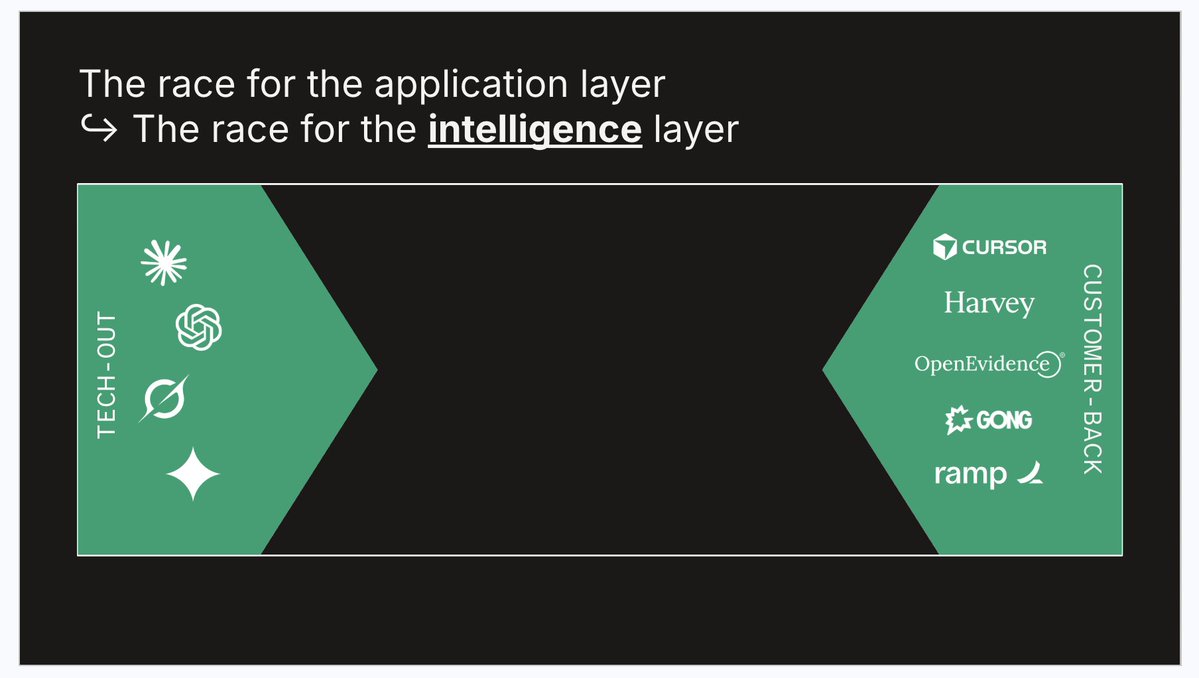
Navigating the Convergence of the App and Intelligence Layers: The boundary between application software and foundational intelligence is blurring. Frontier labs are aggressively moving upward into the application layer, while application startups are diving downward into training loops to dictate how their software thinks. Controlling the product experience increasingly requires direct governance over the underlying learning loop.
The Implementation Playbook: Zero to One
For organizations ready to establish an in-house intelligence strategy, industry experts emphasize that success requires a disciplined, step-by-step technical roadmap. Rather than relying on generalized platform teams, leading companies are deploying small, highly focused skunkworks units—noting that legal tech leader Harvey, for instance, achieved significant research breakthroughs with a lean team of just seven people.
The technical execution of this strategy relies on four foundational pillars:
1. Rigorous Evaluation Frameworks (Evals)
As Gabe Pereyra of Harvey famously noted, “If you don’t have a good benchmark, you can’t train models.” An evaluation framework measures whether a system can execute specific tasks accurately by combining a prompt, necessary context, and a deterministic grader. Most companies begin with subjective "vibe checks," but transitioning to quantifiable, repeatable benchmarks is essential. For instance, Harvey developed a specialized Legal Agent Benchmark comprising over 1,200 tasks across 24 legal practice areas, evaluated against more than 75,000 expert-rubric criteria. Establishing robust evals must precede any decision to build or buy, transforming model selection from guesswork into a measurable science.
2. Harness and Context Engineering
An AI agent typically consists of three components: the model, the context, and the harness. According to LangChain founder Harrison Chase, the primary function of the harness is to deliver the correct context to the model at precisely the right moment. The harness governs product logic, including routing, tool calling, retrieval-augmented generation (RAG), memory management, and debugging traces. A sophisticated custom harness allows enterprises to dynamically route tasks to the most efficient model, enforce consistent evaluations, and inspect execution traces to diagnose failures.

3. Targeted Post-Training Techniques
Organizations must apply the appropriate post-training intervention based on specific performance deficits, as outlined by industry experts:
- Missing Facts: Solved via context injection or Retrieval-Augmented Generation (RAG) rather than full retraining.
- Incorrect Formatting or Behavior: Addressed through Supervised Fine-Tuning (SFT).
- Product Taste and Alignment: Refined via preference tuning.
- Specialized Task Competency: Improved through Reinforcement Learning (RL).
- Performance Bottlenecks: Resolved by model distillation to reduce latency and cost.
4. Continuous Online Learning
Deploying an AI model to production is only the beginning. As Arjun Karanam observed, even the most brilliant general minds struggle on their first day at a new firm without organizational experience. Production AI agents accumulate this vital experience through user trajectories—tracking the context observed, tools invoked, outputs generated, and subsequent user edits or retries. By capturing these trajectories in production monitoring environments (such as LangChain’s LangSmith), enterprises create a continuous learning loop where failed tasks become future evaluation benchmarks and erroneous tool responses prompt immediate harness improvements.
Broader Implications and Industry Outlook
The push toward owning the intelligence layer represents a fundamental pivot in enterprise software architecture. While the out-of-the-box closed model stack offers a high operational floor with minimal initial friction, it ultimately caps a company’s differentiation potential. Conversely, adopting an open-weight, customized stack introduces a steeper learning curve and a potentially lower initial floor, but it unlocks an exponentially higher performance ceiling.
Industry analysts suggest that the future of enterprise AI will not be monopolized by a handful of mega-labs. Instead, the ecosystem is evolving toward a hybrid model where massive foundational brains developed by frontier labs coexist with agile, domain-specific "miniature geniuses" cultivated by individual enterprises. As more organizations embrace the operational discipline required to own their intelligence, the broader AI ecosystem stands to benefit from increased diversity, specialized capability, and robust market competition.