
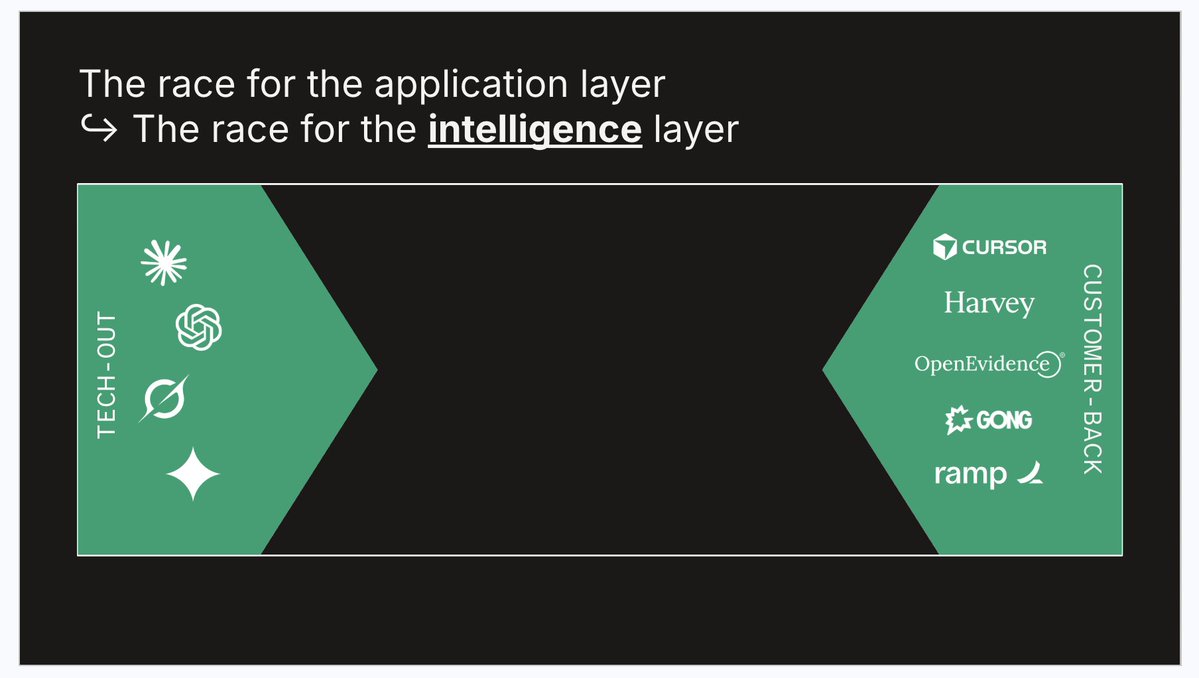
Published August 19, 2026, the ongoing maturation of artificial intelligence has shifted the primary battleground for industry dominance. The race for the AI application layer is not only about UI, workflows, or GTM… it is a fight for the intelligence layer itself. As organizations scale their artificial intelligence deployments beyond experimental phases, industry leaders are increasingly challenging the traditional paradigm of relying entirely on third-party frontier lab application programming interfaces (APIs). A profound structural pivot is underway, characterized by prominent technology figures and venture capital networks urging companies to internalize their model weights, fine-tuning mechanisms, and data flywheels.
This strategic recalibration gained significant momentum following public remarks from prominent industry executives. Palantir CEO Alex Karp famously urged enterprises to "own the means of production," a call to action that resonated deeply across industrial and commercial sectors seeking technological sovereignty. Shortly thereafter, Microsoft CEO Satya Nadella offered a stark economic and strategic warning, noting that purchasing intelligence from a frontier lab carries a dual toll: organizations pay once with capital and a second time by revealing proprietary domain knowledge and telemetry data to make those intelligence models useful for specific corporate workloads.
The central strategic question confronting enterprise technology buyers is no longer merely how to integrate AI into existing software, but rather who should fundamentally own the core intelligence driving their operations.
The Paradigm Shift: Moving Beyond the Rented Frontier
To understand the current industry landscape, analysts emphasize that owning internal intelligence is neither a rigid mandate nor a wholesale recommendation to abandon frontier AI labs entirely. For generalized, broad-spectrum workloads, external frontier APIs and pre-packaged agentic frameworks remain efficient and cost-effective solutions. However, across leading venture portfolios and high-growth engineering organizations, a counter-trend has accelerated: companies are increasingly building proprietary AI capabilities for critical sections of their product pipelines, vertically integrating their technology stacks toward owning and shaping their own model weights.

This movement crystallized weeks ago during an exclusive summit hosted by Sequoia Capital, which convened a select group of artificial intelligence founders, researchers, and infrastructure builders to discuss the architecture of the post-training AI stack. Industry leaders, including representatives from legal tech pioneer Harvey, developer tooling platforms LangChain and Fireworks, and automation startups like Mercor and Trajectory, presented a cohesive technical blueprint for corporate AI ownership.
Two major developments have driven this urgency. First, the open-weight frontier has evolved at a velocity that significantly outpaces historical expectations. The release of highly capable open models—such as Kimi K3 and GLM 5.2—has fundamentally altered the economic and operational calculus of model adoption. Previously, fine-tuning open-source baseline models resembled running on a technological treadmill; engineering teams would invest months into custom fine-tuning routines, only to have their performance gains instantly erased by the release of a superior proprietary foundation model. Today, open-weight baselines sit remarkably close to the performance frontier, allowing enterprises to start from an advanced foundation rather than building from scratch.
Second, the independent post-training ecosystem has matured dramatically. Companies specializing in data curation, synthetic data generation, automated evaluations (evals), and specialized inference infrastructure have democratized access to capabilities once restricted to well-capitalized frontier research labs. Through rigorous harness engineering, localized fine-tuning, and continuous online learning loops, domain-specific open models are now regularly outperforming generalized frontier models within specialized vertical applications.
Strategic Drivers: Cost, Speed, Data Sovereignty, and Destiny
Transitioning from a pure consumption model to an ownership model is an existential and strategic decision for modern enterprises. Industry strategists have identified four primary operational catalysts driving organizations to internalize their AI stacks.
First, artificial intelligence cost of goods sold (COGS) represents an escalating financial burden. As enterprise AI applications achieve commercial success and user adoption scales, inference expenses tied to proprietary API calls expand proportionally. For high-volume products, owning and self-hosting optimized model weights offers the most reliable mechanism to protect gross margins over the long term.

Second, operational latency and speed are paramount in mission-critical domains. In high-performance sectors such as real-time code autocompletion (exemplified by tools like tab-autocomplete systems) or automated cybersecurity threat response, smaller, highly distilled custom models frequently outperform massive general-purpose models simply because processing velocity and response times are absolute operational requirements.
Third, the imperative to protect proprietary data assets cannot be overstated. When corporate feedback loops, compliance logs, internal evaluations, and confidential customer interactions are routed entirely through third-party infrastructure, organizations risk leaking proprietary edge. Many enterprises prefer to maintain strict physical and logical boundaries around their domain-specific training and interaction data.
Finally, the convergence of the application layer and the intelligence layer dictates that companies must control their own long-term destiny. Major AI labs are increasingly expanding upward into finished software products, while application-layer companies are pushing downward into the specialized training loops that dictate how their software reasons. Consequently, true ownership of a software product increasingly requires complete control over its underlying learning loop and intelligence architecture—a strategy actively pursued by market leaders such as Harvey Research, RampLabs, Glean, and Factory.
The Zero-to-One Roadmap: Building an In-House AI Stack
For organizations that have determined which components of their intelligence architecture to own versus rent, executing a successful zero-to-one transition requires a deliberate, structured engineering roadmap.
Industry consensus emphasizes the importance of organizational design: technology leaders advise against shoehorning AI model ownership into generic platform engineering teams. Instead, successful initiatives rely on small, dedicated, de novo research and engineering teams that operate on the offensive—building robust evaluation frameworks, curating high-quality domain data, experimenting with open-weight iterations, and refining harness architectures. Notably, industry pioneers like Harvey have achieved remarkable research breakthroughs with lean technical teams numbering as few as seven core specialists, operating in close partnership with ecosystem infrastructure providers.
Furthermore, market positioning increasingly relies on technical transparency. As enterprise software buyers evaluate competing AI vendors, published research, peer-reviewed benchmarks, and technical whitepapers serve as decisive tiebreakers. Organizations that invest in rigorous in-house research and share their findings publicly tend to establish broader industry credibility.
1. Rigorous Evaluation Frameworks (Evals)
As Gabe Pereyra of Harvey famously noted, "If you don’t have a good benchmark, you can’t train models." An evaluation framework consists of a standardized suite of tasks designed to measure whether an automated system executes specific responsibilities accurately. Each task incorporates a prompt, contextual data accessible to the model, and an automated or expert-guided grader. Most evaluation protocols originate from intuitive founder observations—manually reviewing outputs to verify quality—before being systematically codified into repeatable, quantitative benchmarks.
For instance, Harvey constructed its proprietary Legal Agent Benchmark by translating complex real-world legal workflows into discrete, measurable tasks. Its initial iteration encompasses more than 1,200 specialized agent tasks spanning 24 distinct legal practice areas, evaluated against over 75,000 expert-crafted rubric criteria. Establishing a robust evaluation framework prior to deciding whether to own model weights transforms critical infrastructure decisions from subjective guesswork into data-driven engineering strategies.
2. Harness and Context Engineering
Modern agentic architectures typically comprise three distinct components: the foundational model, contextual memory, and the operational harness. The harness governs the surrounding product logic, including request routing, data retrieval mechanisms, tool execution, memory management, fallback protocols, and operational tracing.
As LangChain founder Harrison Chase observed, "The main job of the harness is to bring context to the model at the right point in time." When an agent operates outside its core training distribution, out-of-the-box harnesses often fail. A well-engineered custom harness enables organizations to route specific tasks to the optimal model for a given job, reuse standardized evaluations across multiple model iterations, and grant agents precisely controlled tools and contextual parameters. Moreover, advanced harnesses provide complete inspectability, allowing engineering teams to trace exact data inputs, executed tool calls, and failure points.

3. Strategic Post-Training Methodologies
Post-training encompasses a diverse array of technical optimization techniques, with the optimal method dictated by specific performance deficiencies. According to infrastructure experts like Lin Qiao, if a model lacks factual knowledge, post-training is unnecessary; standard retrieval-augmented generation (RAG) or contextual injection resolves the gap.
Conversely, if an AI model produces incorrect output formatting or undesirable behavioral patterns, supervised fine-tuning (SFT) is deployed. When addressing subjective product taste or nuanced alignment goals, preference tuning is utilized. If a model requires advanced proficiency in specialized domain tasks, reinforcement learning (RL) is applied. Finally, if an existing model proves excessively slow or cost-prohibitive for production environments, model distillation techniques are employed to compress capabilities into leaner architectures. The primary objective is selecting the most lightweight intervention capable of shifting evaluation metrics positively, followed by serving the optimized model through a unified harness while continuously monitoring quality, latency, and operational cost.
4. Continuous Online Learning Loops
Once an enterprise establishes its foundational triad of evaluations, harnesses, and models, the final developmental phase involves continuous production optimization. As Arjun Karanam noted, while foundational models continue to increase in general capability, every interaction session currently resembles an agent’s first day on the job. Without domain-specific operational experience, even the most advanced theoretical intelligence will struggle with specialized workflows.
An agent accumulates this vital operational experience through execution. A trajectory represents the complete operational path traversed during a task: the contextual data observed, the tool executions and sub-agent invocations triggered, the final output generated, and subsequent user corrections, edits, or retries. Capturing these trajectories using production monitoring platforms—such as LangChain’s LangSmith—is essential for establishing a continuous production feedback loop. Within this loop, failed task trajectories are automatically converted into new evaluation benchmarks, missing informational gaps are routed into context and memory systems, and inadequate tool responses drive immediate harness optimizations.
Broader Implications and Future Outlook
Adopting a strategy centered on intelligence ownership introduces significant complexity into software development lifecycles. The conventional closed-model deployment stack remains undeniably straightforward: an engineering team calls a commercial frontier model, integrates an out-of-the-box software harness, incorporates standard prompt engineering and contextual data, and ships the product. While this approach guarantees a high operational floor during early development phases, it simultaneously imposes a permanent performance and economic ceiling.

Conversely, internalizing the enterprise AI stack requires accepting operational responsibility for a broader swarth of the technological ecosystem. The production infrastructure shifts to encompass self-hosted open-source model weights, custom-engineered harnesses, specialized tool integrations, and dynamic context management, while the development workflow incorporates proprietary evaluations, domain-specific data governance, and continuous online learning feedback loops.
While this comprehensive approach demands increased engineering investment and introduces a potentially lower developmental floor during initial deployment, it ultimately elevates the long-term performance ceiling exponentially.
Frontier research laboratories will undoubtedly continue developing increasingly powerful foundational reasoning engines, and enterprises should continue to leverage these general-purpose capabilities where appropriate. However, parallel to this utilization, market-leading product companies are successfully cultivating their own specialized intelligence systems—engines that are fast, opinionated, domain-obsessed, and precisely tuned to the unique operational realities of their respective industries.
In an economic landscape where a growing number of enterprises take absolute ownership of their core intelligence, the broader technology ecosystem flourishes, individual enterprise differentiation triumphs, and the transformative promise of specialized artificial intelligence is fully realized.