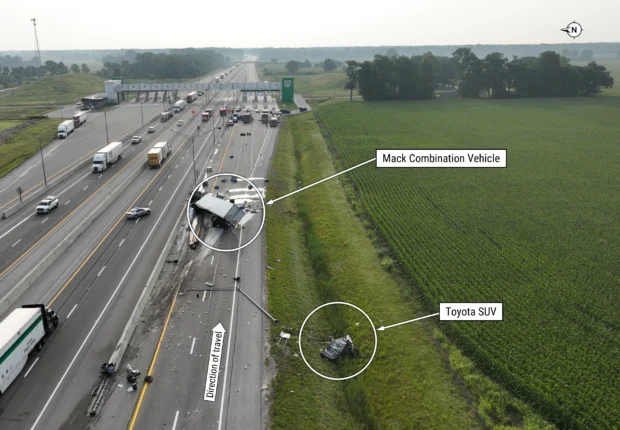
A devastating collision at the Swanton Township toll plaza on the Ohio Turnpike has sparked a rigorous investigation by the National Transportation Safety Board (NTSB), which concluded that the tragedy was a foreseeable consequence of outdated infrastructure. The accident, which occurred on August 15, 2024, claimed two lives and left multiple individuals with serious injuries, highlighting the inherent dangers of maintaining "hybrid" tolling systems where high-speed electronic lanes intersect with legacy low-speed manual booths.
The NTSB’s comprehensive post-accident report serves as a stark indictment of the current tolling configuration on Interstate 80, suggesting that the very design meant to facilitate traffic flow is, in fact, creating hazardous conditions. By forcing drivers to make split-second, high-stakes decisions regarding payment methods, the toll plaza infrastructure has become a focal point for erratic lane changes, dangerous speed differentials, and fatal human error.
Chronology of the August 15 Tragedy
On the morning of August 15, 2024, the Swanton Township toll plaza became the site of a multi-vehicle collision that would eventually necessitate a top-to-bottom review of tolling safety standards. According to investigative records, an SUV was traveling in the high-speed, left-hand lane of the turnpike. As the vehicle approached the tolling infrastructure, the driver—presumably realizing they had entered the incorrect lane for their preferred method of payment—abruptly decelerated.
In a maneuver that the NTSB identified as a common, albeit dangerous, reaction to the hybrid layout, the SUV operator attempted to cut across multiple lanes of traffic to reach the low-speed manual toll booths situated on the far right. This lateral movement placed the SUV directly into the path of a heavy-duty truck-trailer traveling at highway speeds. The kinetic energy involved in the ensuing impact was catastrophic; the truck struck the SUV from behind, forcing both vehicles into a violent collision that caused the truck to overturn.
Emergency services were dispatched immediately, but the aftermath was complicated by a hazardous materials incident. The truck involved in the crash was transporting sulfonic acid, which spilled onto the roadway following the rollover. While specialized hazmat crews were able to contain the spill, preventing further injury from chemical exposure, the scene remained a complex, high-risk environment for first responders for hours. The human cost, however, was already settled: two passengers in the SUV succumbed to their injuries, while the drivers of both vehicles, along with another passenger, sustained life-altering trauma.
The Dangers of Hybrid Infrastructure
The central finding of the NTSB investigation is that the Swanton Township toll plaza’s "hybrid" design acts as a catalyst for dangerous driving behavior. By providing both E-ZPass-style electronic lanes and manual cash-collection booths, the Ohio Turnpike creates a system that requires drivers to process complex information while traveling at high speeds.
Data collected by the NTSB provides empirical evidence of the frequency of this risk. During a three-week monitoring period, investigators documented 1,099 instances of last-minute, erratic lane changes at the Swanton plaza. This equates to an average of 52 such maneuvers per day. Furthermore, the surveillance revealed that many motorists were illegally navigating the "delineated zones"—the areas between the high-speed and low-speed lanes—to correct their pathing errors. These figures suggest that the accident on August 15 was not an isolated anomaly, but rather a statistical probability waiting to manifest within an inherently flawed system.
The "speed differential" issue is perhaps the most significant factor cited by investigators. In a unified electronic tolling system, traffic maintains a constant, consistent velocity. In a hybrid system, vehicles in the electronic lanes move at 60–70 mph, while those seeking the manual booths must rapidly decelerate to nearly 10–20 mph. This variance creates a "bottleneck effect" that increases the likelihood of rear-end collisions, which are statistically among the most lethal types of roadway accidents.
Comparative Analysis: The Regional Shift
The NTSB report draws a sharp contrast between Ohio’s current infrastructure and the modernization efforts undertaken by neighboring states. Both Illinois and Pennsylvania have already completed the transition to fully electronic tolling (FET) on their respective stretches of Interstate 80. In these states, the "gantry" system allows vehicles to pass through toll points at highway speeds without any requirement to change lanes or slow down.
The success of FET in these jurisdictions is measured not just in improved traffic throughput, but in the measurable reduction of toll-plaza-related accidents. By removing the need for manual cash handling and booths, these states have effectively eliminated the primary motivation for the erratic lane-changing behavior that characterized the Swanton crash. The NTSB is now using the performance of these regional neighbors as a benchmark to encourage the Ohio Turnpike and Infrastructure Commission (OTIC) to follow suit.
Emergency Response Limitations
Beyond the tolling design itself, the NTSB identified a systemic weakness in emergency preparedness. The investigation revealed that emergency response teams were significantly delayed in reaching the crash site due to a lack of direct access points to the turnpike at the toll plaza.
While investigators conceded that the severity of the injuries sustained in the initial impact made the delay unlikely to have altered the survival outcome for the deceased, they emphasized that such barriers present a "significant risk for future incidents." The commission has been strongly advised to conduct an audit of its emergency access infrastructure and to construct additional entry points wherever the current layout prevents rapid medical or fire-rescue intervention.
The Role of Occupant Protection
The investigation also highlighted a failure in basic vehicle safety compliance. It was determined that the occupants of the SUV involved in the fatal crash were not wearing seatbelts. NTSB officials noted that while the collision was severe, the use of seatbelts would have substantially increased the likelihood of survival and mitigated the severity of the injuries sustained.
This finding has prompted the NTSB to reiterate a decade-old recommendation to the state of Ohio: implement and strictly enforce mandatory seatbelt laws for all occupants in all vehicles. This recommendation is part of a broader push to reduce preventable road fatalities, emphasizing that infrastructure improvements must be paired with public compliance with existing safety regulations.
Official Responses and Future Implications
NTSB Chairwoman Jennifer Homendy was unequivocal in her assessment of the tragedy. "This crash shows the deadly safety consequences of mixing high-speed electronic tolling with low-speed manual tolling lanes," Homendy stated. Her remarks underscored the agency’s position that the status quo is no longer tenable. "We encourage the Ohio Turnpike and Infrastructure Commission to implement fully high-speed electronic tolling, as states like Pennsylvania and Illinois have, and permanently close the low-speed lanes to make the roadway safer for everyone."
The NTSB has issued a comprehensive suite of recommendations aimed at preventing a recurrence. These include:
- To the Ohio Turnpike and Infrastructure Commission: A directive to move toward a permanent transition to fully electronic tolling and the closure of all manual, low-speed booths.
- To the Federal Highway Administration: A mandate to establish national guidance that explicitly details the safety benefits of electronic tolling, providing states with a clear roadmap for modernization.
- To State and Local Authorities: A call to review emergency access protocols and address the lack of seatbelt compliance through enhanced enforcement and public awareness campaigns.
The implications for the Ohio Turnpike are significant. Transitioning to an all-electronic system requires substantial capital investment, the retraining or restructuring of the toll-collector workforce, and a shift in how the state manages revenue collection. However, the NTSB’s report frames these costs as secondary to the moral and legal imperative of public safety.
As the Federal Highway Administration and the Ohio Turnpike and Infrastructure Commission evaluate these recommendations, the Swanton Township crash stands as a somber reminder of the hidden costs of aging infrastructure. The era of the toll booth, once a ubiquitous feature of the American highway, is being increasingly challenged by data-driven safety standards that prioritize fluid traffic patterns and the removal of complex decision-making from the driver’s experience. For the victims of the August 15 accident, the proposed changes come too late, but they remain the focal point for a national discussion on how to modernize transit for the 21st century.