The Forward Deployed Engineer (FDE) has emerged as the most critical bridge between theoretical artificial intelligence research and the practical realities of enterprise operations. As global organizations race to integrate generative AI into their mission-critical workflows, the demand for professionals who can navigate both high-level software architecture and messy, real-world data environments has reached an all-time high. With recent industry shifts, including major partnerships between AI leaders like Anthropic and global systems integrators, the role of the FDE is being codified as a pillar of the modern technical workforce.
The Rise of the Forward Deployed Engineer
Historically, software engineering was characterized by the translation of well-defined requirements into functional code. An engineer might be tasked with building a specific service or optimizing an existing database query. The FDE role, however, functions in a state of high ambiguity. Rather than receiving a technical specification, an FDE is often presented with a complex business problem: a legacy insurance company with fragmented data across six disparate systems, or a logistics firm struggling with real-time route optimization.
The FDE’s mandate is to assess, architect, deploy, and maintain a solution that integrates AI into the existing ecosystem without compromising security or reliability. According to data from August 2026, this high-stakes responsibility is reflected in compensation trends. ZipRecruiter reports an average annual salary of approximately $116,463 for U.S.-based FDEs, with the median peaking at $124,300. At top-tier AI firms, where the complexity of the deployment is significantly higher, total compensation packages often exceed these averages, reflecting the scarcity of candidates capable of balancing technical depth with client-facing diplomacy.
Chronology of a Growing Industry
The evolution of the FDE role accelerated significantly in early 2026. As AI models moved from experimental chatbots to enterprise-grade tools, the bottleneck shifted from "can we build this model?" to "can we actually deploy this into a legacy corporate environment?"
- Q1 2026: AI companies began scaling their field engineering teams, moving away from purely remote support to "boots on the ground" engagement models.
- June 2026: A landmark alliance was announced between Anthropic and DXC Technology. The partnership aims to train tens of thousands of Claude-certified Forward Deployed Engineers. This move marked a turning point: the industry is no longer relying on organic skill acquisition but is now creating formal certification pathways to address the massive talent shortage in AI implementation.
- August 2026: Mid-year market analysis confirmed that Python remains the primary language of the FDE, appearing in over 40% of all relevant job postings. This period also saw the solidification of RAG (Retrieval-Augmented Generation) and agentic workflow design as core competencies required for the role.
The Seven-Step Roadmap to Mastery
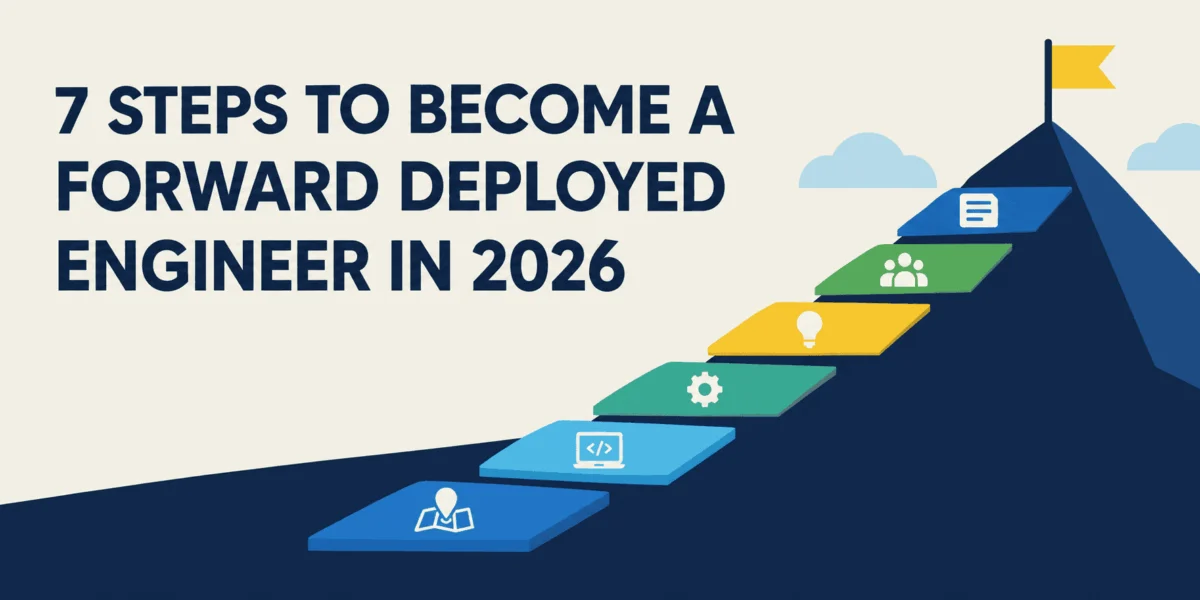
Aspiring FDEs must navigate a multidisciplinary path that diverges from traditional full-stack development. The following roadmap serves as the industry standard for acquiring the necessary breadth of expertise.
1. Software Engineering Fundamentals
Python remains the lingua franca of the field due to its versatility in backend development, data scripting, and AI orchestration. However, proficiency in Python alone is insufficient. Candidates must demonstrate an understanding of data structures, algorithmic efficiency, and the ability to write maintainable code that can withstand the rigors of production-level deployments. While competitive programming is not the primary focus, the ability to pass rigorous technical assessments remains a standard barrier to entry.
2. Mastery of Data Integration and APIs
The "messy data" problem is the defining challenge of the FDE. Real-world corporate environments rarely feature clean, API-first architectures. Instead, they rely on a patchwork of PostgreSQL databases, legacy REST APIs, outdated Salesforce schemas, and isolated S3 buckets. An effective FDE must be adept at data extraction and integration, often requiring the ability to read obscure documentation and reverse-engineer legacy systems. The goal is to move beyond clean interfaces and successfully bridge the gap between AI models and fragmented enterprise data.
3. Deployment and Operational Strategy
"Works on my machine" is an unacceptable outcome for an FDE. The role requires ownership of the entire lifecycle of a system, from the initial prototype to a stable, scalable production rollout. This necessitates proficiency in containerization (Docker/Kubernetes), CI/CD pipelines, and cloud-native infrastructure. An FDE must understand how to monitor latency, track costs, and ensure high availability in environments where downtime carries significant financial risk.
4. Applied AI Engineering
Modern FDE roles are increasingly defined by the ability to operationalize Large Language Models (LLMs). This does not require a background in research-level mathematics or model training. Rather, it demands an understanding of how to build reliable applications around existing frontier models. Focus areas include RAG systems, the design of agentic workflows, prompt engineering, and fine-tuning for specific enterprise use cases.
5. Security and Reliability Standards
As AI is integrated into sensitive sectors like finance and healthcare, security is no longer an afterthought. FDEs are expected to implement robust tenant isolation, least-privilege access controls, and data sanitization protocols. Understanding the compliance requirements of an enterprise environment—such as SOC2 or HIPAA—is essential for ensuring that deployed AI solutions do not become security vulnerabilities.
6. The Art of Customer Discovery
This step is the differentiator between a backend engineer and a Forward Deployed Engineer. An FDE must act as a technical consultant. When a client requests an "AI chatbot," the FDE must possess the analytical rigor to determine if a chatbot is actually the solution, or if a different data-processing tool would be more effective. This involves interviewing stakeholders, scoping requirements, and translating business ambiguity into clear, actionable technical specifications.
7. Building an Integrated Portfolio
A portfolio of disconnected, small-scale tutorials is ineffective for demonstrating FDE capabilities. Employers look for evidence of complex system integration. A high-quality project should simulate a real-world scenario: for example, a document-processing pipeline that ingests messy PDFs, validates fields, stores them in a relational database, and utilizes a human-in-the-loop mechanism for uncertain cases. Each project should document the architecture, security decisions, evaluation metrics, and the rationale behind the chosen technology stack.
Broader Impact and Industry Implications
The surge in demand for FDEs is a clear signal of the maturation of the AI industry. We are transitioning from the "hype phase" into the "integration phase." The implication for the labor market is substantial: the premium is no longer just on researchers who can improve model accuracy by 1%, but on engineers who can navigate the political and technical complexities of enterprise deployment.
By 2026, the Forward Deployed Engineer has become the essential interface between the potential of artificial intelligence and the reality of business operations. As companies like Anthropic and their partners continue to scale their programs, the standardization of this role will likely continue. For the individual engineer, the path to becoming an FDE is not found in certifications alone, but in the rigorous, hands-on application of technical skills to solve real-world problems. The future of AI development lies not in a vacuum, but in the trenches of enterprise deployment, where the Forward Deployed Engineer serves as the architect of the next generation of industrial technology.